Catégorie : droits de l’homme

Situation des droits de l’homme à Cuba, répression et prisonniers politiques

  • latencies-to-cuba-annotated

    Our parliament met in December. A diverse conglomeration of ages, social backgrounds, races and genders… but with a single political affiliation. More than six hundred deputies who say they represent a nation, when in reality they only speak in the name of one ideology. The pantomime of plurality, with statistics designed to impress, given the number of women, youth, mixed-race or workers within it, but not with diversity of thought. A rainbow with seven bands of the same color. Or almost, because the palette contains only red and olive-green. But it is not precisely this tame group of individuals applauding in the Palace of Conventions that I want to write about today, but the fiber optic cable between Cuba and Venezuela.

    When Maimir Mesa, Minister of Telecommunications and Information, issued a report to the National Assembly last month, not a single word was published about the Alba-1 cable. Since August 2012, the newspaper Granma said today, the submarine tendon was active for « voice traffic corresponding to international telephone service. » This means that when Mesa spoke before parliament, he already had information to give and preferred to withhold it, to hide it from us. Why? Perhaps out of fear that with that announcement he might stoke the excitement so many of us have to be connected to the Internet. Better to hide the details from us because he knows no information strategy other than secrecy. « The less they know the better, » seems to be the currency of our leaders.

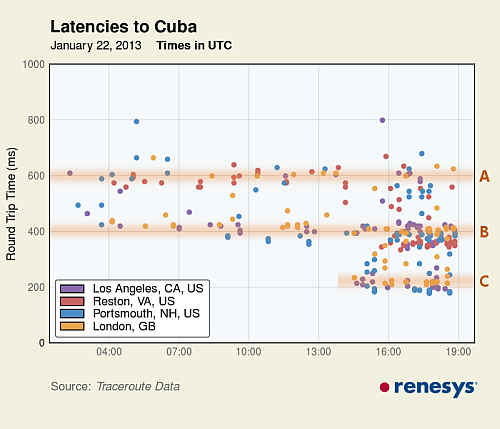
    But this world is a mere handkerchief, a baseball, a sour orange and teensy. A few days ago the American firm Renesys announced (here and here) it had detected latency in the Alba-1 cable. First it was traffic in just one direction, which later balanced in the coming and going of kilobytes. The cable was alive, awake. Two years after arriving on Cuban soil, at a cost of $70 million and a thousand miles in length, the long fiber-optic serpent started to work. We had to learn, as so often happens, through the foreign media. Only when the news was already everywhere did the official press confirm it this morning in a brief note. A note that also warned that « the commissioning of the submarine cable will not automatically mean that the possibilities of access will multiply. »

    The truth is, I no longer believe anything. Not the passive National Assembly, nor a minister who practices secrecy, nor the official journalists who were in that session of parliament and didn’t report on the absence of such an important topic, nor a newspaper that only publishes when its silences are uncovered. Much less do I believe in the character as true citizens of all those thousands of Cubans who have remained silent and have been satisfied with the least access to the Internet of any country in this hemisphere.

    Original post:
    More Than Just a Cable
  •  

    die_plaza

    El Sexto a dit qu’il ferait un graffiti sur ma valise ; une voisine m’a offert une amulette pour le voyage, et un de mes amis a noté sa pointure pour que je lui rapporte une paire de chaussures. Ils me disent au revoir même si je ne pars pas encore. Je ne dispose même pas de la date du vol. Mais quelque chose a changé pour moi depuis le 14 janvier dernier, jour où est entrée en vigueur la Réforme Migratoire annoncée en octobre dernier. Après avoir attendu pendant 24 heures autour du Département de l’Immigration Etrangère (DIE), j’ai su qu’on allait enfin m’envoyer un nouveau passeport. Après vingt « cartes blanches » refusées en moins de cinq ans, j’avoue que j’étais plus sceptique que confiante. Encore maintenant je croirai seulement que je l’ai obtenu quand je serai dans l’avion en train de décoller.

    Nous arrivons au terme d’une longue bataille à laquelle beaucoup ont contribué. Un long parcours pour réclamer que l’entrée et la sortie de notre pays soient un droit inaliénable, et non une autorisation de faveur. Bien que les flexibilités apportées par le Décret-Loi N° 302 restent insuffisantes, elles n’auraient pas été obtenues si nous étions restés les bras croisés. Elles ne sont pas le fruit d’un geste magnanime mais le résultat des critiques systématiques portées contre l’absurde régime migratoire.

    C’est pourquoi j’ai l’intention de continuer à « repousser les limites » de la réforme, de vérifier par moi-même jusqu’où va vraiment la volonté de changement. Pour franchir les frontières nationales je ne ferai aucune concession. Si la Yoani Sanchez que je suis ne peut pas voyager, je n’ai pas l’intention de me métamorphoser en une autre personne pour y arriver. Une fois à l’étranger je ne cacherai pas mon opinion pour qu’ils me laissent ressortir une autre fois ou pour plaire à certains, et je ne resterai pas non plus silencieuse sur les raisons pour lesquelles ils peuvent me refuser le retour. Je dirai ce que je pense de mon pays et de l’absence de liberté dont souffrent les cubains. Aucun passeport ne va fonctionner sur moi comme un bâillon, aucun voyage comme un leurre.

    Ces détails étant précisés, je prépare le programme de mon séjour en dehors de Cuba. J’espère pouvoir participer à de nombreuses manifestations qui me fassent progresser professionnellement et civiquement, répondre aux questions, clarifier certaines campagnes de diffamation menées contre moi… en mon absence. Je rendrai visite dans ces lieux où l’on m’a parfois invitée, mais auxquels la volonté de quelques uns  ne m’a pas permis d’aller; je naviguerai comme une obsédée sur internet et je reviendrai escalader certaines montagnes que je n’ai pas revues depuis presque dix ans. Mais ce qui m’excite le plus, c’est que je vais connaître beaucoup d’entre vous, mes lecteurs. Je ressens déjà les premiers symptômes de cette anxiété : l’estomac serré que provoque l’approche de l’inconnu et les réveils brutaux en plein nuit à se demander à quoi ressemblent vos visages, vos voix. Et moi ? Est-ce que je serai comme vous m’avez imaginée ?

    Traduit par Jean-Claude Marouby

  • die_plaza
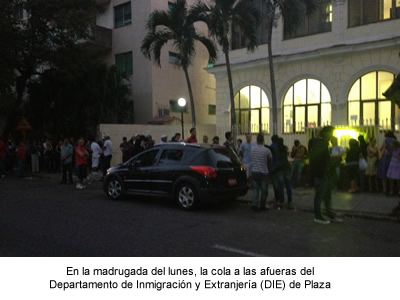
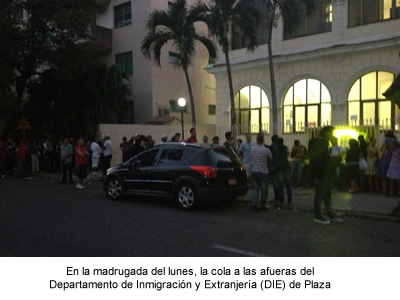
    Early Monday morning, the line outside the Department of Immigration and Aliens (DIE) in Plaza

    El Sexto has said he will paint a graffiti on my suitcase, a neighbor gave me an amulet for the journey and a certain friend noted his shoe size so I can bring him a pair. They said goodbye to me although I still haven’t left. I don’t even have a flight date. But something has changed for me since January 14 when the Migratory Reform announced last October went into effect. After waiting 24 hours outside the Department of Immigration and Aliens (DIE), I knew that finally they would issue me a new passport. With twenty « white cards » — the former exit permit — denied in five years, I confess I was more skeptical than hopeful. Even now, I will only believe I made it when I watch the plane lift off from inside.

    It has been a long battle fought by many. A very long road of demanding that entering and leaving our country is an inalienable right, not a gift to be given. Although the flexibilizations in Decree-Law 302 are insufficient, not even these would have been achieved if we’d stood around with our arms crossed. They are not the fruit of a magnanimous gesture, but the result of systematic denunciations made against the absurdities of travel and immigration.

    Hence my intention to continue « pushing the limits » of reform, to experience firsthand how far the willingness to change really goes. To transcend national frontiers I will make no concessions. If the Yoani S

  • The Cuban health authorities have admitted the existence of a cholera outbreak that so far has affected fifty people in Havana. Ten days after being detected by clinical epidemiological surveillance system and with rumors already circulating through the city, the newspaper Granma published on Tuesday’s front page an « Informative Note to the Population » where they « announced » the existence of the disease in the Cuban capital, while advising that the transmission of the disease is declining as a result of the measures taken.

    Several independent journalists had already warned about the disease and the death of at least one person, which the Ministry of Public Health has not yet acknowledged. Also some foreign correspondents broadcast the news in recent days, leaving the national press little chance of continuing to hide the situation.

    Before the official media confirmed the outbreak, sanitary measures were already visible in public places, especially those where great numbers of people gather. In the bus and railway terminals, and in polyclinics, schools and taxi stations extraordinary hygiene measures were established, including placing containers on the floor with disinfectants and bactericides to clean the soles of shoes. Also in workplaces and schools they have recommended having chlorinated water for washing hands.

    According to reports in the official media, the transmission originated from a food distributor who carried the disease, caught during earlier outbreaks in the eastern provinces.

    Since early last week we have seen unusual purchases of bottles of mineral water and liquid antibacterial products, available only in the stores that operate in hard currency, while the pharmacies ran out of the sodium hypochlorite used to disinfect drinking water. In the crowded Cerro municipality they ordered the temporary closure of food expeditor establishments, both those administered by the state as well those newly emerged since the expansion of self-employment.

    Protective measures proposed on TV are being taken very seriously and include the recommendation to avoid eating in the street. Families who until recently have been drinking directly from the tap, have begun to boil their water to avoid infection. The deteriorated state of the water network has made the complete eradication of cholera more difficult.

    Special irritation has been caused by the media blackout on the existence of the outbreak, which impeded the massive expansion of measures of protection. Many note that the delay in providing information was influenced by the intention to not affect international tourism, one of the locomotives of the Cuban economy. Another reason for so much secrecy might be to avoid the stigma of the appearance of a disease that tends to show up in very poor countries or those with poor healthcare systems.

    Read More:
    Havana Takes Measures to Control the Worst Outbreak of Cholera in Several Years

  • paraiso
    Photo: Yoani Sanchez

    All four sleep in the same bed. Under the mattress there is a pair of suitcases and in the corner of the room a hanger with just a few clothes. Every day they buy pizzas or snacks because they don’t have anything to cook with, no dishes, no spoons. They’ve sold everything, or almost everything. The house, the car from the fifties, and the home appliances they once had. They even got rid of the family vault in the cemetery, the porcelain vases and a post-office box – at the neighborhood post office – which they barely used. They gave their relatives in the countryside everything no one wanted to buy, the used clothes, the faded toys and the old sewing machine. Then they rented the little room where they are now, waiting for this coming Monday when the immigration reform goes into effect.

    Like so many Cubans, this couple has waited for years to be able to emigrate with their two minor children. Only when the new flexibilizations go into effect will travel finally be permitted for those under 18. It seems like a trivial detail, but I know many parents who are tied to this land because they can’t leave their children behind. People who have had to choose between living anywhere else on the planet, alone, or staying here, accompanied but frustrated. For decades the only children who managed to travel were those few privileged ones whose parents served on official missions, or – on the contrary – who left « definitively, » with no return. There was no middle ground when it came to children.

    So, like eager runners at the starting line, many are waiting for the signal to head toward the airport, their children in tow. Meanwhile, they live in rented rooms and try to change their convertible pesos into a currency that will work abroad. From last October, when Decree-Law 302 was published, this fever to escape has swelled. No sooner was the notice published than digital sites started to fill with classified ads offering houses and other property for sale. Part of the capital to pay for the tickets and start a new life somewhere else is obtained through liquidating assets in the national territory. Getting rid of everything to leave, dismantling oneself to exist. A trend that started with the authorization to buy and sell houses at the end of 2011, but that now has intensified.

    Despite various embassies strengthening the requirements to get a visa, we should not underestimate the ingenuity and the thousand and one tricks Cubans can boast of. Including circulating a list of nations that don’t demand a visa from those whose passports bear the shield with a solitary palm. Although, sadly, there are no direct flights to most of these destinations, and so permission is needed from the country where the plane touches down en route. But this is not enough of a reason to discourage those who want to emigrate. They have patiently waited for this moment and no obstacle is going to destroy the illusion. Counting the days, vegetating at half speed, January 14th could be the start of a new life for them. Will they reach it?

    Translating Cuba is a compilation blog with Yoani and other Cuban bloggers in English.

    Taken from:
    Monday the Hated Exit Permit Disappears, Cubans Prepare to Leave

  • trece1

    La cabale, le nombre qui ne se dit pas, la superstition des chiffres, la calamité que pourrait entraîner le simple fait de prononcer six lettres. Je me souviens que lorsque j’ai eu treize ans, à l’école beaucoup de plaisanteries tournaient autour de ça. Quel âge as-tu demandaient les étudiants des classes supérieures pour se moquer de ma gêne à leur répondre. Je devais répondre « douze plus un » ou « quinze moins deux » parce que si je prononçais ce nombre maudit,  une vague d’éclats de rires me tomberait dessus, suivie possiblement de coups de poing sur le crâne et du cri « Touche-toi !» dont je ne sais pas encore aujourd’hui ce qu’il signifiait dans ce contexte. De sorte que j’ai grandi en supposant que le treize n’apportait pas seulement la malchance mais aussi moqueries, plaisanteries et injures.

    Quand je suis partie vivre avec Reinaldo j’ai pensé « quel soulagement ! Au moins il habite au quatorzième étage et pas à celui en-dessous. Imaginez que chaque fois que j’aurais dû donner mon adresse on m’ait crié ce « touche toi ! » sarcastique de mon adolescence. Je n’aurais pas à rougir de cette honte. Des années plus tard le pronostic médical indiquait que mon fils naîtrait le 13 août 1995, mais par chance la nature anticipa l’événement et nous libéra de cette date funeste. Ainsi à force d’évitements et de contournements, en s’abstenant parfois de répondre, en utilisant d’autres fois les additions et les soustractions, je me suis débarrassée de cette sombre superstition du « dix plus trois ». Comme moi beaucoup d’autres ont fait la même chose, parfois plus par précaution que par réelle croyance en leur mauvaise étoile. Mais aujourd’hui une nouvelle épreuve s’annonce pour tous : l’année 2013 va bientôt commencer.

    J’ai l’impression que pour les Cubains les douze prochains mois n’auront rien d’une fatalité. Dès aujourd’hui je peux prévoir qu’ils seront pleins d’occasions de changements et de grands moments. Beaucoup de choses dans le pays que nous connaissons vont changer, pour le bien et un peu pour le mal : des hommes nouveaux vont entrer sur la scène nationale et d’autres auront enfin leur nom gravé sur une pierre tombale. Une ère se terminera donnant pour cette fois raison aux Mayas. Mais tout ceci dépend, presque en premier lieu de la façon dont les citoyens affronteront les défis qui vont se présenter à nous, de la conscience que nous aurons d’être sur le point de vivre un moment clé de notre histoire. Dès à présent je me prépare et je répète comme un mantra : treize, treize, treize, treize, treize…

    • A tous mes amis collègues, blogueurs, journalistes des quatre coins du monde, lecteurs de mes textes, commentateurs qui ont fait leur ce blog, traducteurs qui bénévolement l’ont transcrit vers tant de langues, à ceux qui par leurs commentaires acerbes ou leurs diatribes caustiques m’ont aidée à être meilleure, à tous je vous souhaite de joyeuses fêtes et une bonne nouvelle année.

    Traduit par Jean-Claude Marouby

    More:
    Douze plus un