Catégorie : droits de l’homme

Situation des droits de l’homme à Cuba, répression et prisonniers politiques

  • La petite gare ferroviaire grouille de vie depuis tôt le matin. Les étudiants passent, serrés dans leurs uniformes, et un vendeur de journaux annonce les titres ennuyeux du Granma du jour. On voit des cornets de cacahuètes, des vendeurs qui proposent des boissons fraîches et plusieurs personnes qui ont passé une partie de la nuit sur des cartons posés à même le sol. L’endroit, malgré son architecture sans caractère, pourrait être le terminal ferroviaire de n’importe quelle ville au monde. Sauf qu’il manque quelque chose à la scène, quelque chose qui brille par son absence : on ne voit pas un seul train. Les rails sont vides, on ne distingue aucune locomotive,  et on n’entend pas le moindre sifflet au loin.  Vers le milieu de la matinée on verra arriver  une automotrice, avec encore peintes sur ses flancs le sigle DB (Deutsche Bahn). Les passagers y monteront avec réticence même s’il peut encore se trouver quelque enfant qui vous fasse un signe d’adieu en souriant derrière la vitre.

    Cuba a été doté du premier chemin de fer d’Amérique Latine, inauguré justement un mois de novembre comme celui-ci mais il y a 175 ans. Le tronçon La Havane-Bejucal a été créé une décennie avant que l’Espagne, la métropole d’alors, fasse fonctionner les trains sur son propre territoire. Mais au-delà d’un problème de dates, les voies ferrées sont venues s’insérer dans la géographie nationale de cette île comme l’épine dorsale de laquelle partaient des ramifications infinies. La vie de beaucoup de petits villages a commencé à se mesurer sur une échelle de temps, entre l’arrivée d’un wagon et la suivante, entre les arrivées et les départs affichés sur le tableau de chaque gare. Le quotidien avait cette odeur qui naît de la friction entre le métal des roues et celui des rails. Mais de ce protagoniste ferroviaire il ne reste pas grand chose aujourd’hui. Un jour nous avons dit adieu depuis le quai au dernier train  où nous nous sommes sentis bien, et à partir de cet instant monter dans un autre a été une expérience inconfortable, difficile et angoissante.

    Bien que l’année dernière des travaux de réparation des voies aient été entrepris, et que la quantité de marchandises transportée sur rails ait plus que doublé, le dommage subi par les chemins de fer cubains est d’une gravité qui ne peut pas se mesurer en chiffres. Le  problème principal n’est pas le manque de ponctualité des départs, les wagons détériorés ou les toilettes si sales qu’on ne peut décemment pas les appeler sanitaires. Ce n’est pas non plus le vol systématique des biens des voyageurs, la mauvaise qualité du service des employés envers les clients, l’annulation permanente des départs ou l’absence inquiétante de sécurité sur les voies qui se traduit par des accidents fréquents. Les principaux dégâts sont intervenus dans la mentalité des Cubains pour qui le chemin de fer a cessé d’être le moyen de transport inter-provinces par excellence. Ces milliers de personnes qui ne mesurent plus le rythme de  leur vie au sifflet d’une locomotive, qui ne disent plus fièrement au-revoir depuis la fenêtre d’un wagon. A la scène traditionnelle du baiser d’adieu sur le quai, du mouchoir agité depuis le marchepied, il manque depuis des décennies le protagoniste principal : un train sur le départ, un long serpent de fer, prêt à parcourir l’épine dorsale de cette île.

    Traduit par Jean-Claude Marouby

    View article:
    Le quai désert

  • 2012-11-14-americanproductsproxy.jpg

    Despite the embargo our stores are full of US products.

    Year after year the issue of the U.S. embargo against Cuba is presented in the United Nations. Year after year, the majority of countries votes against this fossil of the Cold War. But even though the existence of such economic sanctions has been condemned 21 times, they remain in force. On both sides of the Florida Straits there are too many interests who want to perpetuate the situation, even though the political discourse says otherwise.

    On one side are the many who believe that financially strangling the Cuban government will produce democratic change in Cuba. These are the people who hold the view of the « pressure cooker » on which they just have to put greater and greater pressure until it explodes. For these defenders of the embargo, if daily life on the island becomes ever more miserable due to lack of material goods, Cubans will finally throw themselves into the streets to overthrow the current system. This theory has demonstrated its failure over five decades. What has actually happened is that when the economy hits bottom, people prefer to escape from the Island, legally or illegally — in some cases to literally throw themselves into the sea — rather than confront the powers-that-be.

    The others who dream of continuing the embargo are all those ideologues of the Cuban government who have run out of arguments to explain the dysfunction of this system. They are those who need, as in a child’s fairy tale, a big bad wolf to blame for everything. They say it is because of the « blockade » that we can’t enjoy the Internet, that we can’t freely associate with others who share our ideas, that we can’t even travel freely. They try to justify everything based on the existence of this mistaken policy of Washington. Trapped in the middle of these two positions are eleven million Cubans, caught between the absurd restrictions of some and the implausible justifications of others.

    My comments on Raul Castro’s new travel and immigration laws can be read here.

    View the original here:
    The Embargo: Both Sides Are Still Living Out the Cold War

  • Depuis l’accession de Raúl Castro à la présidence, en 2006, la répression contre la dissidence, sans avoir jamais cessé, se traduisait souvent par de courtes détentions. (suite…)

  •  

    Pendant que le Grand Coupable

    S’abrite derrière la sage protection du front.

    « Défense du myocarde innocent »

    Rubén Martínez Villena

    Ma famille revendique cette masse de neurones, renforcée des soins qu’elle m’a prodigués étant petite. La maîtresse qui m’a appris à lire exige son crédit pour ces connexions qui ont aidé à unir pensée et langage. Chacun de mes amis pourrait aussi demander sa part, son morceau de tel ou tel lobe, pour les satisfactions ou les contrariétés qu’ils ont inscrites sur ses fragiles circonvolutions. Même l’enfant dont j’ai croisé le regard une courte seconde aurait droit à une portion de mon cortex cérébral, puisqu’à son passage il a gravé un petit souvenir dans ma mémoire.

    Tous les livres que j’ai lus, les glaces que j’ai mangées, les baisers donnés avec indifférence ou avec passion, les films que j’ai vus, le café du matin et les cris des voisins… c’est à eux qu’appartient une portion de cette masse grise que j’ai derrière mon front. Le chat qui ronronne et enfonce ses griffes, le policier qui veille et souffle dans son sifflet, la fonctionnaire qui ajuste son uniforme militaire pour dire « non », le professeur médiocre qui écrit « geographie » sans accent, et le conférencier brillant dont les mots semblent pousser des portes et ouvrir des fenêtres. C’est à eux que je devrais les attribuer, une à une, mes cellules cérébrales, puisque sur elles ils ont pu mettre des marques indélébiles. Mes axones, je devrais les répartir entre des millions de personnes vivantes ou mortes, celles que j’ai connues ou simplement écoutées sur un air de musique ou à travers un poème.

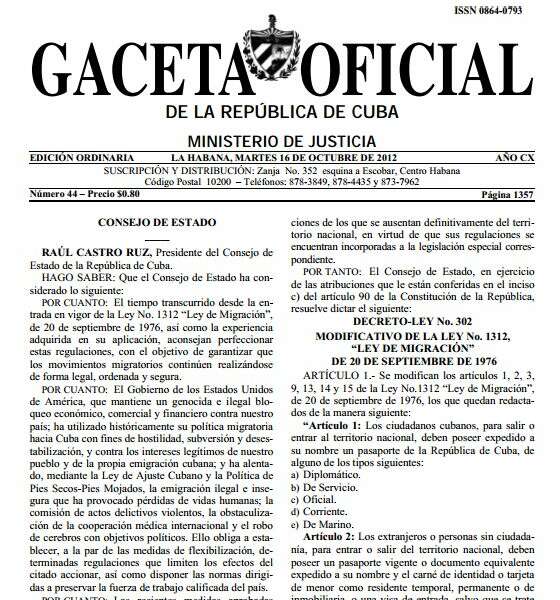
    Eh bien, selon le décret loi 302 qui régule aussi les voyages de professionnels à l’étranger, mon propre cerveau, comme celui des autres diplômés de l’université, ne m’appartient pas. Selon la nouvelle législation, les plis et les replis de cet organe sont propriété d’un système éducatif, qui se prévaut de sa gratuité pour ensuite récupérer la propriété de notre intellect. Les autorités qui régulent la possibilité de sortir de cette île croient qu’un citoyen éduqué est un simple conglomérat de matière encéphalique « formée » par l’Etat. Mais prétendre au droit d’usage d’un esprit humain, c’est comme vouloir mettre des portes à la mer… des fers à chaque neurone.

    Traduit par Jean-Claude Marouby

    Read this article:
    A qui appartient le cerveau ?

  • Friday, the Cuban press issued an aggressive statement from the Ministry of Foreign Relations against the United States Interests Section in Havana (known as « SINA » from its initials in Spanish). A traditional verbal escalation toward our neighbor to the north, accompanied this time by a diatribe about an Internet room open to the public in its consular site.

    The place has been there for a long time and is visited by dissimilar people. From students doing research, to independent journalists needing to publish their news, to families of exiles who want to contact them by email. In a country where access to cyberspace is a luxury enjoyed by few, the long lines to access SINA’s Internet center annoys the government.

    But after reading the bombastic statement, one immediately questions: Why now? If these rooms with web access have operated for almost a decade, why this week do they appear on the cover of the newspaper Granma? The answer points to what will happen this coming Tuesday at the polls in the United States. This is obviously a play that anticipates the results of the American elections.

    The margin between Barack Obama and Mitt Romney is narrow, as Raul Castro’s government knows well. So for months it has begun to adjust its verbal missiles, as much against one candidate as the other. According to official propaganda the current U.S. president is a man who « has strengthened the imperial blockade, » while his Republican opponent represents « anti-Cuban politics. From bad to worse they warn us on all sides.

    From the Island, we look with curiosity and expectations towards elections in our neighbor to the north. There is too much in play across the Florida Straits. The politics of the Plaza of the Revolution defines itself starting from opposition to Washington, which establishes a very peculiar kind of dependence.

    Raul Castro launches a timid travel and immigration reform program, and explains he could not go further because we are besieged by the Empire. Permission to legalize other political parties cannot be granted because « Uncle Sam lurks. » While accessing the Internet has to be gradual and selective, so that we are not overly affected by « the Pentagon’s media war. »

    If we analyze this perennial rivalry, we have to conclude that the fate of Cubans has never depended on the United States more than it does now. Our everyday life has never been so subject to the decisions of the occupant of the Oval Office.

    The man who sells fish on a Havana corner hopes that Obama will be reelected, so his brother will be able to continue selling him the special food these colorful animals require. A former political prisoner, however, wants Romney to win because « things have to get much worse before people will react. » And the clueless teenager is more likely to recognize the face of the White House occupant than that of the gentleman in the checked shirt that appears on television as Fidel Castro. Everyone is attentive, apprehensive.

    With its bitter anti-imperialist discourse the Cuban government has ended up shooting itself in the foot. For weeks the official medial has talked more about the U.S. elections than about our own elections for the People’s Power, going on at that same time.

    Intent on bringing out the negative aspects of the presidential elections, the TV commentators have forgotten the maxim: « Nothing is more attractive than the forbidden. » And so every aggressive adjective, every joke, every diatribe against Obama and Romney, have increased the unusual excitement about the first Tuesday in November.

    All this is also marked by the progressive loss of the importance of Cuba in U.S. politics. The marked irrelevance of this Island has become abundantly clear during the presidential campaign, which has devoted almost no attention to us. That October of 1962, when nuclear missiles forced the whole world to pay attention to the largest of the Antilles, is in the distant past.

    Now Obama’s gaze is directed towards other places and the victor will deepen this trend. Whoever is elected will first pay attention to the economic problems within the United States and try to stabilize its finances. The crisis in Europe will occupy a good part of his attention, as will the situation in Iraq, Afghanistan, Iran, and now Syria.

    Raul Castro needs to regain prominence on the agenda of his eternal enemy, because he sees the power in it. His discourse, from Cuba and when he travels abroad, is based on that rivalry, he cannot exist without it. Thus, we see signs of an escalated diplomacy to force the American president to take a position.

    The political language takes on a sharp edge, the insults are polished off, and little stabs of confrontation seek to force the next leader to react. These are times of trying to insert himself into the priorities of the neighbor to the north, regardless of the cost… but the strategy isn’t working.

    Excerpt from:
    The Election 90 Miles Away – What’s at Stake for Raul Castro

  • Thursday morning will never be forgotten by thousands of people in Eastern Cuba. The wind, flying roofs, heavy rains and trees falling on streets and houses, will remain as permanent memories of Hurricane Sandy. Nor will they be able to get out of their heads that first night after the disaster in which, from their battered beds or rickety sofas, they found nothing separating their faces from the starry night sky.

    Some people lost everything, which was not much. People from whom the gale took the modest possessions they’d accumulated over their whole lives. A human drama extended over this area already affected beforehand by material shortages, constant migration westward, and the outbreaks of diseases like dengue fever and cholera. For the victims it rains and it pours, literally and metaphorically. Nature intensifies the economic collapse and social problems of this region of the country. So these are the times to redouble our solidarity, to roll up our sleeves and help them rebuild their homes, to divide the piece of bread, and to go all out to contribute to those unlucky Cubans that Sandy left behind.

    I think we all know what we can give and do, but I still dare to venture some proposals directed at the Cuban authorities. The decisions they make in the coming days will be crucial to shortening and mitigating the tragedy. I hope they put aside ideological differences and open their ears to the public that wants to contribute to the recovery of our country. Solidarity should not be an institutional monopoly, it never has been, and from this conviction arise proposals to make it more effective, such as the following:

    • Eliminate the custom duties for entry into the country of food, medicines, appliances and building materials.
    • Ensure that the public is organized to collect, transport and deliver clothes, medicines and other resources to the affected areas.
    • Encourage and authorize the collection of funds and resources from Cuban immigrants to bring to the island, both on a personal level as well as a group or institutional level.
    • Ask for an assessment by and cooperation from international organizations that provide aid, loans and advice to overcome this disaster.
    • In the worst hit provinces make the procedures more flexible for obtaining construction permits, and also for the delivery of land in usufruct.
    • Enact a moratorium on the collection of taxes from the self-employed in the regions where Sandy destroyed important parts of the economic and agricultural infrastructure.
    • Renounce the institutional monopoly on the distribution of support, encouraging and respecting the existence of citizen channels to distribute aid.

    Visit site:
    Hurricane Sandy Hits Cuba

  • Je vous le disais déjà sur Twitter, la rumeur de la mort du Comandante resurgit. Les rumeurs, toujours les rumeurs… Un jour, mes petits-enfants me demanderont « Comment il s’appelait mamie… comment il s’appelait? Gastro…?! Mastro…?! ». (suite…)


  • My suitcase has worn out its wheels in five years of rolling around the house, from one corner to the other. The underwear stored in the little thing has lost its elasticity and its color has faded. The airline tickets I never used are gone, after postponing them over and over they ended up in the trash. My friends have said goodbye to me so many times and so many times I didn’t go, that the farewell has become routine. The cat adopted as his own that handbag I never managed to take on a plane, and the dog chewed on the shoes meant for a trip I could not take. Nor did the picture my friend gave me of the « Virgin of Good Travel » resist the test of time and even the shine in her eyes has gone out.

    After five years of demanding my right to travel outside the country, today I woke up to the news of travel and immigration reform. My first impression was to shout « Hurrah! » mid-morning, but as the day advanced I considered the shortcomings of the new law. Finally the objectionable Permit to Leave has been eradicated, as well as the annoying Letter of Invitation that we needed to leave our own country. However, now in the issuance and validation of passports they will define those who can cross the national frontiers and those who cannot. Although the costs of the paperwork will be less and I imagine the time required shortened, this is not the new travel and immigration law we were waiting for. Too limited, too narrow. But at least it has put in writing a legality as a starting point from which we can now demand, protest, denounce.

    In my case I am going to believe — until January 14, 2013 — that I am not on any « blacklist » and that the ideological filters to leave have come to an end. I will fill out the application for a new passport, and wait with that dose of ingenuousness necessary to survive, to not become apathetic. I will be there when they open the doors to decide which Cubans can board a plane and which will continue under the « insular imprisonment. » And my suitcase will be at my side, with worn out underwear, unworn shoes, and a pale picture of Mary who no longer knows if she’s leaving or returning, if there are reasons to be happy or to be satisfied.

    Continue reading here:
    Will Raul Castro’s Travel Reforms End My Own "Island Imprisonment"?