Catégorie : droits de l’homme

Situation des droits de l’homme à Cuba, répression et prisonniers politiques

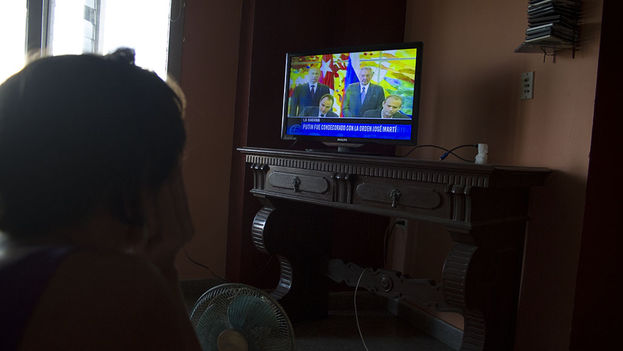
  • Putin and Raul Castro together on Cuban television. (14ymedio)

    Putin and Raul Castro together on Cuban television. (14ymedio)

    « These are the last sweets! » The cry could be the simple proclamation of a candy seller, but I heard it 23 years ago at my high school in the countryside and it was the first evidence I had of the collapse of the Soviet Union. The person shouting was Olga, a student who resold what the wives of the Russian technicians in Alamar gave her. She was the bridge between our Cuban money, worth less every day, and a series of products such as candy and canned goods « Made in USSR. » I remember this teenager, who warned us of the coming of shortages, like a blind Tiresias, alerting us to the adiós of the « bowling pins » (as we called the Russians).

    The old relationship with the Kremlin comes to mind now, with Vladimir Putin’s visit to Cuba. We have seen the official delegation on national television with its businesslike demeanor in suits and ties, no longer speaking of Marxism-Leninism or the dictatorship of the proletariat. They look different, but so much the same. The same glance from above they once had when they knew our island was just a small domino in the game of power. They come looking for alliances, to define the contours of those blocks they are reassembling — right before our eyes — in a new return of the Cold War. We are one step away from returning to our old status as a satellite, diminished before Moscow’s power, its oil, the debt relief it just granted us.

    Not a single official commentator has hinted at the dangers entailed in this approach, nor to the Russian government’s need to use Latin America as a diplomatic « launching pad » against its old enemy, the United States. In the midst of this renewed confrontation among the great powers, we are trapped as a disposable and negotiable part, as the case may be. The risk is such that I again remember Olga and the last Soviet candies she offered us in that dorm. Those sweets in extinction predicted an end, the goodies being announced today, like a new airport and possible Russian investment in the Port of Mariel project, compromise our future. You don’t have to be blind, nor Tiresias, to realize it.


    Click here for selected English Translations from Yoani Sanchez’s newly launched newspaper, 14ymedio.

    See the article here:
    Putin In Havana, Seeking an Ally or a Satellite?

  • Havana, 3 July 2014 — Yesterday on the bus, with the summer heat and after the long wait at the stop, two men commented loudly on their annoyance. « This sure doesn’t happen in Cyprus! » one said to the other, and laughter rang out all over the bus. He was referring to a monologue by the comedian Nelson Gudín, which has become a viral phenomenon on the alternative distribution network for videos. The actor plays a drunk who, among many other absurdities, complains about the space given in the national media to relating the problems of other countries, while remaining silent on ours. The old technique of « the mote in another’s eye… » — which is one of the pillars of the official Cuban press.

    Unemployment, corruption, economic cuts and social unrest… in Cyprus… were a topic of discussion and analysis by the panelists on the Roundtable show on several occasions. To underpin the axiom that « it’s hell out there and paradise in here, » the unpopular TV program placed a special emphasis on the difficulties being experienced by this member state of the European Union. So much time and so many reflections were dedicated to it, that the character played by Gudín ended up commenting, « Huh?… I didn’t know we were living in Cyprus? » The sarcastic phrase has almost become a slogan on our streets.

    Just let an official delay some paperwork, for an ironic voice to note, « this guy surely comes from Cyprus. » That lady who is out of work due to economic adjustments, « is probably Cypriot, » her acquaintances will comment maliciously. Not to mention the empty shelves because of shortages; « It shouldn’t happen in Havana, only in Nicosia, » a frustrated customer claimed a few days ago. « At this rate, we’ll know more about the antagonisms between the Greeks and the Turks than about our own national problems, » a university professor pointed out to his students.

    By the work and grace of the ideologues of the official press our principal preoccupations no longer take the form of an island in the Caribbean, but of this other one in the far off Mediterranean, where all the problems are concentrated.


    Click here for selected English Translations from Yoani Sanchez’s newly launched newspaper, 14ymedio.

    View article:
    ‘It’s Hell Out There… But Paradise Here in Cuba’

  • I remember him well, leaning over the table with head bowed and a vacant look. Carlitos was barely 20 and his every gesture carried the reluctance of someone who had lived too much. The young man ended up emigrating — like so many others — and I suppose there is little time in his new life to let the hours pass lying around bored. However, I continue to see this physical image of apathy and a lack of personal projects everywhere I look. It’s as if the body is speaking and, with its posture, it is saying what so many mouths remain silent about.

    Someday when a Cuban body language glossary is prepared, it will include this pose of « falling into the abyss of nothingness. » This appearance of already being defeated, like Carlitos, that so many young people and not so young people present in this country. It’s the nuisance of moving your hands, the droopy eyelids, the permanent drowsiness and a certain relaxation of the lips which barely articulate lazy words, when they are not reduced to simple monosyllables. That the clock is ticking doesn’t matter, life passes and it doesn’t matter, the country slips through our fingers and people couldn’t care less.

    While the heroes stand proudly on their marble pedestals, reality finds us bent over, tired, throwing ourselves on the first piece of furniture we come across. Is it perhaps the rebellion of indolence? The muffled scream of disinterest? I don’t know, but everywhere there are these poses that betray a lack of personal and national dreams.


    Click here for selected English Translations from Yoani Sanchez’s newly launched newspaper, 14ymedio.

    Link:
    ‘Falling Into the Abyss of Nothingness…’

  • Eugenia lost her job of 30 years in an office of the Ministry of Transport. She was left « available, » according to the declaration of her bosses, before they offered her a job as a bricklayer. Reluctant to lay bricks and mix mortar, she launched herself on the private market to see what she could find. Her possibilities were few. She doesn’t speak any other languages, she’s never touched a computer, and she doesn’t have the « good looks » of youth.

    A friend signed her up on a digital site to look for work. « We don’t accept people with dentures, » said the first interviewer when she went for a job cleaning a house rented to foreigners. The owner of the place wanted « a clean woman who doesn’t talk very much, doesn’t smoke and looks strong. » She hired someone else and Eugenia decided to invest in her physique.

    She dyed her hair, bought new shoes, and made the rounds of several cafes and restaurants in Central Havana. Over 50, almost all the places responded the same, « we already have people in the kitchen and you won’t do for a waitress. » Eugenia noticed that behind the bars or waiting tables in the new privately run places there are almost always young thin women with prominent busts.

    « You are from Havana, right? » she was asked at a place where they contracted with people to wash and iron. Eugenia was born in Holguin and spent nearly her entire life in the Cuban capital, but the owner of the laundry said she wouldn’t do. « We want Havana people, so there will be no problems with relatives who come and want to stay in the house. »

    A neighbor told her about another possibility, caring for an old man. He was retired military and could barely get around in a wheel chair. « You can’t say anything bad about the Revolution in front of him, » warned the children of the old man, who had to feed him, change his clothes and read him the Granma newspaper. In the end, Eugenia also failed to get that job.

    For a few days she managed to care for a child, but it was only a week because, « if you can’t sing and don’t know any children’s games my son gets bored, » the mother of the little boy told her. Eugenia only knows how to fill out forms, attach stamps, and nod her head affirmatively during the long meetings that were held at her company. She can’t compete in today’s job market.

    Yesterday she heard about a job scrubbing in a private restaurant. « You can’t leave the kitchen during work hours, » the cook told her. « It’s better if the customers don’t see you, » he repeated, before confirming that she was « on a trial basis. »

    Click here for selected English Translations from Yoani Sanchez’s newly launched newspaper, 14ymedio.

    See the original post:
    The Challenges of Finding Work in Today’s Cuba

  • Havana | 20 June 2014 — Damaris is almost 40 and has several scars on her face. They were made by a 5th grade classmate with a hair clip. They were in the middle of class and a dispute over the ownership of a pen led the opponent to scream, « I’ll be waiting for you at four-thirty! » This is the worst threat a student can receive in a Cuban elementary school. The phrase lets you know that when school gets out strength and supremacy will be proved with fists or fingernails.

    For Yosniel it was worse. He jumped from a water tank at the People’s Republic of Romania High School, after months of ridicule about the size of his head from his classmates in the dorm. He fell on concrete and no effort at resuscitation was able to save him. The next day, during the funeral, the very students who had ridiculed him offered their condolences to the bereaved family in the impoverished Romerillo neighborhood.

    However, the problem touches both the poor and the better-off. The cold metal of a knife pierced the heart of Adrian, also a high school boarding student, because another student, stronger than he, decided he wanted his Converse sneakers. The parents of the dead boy were in the military, but even so they could not understand how the schools that were supposed to form the « New Man » could end up functioning with the same bullying as in prisons.

    Cecilia, meanwhile, was always one of the ones who hit… not one of those who was hit. She would choose which uniform skirt she wanted, searching the lockers of the weaker and smaller students. One day she met her match in a skinny little gap-toothed girl who — with a knife improvised from a hacksaw blade — slit her face from ear to ear.

    Abuse at school, bullying, is an issue that is rarely discussed in the national media, but it affects hundreds, even thousands, of students across the country. Among the most alarming characteristics of this problem is the complicity or indifference on the part of the teachers. Often the teachers support « these tough guys and girls » in order to control the rest of the students. The result is an institutional validation of a structure of bravado and abuse.

    How can it be reported? No one knows. There is no telephone number that a student victim of bullying can call. There is no Ministry of Education circular protecting the victims in these cases. The parents usually respond to their children’s complaints of abuse with « hit him harder » or « show them who you are. » The teachers don’t want to get in the middle of a dispute and many school directors respond defensively, « You can imagine, I no longer know what to do with this boy. »

    The truth is that the drama of school abuse is not reported, debated, questioned… meanwhile, the many Cecilias who are out there continue taking smaller children’s uniforms, cutting classmate’s faces with a blade, or mocking — to the point of suicide — the head size of another.

    Link:
    Bullying: A Serious Problem in Cuban Schools

  • In a country where there are so few spaces for debate, the loss of any one of them is a tragedy. The departure of Roberto Veiga and Lenier Gonzalez from the magazine Lay Space leaves us with even fewer opportunities for debate. Their work was characterized by its willingness to address controversial and difficult topics in the pages of a publication that, in recent years, became an obligatory reference. With a respectful spirit, a true concern for the nation, and the ability to present arguments, these editors opened a reflective space that we, their readers, fear will be missed from now on.

    Differences in ideas should not lead us to personal confrontation. A lesson that should be learned by more than one person who takes ideological contradictions as a pretext to channel their lowest passions. So, despite my points of difference with many of the ideas of Veiga and Gonzalez, and especially with their category of « loyal opposition, » I have always respected their work and considered it to be of great value. The public existence of their voices improved the quality of discussions within the Island, encouraging different points of view – which is always a good thing – and brought together political tendencies that seem to run along contrary paths. I regret that they never accepted invitations to also participate in non-official debates within the country. I hope, now they have been « liberated » from their jobs, that we will be able to exchange ideas outside the protection of the Cátedra Félix Varela.

    Cuba loses and I can’t imagine who wins with this dismissal. The next archbishop of Havana? Is the church so fickle? One day they snatched the magazine Vitral from us, to turn it into a shadow of the multicolored light it once was. Now, it seems, the same will happen with Lay Space. I am not convinced by the declarations of its current director who assures us that the work of the journal will continue. I believe deeply in the stamp each human being imprints on a work, and in the case of this publication it’s clear that Veiga and Gonzalez were its principal sources of inspiration.

    The ragged tapestry of our civil society just suffered the tearing of another thread.

    Visit site:
    Firing of Catholic Journalists Leaves One Less Thread in Cuba’s Social Tapestry

  • The fear of not being able to leave, of remaining locked on the island, is shared by many of my compatriots. Those who have never traveled fear they will grow old without ever knowing what’s on the other side of the sea. Cubans living abroad are not exempt from this fear. Many of them, when they visit the Island, have a recurring nightmare that they will not be allowed to board the plane when they leave. It is precisely this feeling overwhelms the main character of the novel Eskimo Kiss, by the novelist and journalist Manuel Pereira.

    The book, as yet unpublished, describes the experiences of a man who travels to the land he left twelve years ago. His mother’s advanced age compels him return to the « country of mirages, » as he calls it. His arrival is accompanied by the panic of being trapped and that apprehension is mixed with the constant feeling of being watched. To him, his country is « like a mousetrap » during the four days of the « humanitarian entry permit » the authorities have given him.

    It is not only that perception of confinement that overwhelms the character of Pereira, but the difference between what he remembered from his homeland and what it really was. The distance, years and emotions tend to put a patina of sweetness and harmony on loved ones and everyday life that is often shattered when they are reunited. Nor does a nation fading away, in a moral freefall, do much to help allay the impression of suffocation that runs through the pages of this book. « Will he be able to escape? » we ask ourselves from the moment we start reading. To get to the answer we have to immerse ourselves in the reality — as well known as it is absurd — in which we ourselves are trapped.

    Read the original:
    Cold Kisses Under a Tropical Sun

  • Nobody knows how he got it into the country, with so many customs restrictions and government paranoia, but Miguel has a drone. Tiny, like a kid’s toy, and with a camera. In his spare time, this forty-something Havanan dedicates himself to using his new amusement to explore the nearby patios and rooftops of his neighbors. It’s so tiny that it’s barely noticeable when flying over the neighborhood, while it transmits images and videos to a screen in the home of its proud owner.

    Right now it’s a prank, but if one day Miguel is discovered with his diversion, at best he could show up on official TV as a « CIA agent. » Who knows. An uncle of his was arrested on the street in the seventies for carrying a tape recorder that belonged to the government newspaper where he worked. He spent long hours at a police station, until the director of the publication himself had to intercede for him. Time has flown and now the « fearful » objects are other things, but the reprisals are usually the same.

    In any event, beyond the presumed punishment, Miguel has now learned some valuable things. He has seen the pool hidden behind his neighbor the Colonel’s high fence, the satellite antenna a former minister has on the roof of his house, and even the bowl overflowing with meat for the rottweiler belonging to the painter who lives on the corner. He has also observed, with the device’s night vision, the man who, in the early hours of the morning, dives into the dumpster and emerges with his « treasures » under his arm, and the watchman who spends time opening the warehouse containers to steal from them, without leaving any traces on the security seals. Early one morning he even captured the president of his local Committee for the Defense of the Revolution (CDR) trafficking in the alcohol from a nearby hospital.

    Through the eyes of his drone, Miguel has been looking at Cuba from the air, and what he is seeing is a country divided into pieces that don’t fit.

    View article:
    Miguel’s Drone, Cuba From the Air