-
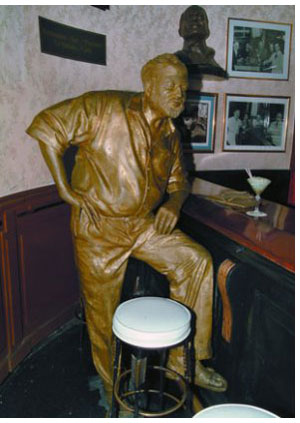
La sculpture de bronze fondu pose un de ses bras sur le comptoir du bar. Elle semble pr
-
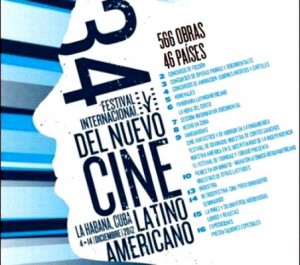
Every December, like a returning friend, the Havana International Festival of New Latin America Cinema returns. A film event that this year will bring more than 500 movies from 46 countries. A true delight for our senses, the Festival includes a visit to the country of actors and directors from all latitudes, thematic film showings, and even concerts. From Fito Paez’s massively-attended presentation, through the American actress Annette Bening, to the filmmaker Eliseo Subiela.

Tributes to the leading figures of celluloid are also part of the offerings of the two weeks that the greater part of the activities last. This time the honorees are French filmmaker Chris Marker (1921-2012), the Italian Michel Angelo Antonioni (1912-2007) and the Czech master of animation Jan Svankmajer (1934).
This year 21 feature-length films, as well in the other categories of documentaries, shorts, animation, scripts, posters and debut films. There will be a retrospective for the centennial year of film production in Puerto Rico, with more than 20 titles and the usual showings dedicated to Spain, Italy, Canada and Poland.
Among the big surprises on this occasion is a series of films grouped under the title « From Hollywood to Havana, » which will be presented by the president of the U.S. Academy of Motion Picture Arts and Sciences himself, Hawk Koch.
However, beyond the high quality of the films and collateral programs, the Festival is surrounded by a magical aura. It is something that can’t be described, neither with the number of titles in the catalog, nor with the significance of the international stars who are coming. It’s something deeper in our skin, closer to the personal biographies of those of us who have come of age looking forward to every December.
For example, my adolescence is inextricably linked the very long lines to see an Argentine or Mexican film. Still vivid is the sense of wonder when one night the glass in the doors of the Acapulco cinema where shattered before my eyes by the push of people eager to enter. The furtive kiss in the darkness of the room, while the a brilliant tropical rainforest shimmered on the screen and a horse whinnied from the speakers. Days also that I sat in the seats through so many films I’d seen in a few hours. We were so young and at that time the film festival was as well.
After 34 years of the inauguration of the Havana Latin American Film Festival, the social reality in which is operates has changed dramatically. I could list endless transformations that happened in Latin American film, but I prefer to concentrate on the changes within us, on this side of the screen. Among the major differences that I perceive relative to the film festivals of the ’70s, notable are the new forms of access to popular films. Before, we were totally dependent on the schedules in the State-owned projection rooms. So if a particular movie was not programmed for these public spaces, there was no chance that we would see it.
This happened very often, either because of censorship, disinterest, or the lack of rights to show a film on the national circuit. Very timidly, in the mid-eighties, the first VCR players appeared in homes. And this began to totally change our relationship to the audio-visual world.
Now, proliferating all over the city are video rooms operated by the self-employed, and many families have at least one DVD player to watch documentaries, movies and television shows that never become part of the official programs. A wave of commercial films, but also documentaries censored for their ideology, have made their way to us thanks to modern technology.
And that is now the great challenge and main competition for the International Festival of New Latin American Cinema. Getting people to leave their home screens and return to the projection rooms, to motivate them with an event that up until a few years ago was the only window we had to get a peek at a fresh and different cinema.
Read the original post:
Havana’s Annual Film Festival Returns -

The Mantilla neighborhood exhibits a rare blend of a Havana suburb with a rural village. Its park, its church, its streets that foreign tourists rarely see, and even its famous writer. This last is Leonardo Padura, born in Havana in 1955, a journalist and author of numerous novels. Despite his international recognition and his possession of Spanish nationality, Padura has preferred to live in the same town on the Island where he was born, which has been the scene of so many of his stories.
The name of this universal Cuban is associated with detective stories, but his work also includes journalism and screenplays. A baseball fanatic, incisive in his opinions and of a proven nobility, on the eve of his sixth decade he is an unusual man. His « rarity » lies fundamentally in having been able to sustain a critical vision of his country, an unvarnished description of the national sphere, without sacrificing the ability to be recognized by the official sectors. The praise comes to him from every direction of the polarized ideological spectrum of the Island, which is a true miracle of letters and of words.
Padura commands the force of talent. He has been received with respect, even by those in the Cuban Writers and Artists Union who observe him with resentment for his books that feature the detective Mario Conde. In the hard years of the Special Period his novels took a deep look at a reality that others preferred to whitewash.
His literary honesty, his tenacity, and also a good dose of luck, allowed him to reach the dream cherished by every Cuban writer: to be published in other parts of the world. Publishers ranging from the University of Guadalajara to Tusquets in Barcelona, have helped him to position himself as an acclaimed novelist. This international recognition has also prevented local censorship from simply making him invisible, and instead they try to accept him, although reluctantly.
The « writer of Mantilla, » as many call him, has the rare privilege of seeing his novels photocopied and circulated as pirated editions among his compatriots. This insatiable appetite for his pages is also due to the small runs the local presses have produced of his most popular titles. If we were to measure the success of an author by the number of times someone makes an illegal copy of his work, then Padura would earn the highest score of any living Cuban.
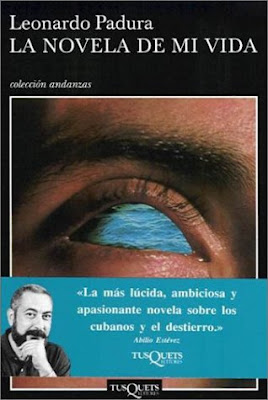
If 2011 was a year full of accolades for the author of Past Perfect (Tusquets, 1991) and The Novel of my Life (Tusquets, 2002), it now ends confirming Padura as the great Cuban novelist of today. In 2012 he has continued to build on the favorable track record left by his book The Man Who Loved Dogs (Tusquets 2009), which deals with the life of Ramon Mercader, Leon Trotsky’s murderer. In November, he was also celebrated with an Author’s Week in which Havana’s Casa de las Americas presented a collection of his stories and essays under the title A Man and an Island.
Currently working on the book Heretics, which he has defined as « three novels which have a tenuous and invisible thread. » The movie 7 Days in Havana (French-Spanish co-production, 2012), which he collaborated by writing the script from one of his stories, has given us a lot to talk about by showing a city if interwoven hardness and sensuality.
Leonardo Padura is now the face of Cuban literature inside the island and we are tremendously lucky that this is so.
Excerpt from:
Leonardo Padura: The Man Who Loved Books -

Ne vous inquiétez pas, lecteur, ce texte ne parle pas de ce que vous croyez. Ca n’est pas un appel à l’Académie Royale de la Langue Espagnole pour qu’elle facilite le processus d’acceptation de nouveaux mots, ni même une réclamation visant à simplifier l’orthographe castillane. Rien de tout cela. Ma blouse de philologue, voilà bien longtemps que je l’ai mise au placard, et maintenant, je m’y entends mieux en bits qu’en syllabes, en tweets qu’en conjugaison. Je voudrais plutôt parler de ces tournures si particulières utilisées à Cuba pour désigner les phénomènes économiques, politiques et sociaux. Les “réformes” que nous vivons semblent se dérouler davantage sur le plan de la linguistique et de la sémantique que de la réalité concrète. Je vais proposer quelques exemples… n’ayez crainte.
Dans notre pays, on s’est mis à nommer “actualisation du modèle socialiste” des mesures qui ajoutent tout simplement à notre système des éléments propres à l’économie de marché. On désigne sous le terme “travail à son compte” ce que partout ailleurs dans le monde on appellerait “secteur privé”. Les chômeurs ne sont pas non plus catalogués en utilisant le mot adéquat, mais sous l’étiquette de “travailleurs disponibles”, une manière bien édulcorée de décrire le drame du chômage. Dans les hôpitaux, lorsque l’on supprime à tour de bras le nombre de radiographies et de scanners, on explique alors que c’est une bonne occasion de “renforcer le diagnostic clinique”. Ce qui, traduit de façon honnête, signifie que le médecin doit découvrir à l’aide de ses seuls yeux et mains aussi bien une fracture qu’une hémorragie interne.
Selon le discours officiel, la frustration populaire par rapport aux réformes n’est qu’une preuve d’”incompréhensions et d’indiscipline”. Si en plus cette non-conformité débouche sur une manifestation de rue, alors les participants ne sont ni des “indignés”, ni des “prolétaires réclamant leurs droits”, mais plutôt des “mercenaires” et des “contre-révolutionnaires”. Dans cette Ile, l’expression “le peuple” est l’un des nombreux pseudonymes par lesquels le pouvoir se désigne, vous pouvez donc imaginer les confusions que cela occasionne souvent. Quand on lit “selon la décision du peuple souverain…” ou “avec la participation de tout le peuple”, on pourrait remplacer le sujet de chacune de ces phrases par “le Parti Communiste”. Le virus du choléra lui non plus ne peut être désigné par ses sept lettres, puisque le journal Granma a déjà inventé la phrase “affection diarrhéique aiguë”. Et ces quartiers pauvres qui s’étendent en périphérie de la ville, attention, ne les appelez pas favelas ou bidonvilles, non! Ce sont, par le biais de la sémantique déformée qui nous entoure, des “communautés aux moyens réduits”.
Je ne comprends rien, et vous non plus. Un métalangage a pris possession de nos vies et aucun mot ne ressemble à ce qu’il est vraiment. Mais écoutez-moi bien, lecteur, et “ne vous inquiétez pas”, c’est ainsi que nous disons tous les jours que “la situation est inquiétante”.
Traduit par M. Kabous
Read More:
Réformes linguistiques -

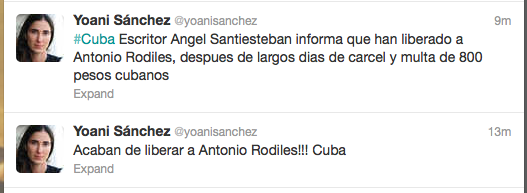
9 minutes: Writer Angel Santiesteban reports that Antonio Rodiles has been released, after long days in jail and a fine of 800 Cuban pesos.13 minutes: Antonio Rodiles was just released!
Translator’s note: 800 Cuban pesos is approximately $30.00 U.S. Rodiles, severely beaten and held for over two weeks, had been threatened with a long prison term.
View article:
Cuban Regime Caves, Releases Antonio Rodilies With $30 Fine -
People visiting Havana for the first time agree on the similarities of this city with Cadiz. The cultural similarities and certain visual resemblances tie the Cuban capital to its Andalusian first cousin. The presence of the sea, some of the architectural style, and the open behavior of its people, complete the embrace.
But not even this closeness has moved Raul Castro to participate in the XXII Ibero-American summit that began November 16 in this Spanish town. The Cuban leader preferred to send his Foreign Minister, Bruno Rodriguez.
Raul Castro travels little and when he does he prefers politically like-minded countries. Venezuela, Russia, China and Vietnam are among his few destinations since he assumed the office of the presidency in February 2008. His absence in Cadiz was expected, as he has never gone to any Ibero-American summits in other countries. Perhaps he prefers to avoid possible critiques of the state of human rights on the island.
But the General is just one among many absent from this meeting. His counterpart Hugo Chavez also will not attend, nor will the Argentine president Cristina Fernandez de Kirchner, who has offered the excuse of health problems. The recent earthquake in Guatemala has prevented the trip of Otto Perez-Molina, while the Paraguayan Federico Franco has excluded himself given his strained relations with his Latin American neighbors. So many empty chairs has robbed some of the luster from an event that for several years now has captured less and less interest in the region.
The main theme of this Ibero-American Summit deals with the world economic situation and ways to cope. Cuba has not escaped the red ink. A year is ending in which Raul Castro’s reforms have failed to boost the productivity of the country as was hoped. Not even the relaxations in the rules governing self-employment have resulted in an improvement over Cubans’ deteriorating standard of living.
To top it off, Hurricane Sandy damaged more than 137,000 homes — wholly or partially — in the east of the island. Thousands of homeless and a delicate epidemiological situation, complete the picture.
Nor has foreign investment taken off on the island, although the large number of guests at the last International Fair of Havana (FIHAV) might make one think otherwise. The international crisis and businesses’ lack of confidence in the Cuban « opening, » are among the reasons for the slowness with which that sector is moving. Everywhere we look we see the country’s urgent need for fresh, new and convertible capital.
The Carromero Case
Beyond Raul Castro’s absence at the Cadiz Summit, the most conspicuous issue that touches the Cuban side seems to be that of the Spaniard Angel Carromero. Detained in Cuba since July 22, this young leader of the Popular Party’s New Generations, was driving the car that killed regime opponents Oswaldo Paya and Harold Cepero. A court has convicted Carromero of « involuntary manslaughter, » though Pay