Catégorie : droits de l’homme

Situation des droits de l’homme à Cuba, répression et prisonniers politiques

  • « The newspaper was talking about you… » sings the voice of Joaquín Sabina, while I read the newspaper Granma. On the cover, as usual, there’s some event. A tribute to a figure from the past, a reminder, a phrase someone said forty or fifty years ago. All the pages have this rancid stink of journalism that doesn’t dare to address the present, that avoids the here and now.

    The Cuban official press can’t reform itself because to do so would be committing suicide. To report on the national reality it would have to renounce its role as ideological propaganda. It’s not enough to change the design of its digital sites, add new signatures to its articles, or keep the readers’ letters complaining about bureaucrats and corruption. It must go further and shed its political commitments and take on the truth as its only obligation. But this… this we know it cannot do.

    I expect more from the press that will emerge, or consolidate, than a « new official journalism. » But I am also aware that the work of reporting from civil society, precarious and illegal, has to improve. Information is not trench warfare and it is not a weapon. Events should not be reported from the point of view of what we want to have happened, but from what did happen.

    For its part, thematic variety is not contrary to the defense of freedom and human rights. There are many ways of speaking, and of speaking beautifully. We must search, then, for ways of reporting that bring us closer to ordinary readers. Creativity, daring and diverse points of view help us to be better professionals of the press. Going down that path is worth it.

    For my part, I’m taking the first steps. The countdown to the digital media I’ve been working on for four years has begun. A new professional challenge approaches, but I will not be alone; rather I will be accompanied by a team of talented people who want to do journalism with a capital J.

    In the coming weeks this personal blog will be transformed–right in front of your eyes–into a media of the PRESS. Words of encouragement are welcome!


    My blog, GENERATION Y, has moved: READ IT HERE.

    Read me and other Cuban bloggers on TRANSLATING CUBA.

    And here is a link to my blog IN OTHER LANGUAGES.

    Link:
    The Countdown to an Independent Newspaper in Cuba Has Begun


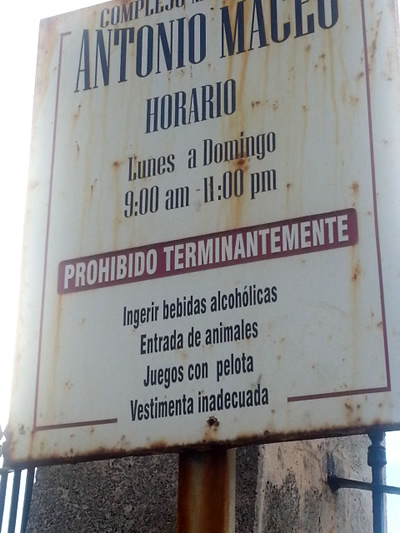
  • Strictly Prohibited: Drinking alcohol, Animals, Ball games, Skimpy clothing

    It’s difficult for a cell to maintain its health inside a sick organism. In an inefficient society the bubble of functionality bursts. In the same way, certain ethical values — selected and filtered — cannot be strengthened in the midst of a debacle of moral integrity. Rescuing codes of social conduct implies also accepting those that clash with the prevailing ideology.

    We are now being called upon by the official media to recover lost values. According to the version put forth by the commentators on TV, responsibility for the deterioration falls mainly on the family, a portion on the schools… but not at all on the government. They talk about bad manners, rudeness, lack of solidarity and the extent of bad habits such as stealing, lying and laziness. In a country where for half a century the educational system, the entire press, and all the mechanisms of cultural production and distribution have been monopolized by a single party, one can only ask: what is the source of such impoverishment?

    I remember that when I was a little girl no one dared to address another person as « señor » — mister — because it was a bourgeois throwback. As the use of « compañero » — comrade — is associated with an ideological position, many of us began to adopt new forms: « cousin, » « young man, » « hey you, » « Pop »… along with a long list of phrases derived from vulgar speech. Now they complain on TV that when we address others we are insulting, but… who started this deterioration?

    The Cuban system opted for social engineering, and toyed with individual and collective alchemy. The most perfect example of this failed laboratory was the so-called « New Man. » This Homus Cubanis would supposedly come of age in sacrifice, obedience and loyalty. His uniformity was incompatible with the particular ethics of each home. So to achieve him, millions of Cuban children were removed — as much as they could be — from the family environment.

    We went to daycare centers just 45 days after we were born; the Pioneer Camps took us in right after we learned our first letters; we went to schools in the countryside as soon as we left childhood, and spent our adolescence in high schools in the middle of nowhere. The State believed it could take over the formative role of our parents, thought it could exchange the values we brought from home for the new communist moral code. But the resulting creature deviated greatly from the one they had planned. We didn’t even manage to convert ourselves into the « New Man. »

    They also launched themselves against religion, ignoring that dissimilar creeds transmit a share of the ethic and moral values that molded human civilization and our own national customs. They made us denigrate those who were different, we insulted the presidents of other countries with obscenities, mocked historic figures from the past, stuck our tongues out or blew raspberries when passing a foreign embassy.

    They instilled in us the « Revolutionary promiscuity » that they themselves had already practiced in the Sierra Maestra, and incited us to laugh at those who spoke well, were deeply cultured, or showed any kind of refinement. This was carried out with such intensity that many of us faked speaking vulgarly, left off syllables when we talked, or shut up about our reading, so no one would notice that we were « weirdos » or potentially « counterrevolutionaries. »

    One man — from the podium — screamed at us for 50 years. His diatribes, his hatred, his inability to listen calmly to an opposing argument, were the « exemplary » postures we learned in school. He instilled in us the gibberish, the constant tension, and the authoritarian index finger when we address others. He — who thought he knew everything but in reality knew very little — conveyed to us the pride of never asking forgiveness and of lying, that deception of rogues and scam artists that he was so good at.

    Now, when the ethical picture of the nation looks like a mirror shattered against the floor, they call on the family to fix it. They ask us to shape values at home and to pass on order and discipline to our children. But how can we do it? If we ourselves were shaped to disrespect every code? How can we do it? If there’s no process for the powers-to-be to criticize themselves, for those who played at social engineering with our lives to recognize what they did?

    Ethical codes are not so easily reassembled. A morality devalued by public discourse can’t be put back together overnight. And now, how are we going to fix this disaster?


    My blog, GENERATION Y, has moved: READ IT HERE.

    Read me and other Cuban bloggers on TRANSLATING CUBA.

    And here is a link to my blog IN OTHER LANGUAGES.

    See the article here:
    Cuban Communist Regime Replaces Parents and Then Complains Its Children are Badly Brought Up


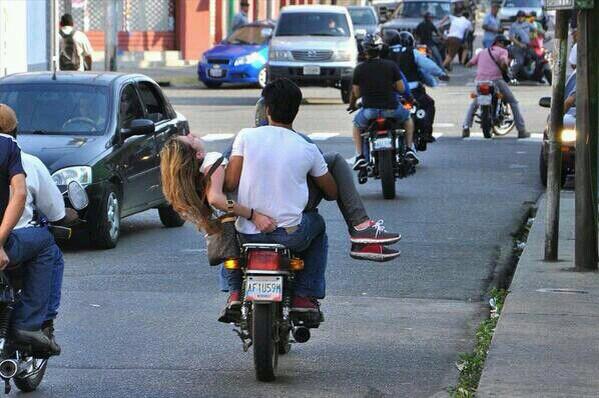
  • Genesis Carmona, college student and local beauty pageant winner shot in the head during the protests, being rushed to the hospital, where she died. Photo from runrun.es

    They say no one learns a lesson through someone else’s head, that we repeat the mistakes of others and stumble, over and over, on the same stone. Skeptics assure us that people forget, close their eyes to the past and commit identical mistakes. Venezuela, however, has begun to disprove that inevitability. Amid a reality marked by insecurity, shortages and inflation, Venezuelans are trying to amend a mistake that has lasted too long.

    Taken over by Cuban intelligence, monitored from the Plaza of the Revolution in Havana, and ruled by a man who incites violence against those who are different, this South American nation now finds itself facing the most important dilemma of its contemporary history. Totalitarianism or democracy, those are the options. What is being decided in its streets is not only Nicolás Maduro’s permanence in power, but the very existence of an axis of authoritarianism and personal ambition that spans all of Latin America. A system that disguises itself with empty words in the style of « socialism of the 21st century, » « a revolution of the humble, » « the dreams of Simon Bolívar » and « the new left, » whose fundamental characteristics are its leaders’ lust for power, economic inefficiency, and the curtailing of freedoms.

    But Venezuelan students have given Chavismo a dose of its own medicine. Young people and college students have been the driving force of the protests this time. Which proves that Miraflores has lost the most rebellious and dynamic part of society. Although the headlines in the government controlled press speak of conspiracies fomented from abroad, it’s enough to look at the images of the police and the armed commandos beating the protestors to understand where the violence comes from.

    Venezuela is going through difficult times, like all awakenings. The oligarchs in red will not give up power voluntarily and Raul Castro will not let them so easily snatch away the goose that lays the golden egg. But at least we already know that Venezuelans will not walk the same road they imposed on us in Cuba. Meekness, fear, complicity, and escape as the only way out… those have been our mistakes. Venezuela doesn’t want to repeat them, it can’t repeat them.


    My blog, GENERATION Y, has moved: READ IT HERE.

    Read me and other Cuban bloggers on TRANSLATING CUBA.

    And here is a link to my blog IN OTHER LANGUAGES.

    See the original post:
    Venezuela, With Eyes Wide Open


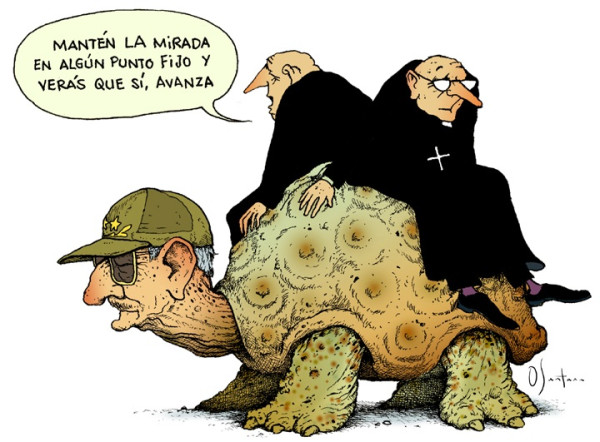
  • Focus on a fixed point and you’ll see that we are, in fact, advancing. Graphic humor from Santana

    Everything moves clumsily, heavily. Even the sun seems to take longer than normal up there. The clock knows nothing of precision and the minute hand is stuck. Making an appointment with the exactitude of three-fifteen or twenty-to-eleven is the pure pedantry of those in a hurry. Time is dense, like guava jam with too much sugar.

    « If you hurry, your problems double, » the clerk warns the customer anxious to get home early. The man sweats, drums his fingers, while she cuts her really long fingernails before even hitting a key on the cash register. The line behind him also looks at him with scorn, « Another one who thinks he’s in a big hurry, » says an annoyed lady.

    We live in a country where diligence has come to be interpreted as rudeness and being on time as a petulant quirk. An Island in slow motion, where you have to ask permission from one arm to move the other. A long crocodile that yawns and yawns as it lolls in the Caribbean waters.

    Someone who manages to complete two activities in one day might feel fortunate. It’s common not to be able to find ways to do even one. There’s a hitch at every step, a sign that says, « Today we’re closed for fumigation, » « We don’t serve the public on Friday, » or Raul’s phrase, « Without hurry but without pause. » Delay, postpone, suspend, cancel… the verbs most conjugated when you face any procedure or paperwork.

    The turtle’s pace is everywhere. From the bureaucratic offices and the bus stops to the recreation and service centers. But the big winner of the award for having « the blood of a turnip » is the government itself: Three years after the fiber optic cable was connected between Cuba and Venezuela it is still impossible to contract for a home Internet connection.

    Two decades of the dual monetary system and they still haven’t published a schedule for the elimination of this economic schizophrenia. Fifty-four years of single-party government and there is no sign of a day when we will have the right to free association. Half a century of government blunders and mistakes and they haven’t even begun to hint at an apology.

    At this rate, one day they’ll re-baptize the Island « Never Never Land, » a place where clocks and calendars are banned.


    My blog, GENERATION Y, has moved: READ IT HERE.

    Read me and other Cuban bloggers on TRANSLATING CUBA.

    And here is a link to my blog IN OTHER LANGUAGES.

    View the original here:
    Am I Living in Cuba, or Never Never Land?


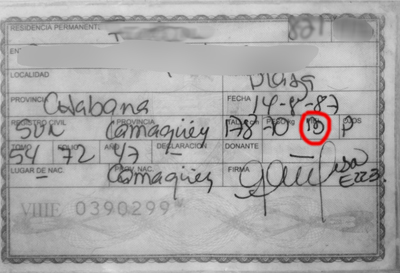
  • Backside of the Cuban Identify Card with a box for « Skin »

    It’s just been born and in a few hours they will register the baby with its brand new name. A few days will pass before the parents get the birth certificate and then the so-called « minor card. » Without an identification card you can’t receive products from the ration market, enroll in school, get a job, travel on an inter-provincial bus, or put your belongings in a bag-check at a shop. Every day of your life you need this document, which at the top carries a unique combination of eleven digits. On the little piece of cardboard your temporal and geographic data is registered… and also certain physical details.

    It looks just like a letter on the back of the identity card, but it is an initial that describes the color of our skin. This consonant classifies us as one race or another, divides us into one group or another. Amid repeated institutional calls to end discrimination, the Cuban Civil Registry still maintains a racial category for every citizen. Along with the date of our birth, and our address, it specifies if we are white, mixed or black. The assignment of a « B, » « M » or « N, » (Blanco-white, Mestizo-mixed, Negro-black), in a nation with so much race mixing, is often the result of a functionary’s subjective judgement.

    Amid so many priorities, so many rights to demand and injustices to end, it might seem trivial to demand the withdrawal of a letter on our identify card. However, its small presence doesn’t diminish its gravity. Especially when the document itself already has a photo of its holder, where you can see his or her physical features.

    No citizen should be evaluated by the color of their skin, nor placed in a category according to the amount of pigment they carry in their epidermis. Such bureaucratic backwardness speaks more to prison files than civil registries. It’s not a question of melanin, but of principles.


    My blog, GENERATION Y, has moved: READ IT HERE.

    Read me and other Cuban bloggers on TRANSLATING CUBA.

    And here is a link to my blog IN OTHER LANGUAGES.

    More:
    Race and Identity in Cuba

  • Our apologies, we do not have subtitles for this video. Article 53 of the Cuban Constitution (referenced in the video) reads:

    ARTICLE 53. Citizens have freedom of speech and of the press in keeping with the objectives of socialist society. Material conditions for the exercise of that right are provided by the fact that the press, radio, television, cinema, and other mass media are state or social property and can never be private property. This assures their use at exclusive service of the working people and in the interests of society.

    Reinaldo speaks little of his time as an official journalist. When he does, it is with a mixture of frustration and relief. The first from his responsibility for the fabrication of so many stereotypes, and the second because by expelling him from the newspaper Juventud Rebelde (Rebel Youth) they turned him into a free man. Cuba International Magazine holds a prominent place in his memories, as he worked there for almost fifteen years.

    In our house we have created an entire category of news with the name of this publication. When a provincial correspondent speaks on TV of the marvels of a battery factory — without mentioning how many are actually being produced — we watch, laugh, and say to ourselves: « This is in the worst style of Cuba Magazine. » If there is an article in the press presenting the life of a small provincial town through rose-colored glasses, we connect this, as well, with the editorial approach that has done and is doing so much damage.

    Mayerín, unlike Reinaldo, just graduated from the Faculty of Social Communication. Sometimes he calls from a public pay phone to tell me about his latest article on a digital site he collaborates on. « Did you see, » he asks me, « what I managed to slip in in the third line of the second paragraph? » So I go check my reporter friend’s daring and find that instead of writing « our beloved and invincible Commander-in-Chief, » he has simply put « Fidel Castro. » Keep up your daring work!

    Several generations of information professionals have had to approach their work through censorship, ideological propaganda and the applause of power. Sugarcoating reality, using national media as a showcase for false achievements and filling newspapers with a doctored and distorted Cuba, these are some of the evils of our national press. If these deformations leave a sour taste the mouths of readers and television viewers, the effect is even worse on the journalists themselves.

    The informants end up prostituting their words to stay out of trouble or to earn certain privileges, and the social prestige of the reporter plummets and the press becomes an instrument of political domination. For this informant, who as a child dreamed of uncovering some scandal or investigating an event to its ultimate consequences, all he is left with is folding or breaking down the door, continuing to put make-up on reality, or being declared a « non-journalist » by the government.

    My blog, GENERATION Y, has moved: READ IT HERE.

    Read me and other Cuban bloggers on TRANSLATING CUBA.

    And here is a link to my blog IN OTHER LANGUAGES.

    See more here:
    Being a Journalist in Cuba: Success Is Measured By Your Ability To Make Things Up

  • Infanta and Vapor Streets, eight at night. The scaffolding creaks under the weight of its occupants. The area is dark, but there are still two painters passing their brushes over the dirty balconies, the facades, the tall columns facing the avenue. Time is short, the 2nd Summit of the Community of Latin American and Caribbean States (CELAC) will start in just a few hours and everything should be ready for the guests. The streets where the presidential caravans will pass will be touched up, the asphalt addressed, the potholes and poverty hidden. The real Havana is disguised under another stage-set city, as if the dirt — accumulated for decades — was covered by a colorful and ephemeral tapestry.

    Then came the « human cleansing. » The first signs of one more stage set being erected comes via our cellphones. Calls are lost into nothingness, text messages don’t reach their destinations, nervous busy signals respond to attempts to communicate with an activist. Then comes the second phase, the physical. The corners of certain streets teem with supposed couples who don’t talk, men in checked shirts nervously touching their concealed earphones, neighbors set to guard the doors of those from whom, yesterday, they asked to borrow a little salt. The whole society is full of whispers, watchful and fear-filled eyes, a huge dose of fear. The city is tense, trembling, on alert: the CELAC Summit has started.

    The last phase brings detentions, threats and home arrests. Meanwhile, on TV the official announcers smile, comment on the press conferences and carry their cameras to the stairs of dozens of airplanes. There are red carpets, polished floors, tree ferns in the Palace of the Revolution, toasts, family photos, traffic diversions, police every ten yards, bodyguards, accredited press, talk of openings, people threatened, dungeons filled, friends whose whereabouts are unknown. Not even the Ñico López refinery is allowed to let its dirty smoke leave the chimney. The retouched postcard is ready… but it lacks life.

    Then, then everything happens. Every president and every foreign minister returns to their country. The humidity and grime push through the fine layer of paint on the facades. The neighbors who participated in the operation return to their boredom, and the officials of #OperaciónLimpieza — Operation Cleansing — are rewarded with all-inclusive hotels. The plants installed for the openings dry up for lack of water. Everything returns to normal or to the absolute lack of normality that characterizes Cuban life.

    The fake moment has ended. Goodby to the Second CELAC Summit.


    My blog, GENERATION Y, has moved: READ IT HERE.

    Read me and other Cuban bloggers on TRANSLATING CUBA.

    And here is a link to my blog IN OTHER LANGUAGES.

    Visit link:
    Cuban Regime "Cleans up" Opposition for CELAC Summit

  • Angle des rues Infanta et Vapor, 20h. Un échafaudage grince sous le poids de ses occupants. La zone est sombre, mais malgré cela, deux peintres passent leurs rouleaux sur les balcons sales, les façades, les hautes colonnes qui donnent sur l’avenue. Le temps presse, le IIème Sommet de la CELAC s’ouvrira dans à peine quelques heures et tout doit être prêt pour les invités. Les rues par lesquelles passeront les caravanes présidentielles seront retouchées, le revêtement sera réparé, les trous bouchés et la pauvreté camouflée. La véritable Havane se cachera sous une ville de carton-pâte, comme si l’on posait par-dessus la crasse –accumulée durant des décennies- un tapis luxueux et éphémère.

    Le “nettoyage humain” viendra dans un second temps. Les premières preuves du montage d’une autre scénographie viennent des téléphones portables. Les appels se perdent dans le néant, les SMS n’arrivent pas à destination, lorsqu’on tente de joindre un activiste, ça sonne occupé. Vient ensuite la deuxième phase, physique. Au coin de certaines rues prolifèrent de soi-disant couples qui ne se parlent pas, des hommes aux chemises à carreaux qui touchent nerveusement l’écouteur dissimulé dans leur oreille, des voisins qui montent la garde devant les portes de ceux à qui, la veille, ils demandaient un peu de sel. Toute la société s’emplit de murmures, de regards attentifs et de peur, d’une forte dose de peur. La ville est tendue, en alerte, elle tremble : le Sommet de la CELAC a commencé.

    La dernière phase consiste en des arrestations, des menaces et des assignations à domicile. Pendant ce temps, sur les chaînes officielles, les invités sourient, commentent les conférences de presse et dirigent leurs objectifs vers les escaliers de dizaines d’avions. On voit des tapis rouges, des parquets cirés, de gigantesques plantes dans le Palais de la Révolution, des toasts, des photos de famille, des déviations sur les routes, des policiers tous les cent mètres, des gardes du corps, de la presse accréditée, des discours d’inauguration, des experts, des prisons remplies, des amies introuvables. Même la raffinerie Ñico López n’a pas le droit de montrer la fumée sale qui sort de sa cheminée. La carte postale retouchée est prête … mais il lui manque le souffle de vie.

    Ensuite, ensuite on passe à autre chose. Chaque président, chaque chancelier retourne dans son pays. L’humidité et la saleté ressortent sous la fine couche de peinture des façades. Les voisins qui ont participé à l’opération retrouvent leur ennui et les officiels de l’Opération Nettoyage sont récompensés par des nuits dans des hôtels all included. Les plantes installées pour les inaugurations se fanent par manque d’eau. Tout revient à la normale ou plutôt à l’absolu manque de normalité qui caractérise la vie cubaine.

    C’est la fin de la photo truquée. Adieu IIème sommet CELAC.

    Traduction M. Kabous

    Read this article:
    Opération nettoyage