Catégorie : droits de l’homme

Situation des droits de l’homme à Cuba, répression et prisonniers politiques

  • A crowd was waiting outside the mansion in Vedado with a statue of Abraham Lincoln in the garden. The language school opened its doors to new registrations and in the days that followed tested the attitudes of those interested. Everyone waited nervously, thinking that they would be evaluated on a pronunciation here… a mastery of vocabulary there. To our surprise, the main questions weren’t about language, but rather alluded to politics. By mid-morning a young woman who had been rejected warned us, « They’re asking the name of the first secretary of the Cuban Communist Party (PCC) in Havana. » We stood there mouths agape, who would know that?

    A few decades ago the leaders of the so-called « political and mass organizations » were figures known throughout the country. Whether through their excessive presence in the official media, long tenure in their jobs, or simply because of personality, their faces were easily identifiable, even to kids in elementary school. We relentlessly heard talk of the secretary of the Young Communist Union, saw on every newscast who was leading the PCC in a province, or overdosed on declarations from some president of the Federation of University Students. There they were, clearly recognizable. Some even came to have nicknames, along with numerous jokes about their quirks and inefficiencies.

    This morning on national television they mentioned Carlos Rafael Miranda, national coordinator for the Committees for the Defense of the Revolution (CDR). And it started me thinking about how blurred these positions have come to be, posts that before seemed to have so much power to decide the fate of so many. People now unknown leading institutions that every day fall deeper into indifference, are more forgotten. Leaders whose led can no longer remember their exact names and surnames. Figures who came too late to stand in the flashes of the camera, to be included in the analyses of the Cubanologists, or — at least — to be the targets of some joke. Mere shadows of a system where charisma is increasingly scarce.


    My blog, GENERATION Y, has moved: READ IT HERE.

    Read me and other Cuban bloggers on TRANSLATING CUBA.

    And here is a link to my blog IN OTHER LANGUAGES.

    View the original here:
    The Nobodies of the Cuban Nomenklatura
  • That house had a protective fence bristling with iron spikes, and the one next door had a huge gate and double locks. On the doors of certain offices signs warn « Authorized Personnel Only, » and around the Council of State the armed guards are stationed every 10 yards. Protecting themselves from others, avoiding contact, keeping strangers out, are the objectives of these physical and legal parapets. They are just like what the masterful Ryszard Kapuscinski described in his article, « Chairman Mao’s One Hundred Flowers, » during his trip to China.

    In this vivid and sharp text, the Polish journalist brings us the human mania to construct obstacles to separate us from the different. The perfect example is that serpent of bricks, stones and various materials that snakes across the geography of the great Asian giant. All to defend itself — or isolate itself — from those who were left on the other side of the wall. In the Cuban case, it has been simpler, because the sea distances us from the rest of the planet. A strip of salt water that has marvelously served the political discourse of a « people under siege » and « the enemy » on the other shore. All out of fear, out of pure fear of diversity.

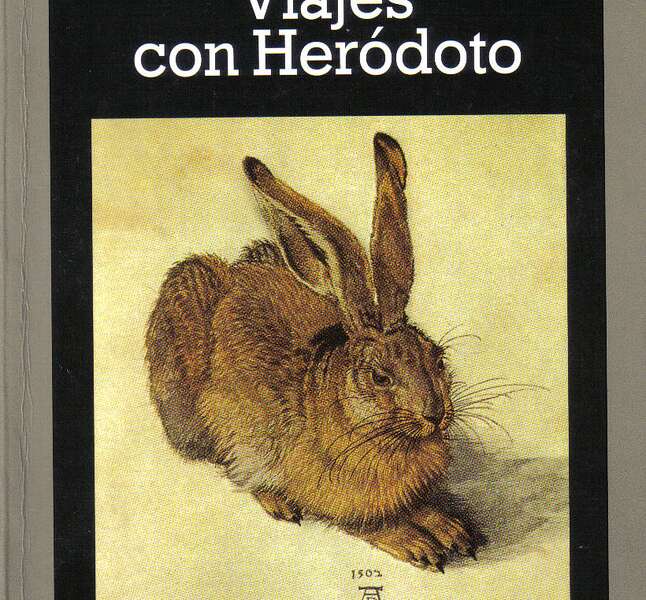
    Kapuscinski reflected on the human and material costs of the construction — real or discursive — of walls. An exercise we could try in our own country. How much has isolation cost us? How many resources have been spent on trenches, tunnels for war, aggressive diplomatic campaigns, indoctrination in schools to foment the idea of a foreign enemy? How many lives have been destroyed, diminished or terminated because of these walls erected for the benefit of a few? « The wall serves not only to defend oneself… it allows one to control what happens within it, » reads Travels with Herodotus, and it’s painful that 60 years later it continues to be a reality in so many places.


    My blog, GENERATION Y, has moved: READ IT HERE.

    Read me and other Cuban bloggers on TRANSLATING CUBA.

    And here is a link to my blog IN OTHER LANGUAGES.

    Read the original post:
    Kapuschinski and Walls

  • A friend called me yesterday. He was nervous. All around his house the police were engaged in an intense « cleansing. » The reason for such concern was that this retiree with no pension has an illegal satellite antenna with which he provides TV service to several families. So, when the forces of order get strict, my friend has to cut the cables, hide the dish and give up the service fees he earns for several days. A real economic disaster for him. Whenever he hears about an international summit, a meeting with invited foreigners, or some dignitary visiting from another country, he starts to fear for his business. He knows that each of these events corresponds to a police raid carried out with zeal and intransigence.

    When Pope Benedict XVI visited the Island, hundreds of beggars, prostitutes and dissidents were « taken out of circulation. » The phone company, Cubacel, also did its part, cutting service to 500 users across the country. Now, the second Summit of the Community of Latin American and Caribbean States (CELAC) is coming our way, to be held in January in Havana. Already truckloads of flowerpots have appeared, with plants that will be watered only for the two weeks they are located along the main avenues. In some central streets scaffolding is rising, with housepainters who are coloring over the cracked and blackened walls. They are also retouching the traffic signals along the route where the guests will pass, and even the old chipped billboards are being replaced by others.

    The clandestine and officially « unpresentable » Havana has been warned that it must be quiet, very quiet. The beggars are being held until the Summit is over, the pimps warned to maintain control over their girls and boys, while members of the political police visit the homes of the opposition. The illegal market is also being held in check. « Calm down, let’s have a little calm, » the police repeat in a threatening tone, without ever leaving written notification. So my friend started this morning. He is disconnecting his equipment and called me again to assure me that on the 28th and 29th he won’t even think of putting a foot in the street. « Not at all! I have no desire to sleep in a dungeon, » he told me, before hanging up the phone and locking away his antenna.


    My blog, GENERATION Y, has moved: READ IT HERE.

    Read me and other Cuban bloggers on TRANSLATING CUBA.

    And here is a link to my blog IN OTHER LANGUAGES.

    See the original post:
    Cuban Regime ‘Cleans Up’ Before Foreign Dignitaries Arrive

  • http://www.cubantrip.com/wp-content/uploads/2014/01/448fCELAC_Habana.jpgHier un ami m’a appelé. Il était nerveux. La police était en train de faire un sérieux “nettoyage” autour de chez lui. Il avait de bonnes raisons d’être dans cet état, car ce retraité sans pension vit des revenus d’une antenne parabolique illégale à partir de laquelle il assure un service à plusieurs familles. Aussi, quand les forces de l’ordre deviennent strictes, mon ami doit couper des câbles, cacher la parabole et arrêter de gagner les parts d’abonnement correspondantes. Un vrai désastre économique pour lui. Dès qu’il entend parler de la tenue d’un sommet international, d’une rencontre avec des hôtes étrangers ou d’une visite de dignitaires d’un autre pays, il se met à craindre pour son commerce. Il sait qu’à chacun de ces événements correspond une razzia policière conduite avec zèle et intransigeance.

    Lorsque Benoît XIV a visité Cuba, des centaines de mendiants, de prostituées et de dissidents ont été « écartés de la circulation ».L’entreprise de télécommunications Cubacel a tenu son rôle en coupant un demi-millier d’utilisateurs dans tout le pays. Aujourd’hui nous tombe dessus le second Sommet de la Communauté des Etats Latino-américains et Caribéens (CELAC) qui tiendra session jusqu’à fin janvier à La Havane. Aujourd’hui on peut voir les camions pleins de pots de fleurs, et de plantes que l’on arrosera à peine pendant deux semaines et que l’on trouvera dans les principales avenues. Dans certaines rues du centre-ville on dresse des échafaudages recouverts de peintures grossières qui mettent de la couleur sur les murs lézardés et noircis. On replace aussi les panneaux de signalisation sur l’itinéraire des invités et même les vieilles clôtures défoncées sont remplacées par de nouvelles.

    La Havane clandestine et officiellement non présentable a été informée qu’elle devait rester tranquille, très tranquille. Les mendiants ont été reclus jusqu’à la fin du Sommet, les proxénètes priés de contrôler leurs filles et leurs garçons, et les membres de la police politique visitent les maisons des opposants. Le marché illégal est aussi à l’arrêt. « Tranquilles, tranquilles »  répètent les policiers sur un ton menaçant, sans jamais laisser leur consigne par écrit. C’est pourquoi mon ami a commencé ce matin à débrancher ses équipements et m’a rappelée pour me confirmer que les 28 et 29 janvier il ne pense pas mettre un pied dehors. « C’est sûr, je n’ai pas envie d’aller dormir en prison » m’a-t-il dit avant de raccrocher et de mettre sa parabole à l’abri.

    Traduction Jean-Claude Marouby

    Taken from:
    Le Sommetde la Communauté des Etats Latino-Américains et Caribéens (CELAC)


  • Terminal 3 at José Martí International Airport

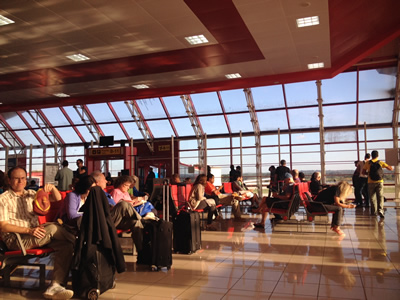
    This time she couldn’t enter the terminal to watch him leave. A sign warns that the interior of José Martí International Airport can only be accessed by travelers, not their companions. So she said goodbye at the door. He is the second son who has left since Immigration and Travel Reform was implemented a year ago. For her, like so many Cubans, it’s been a year of goodbyes.

    In the first ten months of 2013 some 184,787 people traveled outside the Island. Many of them for the first time. Although the official statements try to deny that people flee the country, more than half of all travelers hadn’t returned as of the end of November. Nor do we need the numbers. It’s enough for each of us to just look around to quantify the absences.

    From the personal and family point of view each trip can transform a life. Whether escaping for good from a country where you don’t want to live, learning what exists on the other side, rediscovering relatives or simply some time away from the daily routine. The question is whether the sum of all these individual metamorphoses serves to change a nation. The answer — as with so many things in the world — can be a « yes » and a « no. »

    In the case of Cuba, the departures have served, in part, as an escape valve for the dissent. The most rebellious sector of society packed its bags to leave for a short or a long time. The government took advantage of this and also of the material benefits of the journeys, which result in more remittances sent, more imported consumer goods, and more airport taxes collected. The smokestack-free travel industry.

    For civil society activists who took international tours, the opportunity was extraordinary. Bringing their voices to places where, before, only officialdom was heard, has already been a good step forward. They have been able to get closer to the topics debated in the world today and this has helped them to modernize their approaches, to better define their civic role and to involve themselves in issues that transcend national frontiers.

    During all this time, however, they have refused to let the former prisoners of the Black Spring travel outside the country. Also the number of exiles blocked from entering Cuba has maintained an upward trend. Lamentably, after the huge headlines announcing Decree-Law 302, those dramas did not find sufficient coverage in the international press or organizations.

    A good part of the population still can’t afford a passport. For all these Cubans, the Immigration and Travel Reform takes place only in the lives of others, on television screens, or in the pages of newspapers. Coincidentally, this is the same sector that still has not been able to contract for a mobile phone, stay in a hotel, or even peek into the markets for houses and cars.

    So 2013 was a mix of suitcases, goodbyes, returns, names added to phone directories, sighs, long lines outside the consulates, reunions, listings of homes for sale to pay for airplane tickets… A year for leaving and a year for staying.


    My blog, GENERATION Y, has moved: READ IT HERE.

    Read me and other Cuban bloggers on TRANSLATING CUBA.

    And here is a link to my blog IN OTHER LANGUAGES.

    See more here:
    Cuba: One Year of Immigration And Travel Reform… What Changed?

  • http://www.cubantrip.com/wp-content/uploads/2014/02/b277android.jpg

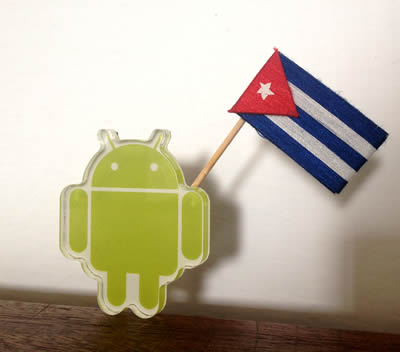
    C’est un robot vert avec des antennes de tous les côtés. On le voit sur les annonces des réparateurs de téléphones portables, sur certains T-shirts attrayants ; et il nous regarde même sur les pare-brise de certaines voitures.

    Non seulement l’icône d’Android est présent dans beaucoup d’endroits à Cuba, mais le système d’exploitation de Google a lui-même gagné en popularité l’année dernière. La créature basée dans Linux réside dans la plupart des téléphones intelligents entrés dans le pays légalement ou illégalement.

    Si nous jetons un œil sur ce que contiennent ces smartphones, nous remarquerons la prévalence d’applications offline. Les usagers locaux préfèrent celles qui fonctionnent sans accès à internet, pour pallier les limitations imposées par la vie dans « l’île des déconnectés ».

    Il y a une grande demande pour les cartes de tout le pays, les encyclopédies illustrées, les traducteurs dans diverses langues, les jeux de rôle et les outils du quotidien.

    Après avoir enquêté parmi les divers usagers et les boutiques de téléphones on peut dresser une liste des dix applications les plus populaires d’Android à Cuba :

    • WikiDroyd: Une version de la célèbre encyclopédie interactive Wikipedia, qui inclut non seulement le texte des fiches, mais aussi leurs illustrations. Elle fonctionne sans connexion à internet, mais il faut charger la base de données sur le téléphone. Il suffit d’en faire la demande au technicien pour avoir la version la plus à jour en Espagnol avec presque deux gigabits de volume.
    • EtecsaDroyd : Copie piratée de l’annuaire téléphonique de l’entreprise ETECSA. Elle comprend le nom complet, le numéro de la carte d’identité et même l’adresse personnelle de chaque abonné. Bien que cette information doive normalement être bien protégée et non d’utilisation publique, elle est filtrée chaque année et finit sur les ordinateurs et les téléphones portables de milliers de gens. Un nouvel exemple de ces choses interdites et que tant de cubains font.
    • WiFi Hacker: Outil servant à « hacker »les réseaux WiFi et accéder gratuitement au web. Cela peut sembler un peu inutile dans un pays où il y a peu de connexions à internet sans fil…mais on ne sait jamais.
    • Revolico : une version non autorisée du fameux site d’annonces Revolico.com. Dotée d’une interface sensible, cette application permet de décharger les annonces d’achat vente dans différents domaines. Son utilisation s’est développée rapidement, étant donné la croissance rapide du marché illégal ou alternatif, au détriment des marchés d’Etat très chers et peu achalandés.
    • Go SMS Pro: Magnifique outil de messagerie, pour gérer SMS et MMS. Bien supérieur à l’application native de même finalité sur Android. Fond clair, multiplicité des thèmes pour changer la charte graphique, correcteur d’orthographe et même une configuration agréable de pop-ups annonçant l’arrivée de nouveaux messages.
    • Gestor de ficheros ASTRO: Permet d’administrer les archives contenues dans le portable ou la tablette. Pour ceux qui aiment fouiller dans les dossiers et les répertoires, cette application les aidera. Effacer, copier, renommer et retrouver certains fichiers peut se faire en quelques clics.
    • Photo Studio: Découper une photo, lui appliquer un bon filtre de couleurs ou simplement la retoucher, n’avait jamais été aussi facile. Vous pouvez sélectionner une image en haute définition et la réduire à la taille qui permet de l’envoyer par MMS (Multimedia Messaging System), ce qui n’est possible à Cuba  que jusqu’à 300 kilobits par envoi.
    • OfficeSuite Pro: Pour ceux qui emportent leur bureau partout avec eux, voilà un merveilleux outil pour écrire, noter et saisir les idées qui nous arrivent dans les endroits les plus incroyables. Il permet aussi de créer et lire des archives d’Excel, Power Point et Adobe Reader.
    • Linterna: Dans les salles de cinéma obscures où manquent les ouvreuses, ou dans ces escaliers sans une seule ampoule, une chose aussi simple qu’une lanterne nous évitera de trébucher. Avec de telles fonctionnalités on comprend qu’un téléphone puisse aussi se comporter de façon simple mais indispensable.
    • OsmAnd: Fait partie d’une série d’applications très appréciées pour offrir des cartes offline. Parmi celles-ci on trouve  aussi OruxMaps, City Maps 2GO, MapDroyd, Soviet Military Pro. Bien que le GPS ne soit pas disponible, la géo-localisation fonctionne assez bien grâce à la triangulation des antennes de téléphone portable. Il y a également des plans de rues très détaillés des principales villes cubaines, mais dans les zones rurales, la description des chemins n’est pas aussi précise. Dans un pays où les routes et les rues sont affreusement mal signalées… cet outil est presque un miracle.

    Traduction Jean-Claude Marouby

    pantalla_android

    See original article:
    Les 10 applications d’Android les plus populaires à Cuba

  • We live in a society of alchemists. They don’t turn iron into gold, but they are skilled at replacing ingredients and adulterating almost every product. Their goal is to cheat every client or to steal from the state itself. To achieve this they use even Mendeleev’s periodic table in search of elements that can be replaced by cheaper ones.

    Some of these ingenious formulas deserve an Anti-Nobel in Chemistry, especially for their negative effects on human health. Such is the case with a lengthy recipe for tomato sauce that includes beets, boiled sweet potatoes, spices, cornstarch and red hair dye. When a curious observer asks, « And the tomato? » the inventors respond, almost scolding, « No, there’s no tomato. »

    So the streets are full of glue sticks that, when you press them, only contain air. Bottles of shampoo mixed with clothes-washing detergent. Soap with plastic shavings added by the employees at the factory who resell the raw materials. Bottles of rum that come off clandestine production lines with hospital alcohol and burned sugar to simulate aging. Bottled water refilled from some tap and offered for sale on the shelves of many markets.

    Needless to say, the imitations of Cohiba cigars and other brands are sold to naive tourists as if they were authentic. Nothing is what it seems. A good part of the population accepts these deceptions and feels a certain solidarity with the cheaters. « People have to live somehow, » they justify, with even the most injured treating it like a joke.

    Within the long list of what is falsified, rationed bread occupies first place. This is the most adulterated product in our basic food basket, its formula lost decades ago due to standardization and the diversion of resources.

    In the bakeries, the « alchemists » have reached the heights of true genius. They add huge amounts of yeast to the dough to make it rise so much that we get « air bread, » which leaves us with sore gums and unfilled stomachs. And don’t even mention the substitution of baking flour for other uses in the making of pasta and noodles. With this process we end up with something in our mouths that is hard, dry and flavorless. Best not to look before you eat, because the appearance is worse than the taste.

    If Paracelsus were resurrected, he would have to come to this island. He would learn so much!

    My blog, Generation Y, has moved. Read it here.

    Read me and other Cuban bloggers on Translating Cuba.

    And here is a link to my blog in other languages.

    Read More:
    Cuba: A Society of Alchemists and Liars

  • On the couch there’s a stuffed dog missing an eye and losing an ear. Thirty years ago he was the plaything of a little girl who now has two children. Neither of them is old enough to have experienced the ration market when it offered manufactured products. So when their mother explains that the dog was a « basic category » toy, they look at her as if she’s speaking Chinese.

    For them, everything is different. Since they were small they’ve known that toys are only sold in hard currency. Sometimes when they go to the big market in Carlos III Street, they press their noses to the glass in front of a pink pony and a plastic house with a fireplace.

    The two distinct generations are united by a similar unease. In her thirties she experienced the era of Soviet subsides and regulated distribution of everything… or almost everything. Her children, for their part, have lived in times of a dual currency system and scarcities. For her, Three Kings Day isn’t celebrated on 6 January, rather it was officially moved to July and given another name, but her children have seen the frantic rebirth of many traditions.

    In the eighties the grandmother of that little girl with the stuffed dog whispered to her the story of Balthasar, Melchior and Gaspar. Once she grew up she taught her own offspring — openly — the ritual of the letter with requests and the water ready for the thirsty camels.

    Today that girl of days past greets the dawn outside a toy store very different from those of her childhood. No employee will demand a ration book with coupons to tear out and checkboxes where the number assigned to each product is entered

    Now there are convertible pesos — that hard currency she doesn’t receive her salary in — the only money that will give her children access to the dolls, the toy cars, or simply to some marbles.

    She manages to buy a plastic flute and the tiniest stuffed dog. He has big floppy eats and blue eyes.

    Yoani’s English Language blog is here, and her posts also appear in TranslatingCuba.com here, along with those of over 100 independent voices writing from the Island. You can help translate Cuban bloggers at HemosOido.com here.

    Read the original:
    Cuban Parents Need Hard Currency to Buy Their Children Toys