Catégorie : droits de l’homme

Situation des droits de l’homme à Cuba, répression et prisonniers politiques


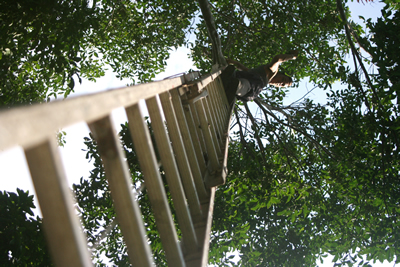
  • To climb to the sky… you need a big ladder and a little one. Photo: Silvia Corbelle

    Any day is a good day to start a project, to realize a dream. However, at the beginning of each year we repeat the ritual of setting goals for the coming 12 months. Some of them will be met, others will remain unfinished and added to the agenda for the following January. There are those that address personal matters, like having more time for family, playing sports, making that postponed visit to the dentist… but the list can also be tilted toward professional aspirations such as changing jobs, finishing some research, getting a degree in a new subject.

    I’ve asked some friends and acquaintances what their desires are for 2014 and the answers are a kaleidoscope of intentions. From « get strong in the neighborhood gym, » « sell the biketaxi to buy a motorcycle, » « fix the roof »… to « finish my university degree, » « reunite the whole family in Miami, » « make a video, » or « open my own snack bar. » Visas to emigrate remain among the commonly shared desires, particularly for young people. To the point that many professional plans are primarily aimed at accumulating resources so as to be able to leave the country. Nearly six years after they were begun, the so-called « Raul reforms » have not managed to significantly improve our individual standard of living or the national economy.

    Personally, after a 2013 that changed my life, my sequence of projects is so diverse as to be impossible to complete in its full scope. I will continue offering courses to teach people how to use the new technologies. This year my dream of an independent digital media will finally see the light, a project that has had me running all over the place the last few weeks. Like all births it will bring rupture, pain, joys and anxieties. In the coming weeks I will publish the schedule for the « birth. » Stay tuned.

    In my room there is a mountain of books that I would like to read for the first — or the umpteenth — time. How deluded am I to believe I will have the free time to do it?! I want to return to the pages of the masterful Kapuscinski, reconnect with Truman Capote, and find some texts of Javier Cercas that are missing in my library. I will continue to devour magazines about apps, gadgets, software… because, I confess, every year I am little geekier.

    Friends and readers have an important place in my annual plans. Hopefully I can pamper you a little more, spending time in good conversation with a coffee in front of us. To those who are far away, I only hope that « the gods of technology » will take pity on me and give me greater access to the Internet so that I can answer your emails. But you already know, Olympus is capricious and Zeus does not release the lightning bolt of connectivity.

    My house, my little family, my plants and animals, which complicate my life and make it happy, are also among the priorities. I can’t complain, really, because they don’t ask for much and they give me everything. I hope to review with my son his first lessons in philosophy, and to bring Reinaldo to that « dirty piece of sea » we made ours twenty years ago. I will focus on them. Because in times of increasing pressure, they have been the people I love who have helped me to keep smiling.

    The center of all my plans is my country. Without it I would have neither home, nor family, nor friends, nor things to write about, not plans to make… nor even a potted yagruma to care for. Although I know that home can be anywhere, mine, I have decided — for good or ill — is located on this Island. I stay, despite so many acquaintances having departed and the continued blocking of the great national potential by an outdated and intolerant power. I stay, also, to help create, through journalism and information, a free, democratic, prosperous and inclusive Cuba.

    As you can see, I have in hand the list of resolutions for 2014. I will have to cross some out along the way. Which? I don’t know. But for now I like to think that all of them are possible.

    Yoani’s English Language blog is here, and her posts also appear in TranslatingCuba.com here, along with those of over 100 independent voices writing from the Island. You can help translate Cuban bloggers at HemosOido.com here.

    Taken from:
    Yoani Sanchez: My Resolutions for 2014
  • 2013-12-31-colchonero450x292.jpg

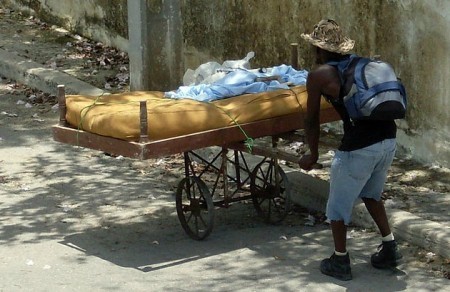
    A woman shouts from the balcony and they stop, along with the cart they are pushing. On the sidewalk itself they set up a workshop. On some boards and in sight of everyone. The broken springs are replaced, enormous needles sew up the edges and the old lining, stained here and there, is replaced with another made from the cloth of a flour sack. Their hands move quickly. In less than an hour they’re done and continuing down the street looking for new customers. A mixture of dust, lint and the accumulated odor of years of intimacy floats on the air.

    Mattress repairers always have work, a lot of work. In a country where many still sleep on the same bed their grandparents slept on, this work is vital. These days experts in padding and bedframes are everywhere. With their spools of thread, they loudly shout out their promises of thirty-day guarantees after the renovation. They repair that which passed its expiration date decades ago, returning a comfortable sleep to those who find some out of place spring poking into their backs every night.

    Also abundant are the scammers. Creators of an illusion that barely lasts and leaves the buyers with pains all over their bodies and in their wallets. They stuff in successive layers of dry banana leaves, plastic fibers or sawdust. Then they cover them with brightly printed fabric, taking special care to tightly stitch the edges. They situate themselves near commercial centers and assure people that their merchandise is « just like in the store. » In a country where a professional needs a year’s salary to purchase a marital mattress, the offerings — outside the state stores — are cheaper, and always very tempting. However, much of the time the advantage turns to frustration in a very short time.

    The scenario repeats itself when the repairers come to a neighborhood. A mother is annoyed by the urine stains that her youngest child has left on the bed. Others are embarrassed because the neighbors will see the successive patches that have been made to their mattress over the years. Phrases such as, « It’s not mine, it belongs to a relative, but I’m doing them the favor of fixing it, » are common. Some appear with an amorphous structure, lacking defined corners and sunken in the middle, that needs more than magic to restore it. « Let me make it like new, » says the repairer, and he starts to move his hands, sink the blade in a few points, and finally name a price.

    More than a restorer of mattresses, he is a restorer of dreams.

    See the original post:
    The Cuban Mattress: A New One Costs a Year’s Wages

  • http://www.cubantrip.com/wp-content/uploads/2014/02/3116image.jpg

    A l’entrée de l’immeuble, se trouve la statue d’un homme, de taille réelle, avec une barbe et des béquilles. Tout le monde se signe devant lui. On a également sculpté à son côté deux chiens, également en bois : des chiens errants, maigres et soumis. La statue de Saint Lazare jouit d’un intérêt particulier lorsqu’on se rapproche du jour de sa fête. C’est un des saints les plus vénérés du pays, et qui fait l’objet des plus grandes démonstrations de dévotion populaire. Son sanctuaire dans le village d’El Rincon, grouille tous les 17 décembre de pèlerins, diseuses de bonne aventure, marchands de fleurs et policiers. Tout autour se réunissent les souffreteux, les nécessiteux, tous ceux qui ont tout essayé et pour qui rien n’a réussi… les abandonnés du sort, de la science et de l’amour.

    Lorsque j’arrive à El Rincon, je ressens cette énergie qui vient de la douleur et de la foi. La léproserie et ses histoires tristes, les campements illégaux qui se sont développés de chaque côté de la voie de chemin de fer et l’odeur des cierges qui brûlent en permanence. Ce n’est pas un lieu de sourires. Il m’est parfois arrivé d’accompagner un ami pour déposer l’offrande promise après la réalisation d’un vœu. J’y suis allée d’autres fois, poussée par cette curiosité que provoque en nous tout ce que nous ne pouvons comprendre ou expliquer. En au moins deux occasions, je suis arrivée au milieu de la nuit du seize sous le toit du temple, et j’ai vécu là des moments difficiles à oublier. Il y a quelqu’un qui pleure et beaucoup de personnes prient ; il fait une chaleur torride et tout le monde transpire ; on sent les plaies ouvertes et la pauvreté. L’Eglise est pleine à craquer.

    Aujourd’hui je suis sortie de chez moi et tout à côté on avait mis un manteau violet sur la statue du vieux Lazare. Un vieil homme qui passait devant s’est incliné pour lui murmurer quelque chose à l’oreille. Lui aussi avait une barbe flétrie et des vêtements qui datent de l’époque des subventions soviétiques, où existait un marché rationné des produits industriels. Je l’ai vu approcher son visage desséché de celui du saint et j’ai fait attention à son apparence. Les deux appartiennent au troisième âge, ils ne peuvent compter que sur ce qu’ils ont sur eux, et n’ont pas beaucoup de raisons de sourire. Les deux si proches, mais l’un sur un autel et l’autre dans la rue. L’un entouré de promesses à accomplir, et l’autre sachant que toutes celles qu’on lui a faites sont déjà brisées.

    Traduction Jean-Claude Marouby

    More:
    Le vieux Lazare

  • 6a00d8341bfb1653ef019b02cf1d16970d-550wi

    There were no great crowds of long lines outside the movie theaters and it didn’t feel like December because of the high temperatures and strong sun. These are the days of the New Latin American Film Festival, but the whole context is very different from 35 years ago when it was founded. The loss of importance of this cultural event is obvious, as is people’s reduced expectations round the Coral awards for the best films. But.. what has changed more? The Festival or us?

    The competition faced in Cuba for any movie is much greater now. Despite our material and technical limitations, our society has seen its access to films, documentaries and TV programs other than those broadcast by the official media skyrocket. Movie theaters have ceded space before home projections or private salons with flat screens and plastic chairs.

    Despite recent prohibitions on the film circuit operated by the self-employed, the phenomenon of « non-institutional programming » is unstoppable. So the Festival of New Latin American Cinema is not a film oasis in the wasteland of Soviet films we experienced in the 80s. Now it must compete with more commercial and dynamic offerings that address a broad spectrum of tastes.

    In the illegal market « combos » or « packages » proliferate, selections of series, reality shows and audience participation films. There are also abundant scientific and historic documentaries and big screen releases. We Cubans are true « Pirates of the Caribbean » when it comes time to copy and distribute recently released movies from other countries. One week after the film Avatar took New York by storm, the savvy marketers in our own backyard were offering a lesser quality — but similar impact — copy on local networks.

    « The Festival » (period… as we call it), had a clear ideological focus from the beginning to promote creations filled with social criticism, a reflection of regional problems or the historic memory of the dictatorships that plagued Latin America. Hence, its current problems in competing for an audience that increasingly wants lighter entertainment — humorous or simply frivolous. From a mass phenomenon, the Festival has become an elite event that tries to compensate for the excess of Hollywood movies, today available everywhere.

    Another element that marks the decline of this film event is the death of its creator and inspiration. Along with all that might have been controversial in the life of Alfredo Guevara, the Festival director, his drive and his personal relations shaped this film festival each December. Like every creature made in the image and likeness of man, the Festival received a very hard blow with the death of its principal author. However, in Cuba we’re already used to the survival of the most inert phenomena, so it shouldn’t come as a surprise in this case that there is another ad infinitum extension, another living-dead.

    For the filmmakers as well, the Havana event has declined in importance. It has become more of a get-together, mojitos in the gardens of the Hotel Nacional, or simply a walk though this theme park of the past that we have become. But to get a Coral award feels more like a remembrance than a present honor. Other places, other festivals, have gained in prestige and media reach in recent decades, to the detriment of an event that hasn’t known how to keep up with the times.

    Its political filter remains an impediment to the rejuvenation of the Festival. Although criticism has gained a space in its offerings, and its directors are not part of the institutional framework, it remains far from being a space without censorship. Another point on which it can’t compete — not even close — is with the underground movie networks, packed with controversial materials. But 35 years on, the International Festival of New Latin American Cinema continues.

    However, it is worth asking whether this is evidence of its good health or the stubbornness of its organizers. Unable to compete with the illegal — and international — networks of film distribution, rocked by the passing of its creator, and given its apparent loss of popularity, this event needs to be renewed. Otherwise, it could end up like that moment of the year when we dust off our nostalgia, going to theaters with broken seats and noisy projectors, to evoke that time when we could only see good movies in December. Two weeks for longing and remembrance.

    Yoani’s English Language blog is here, and her posts also appear in TranslatingCuba.com here, along with those of over 100 independent voices writing from the Island. You can help translate Cuban bloggers at HemosOido.com here.

    View article:
    Cuba’s Outdated Film Festival Carries On

  • These are bad times for the word, gray days for a philologist. The main problem is not the abundance of vulgar expressions, which can even be revealing in a linguistic and sociological analysis. The saddest thing is the decline of articulate speech, the fear of pronouncing words, the expanding silence. « A man who is a man doesn’t talk too much, » a vendor told me this morning when I insisted on knowing if the cupcakes were guava or coconut. Later I received a grunt when I inquired of an official about her office’s opening hours. To top off the day, I got nothing more than shrugged shoulders when asking where the bathroom was in a coffee shop.

    What is happening with the language? Why this aversion to expressing oneself in a coherent manner with well-structured phrases? The tendency to monosyllables is quite worrying, as is the use of signs instead of sentences with subjects and predicates. Who said so many people talking is a sign of weakness? Do adjectives show laziness? The phenomenon is widespread among young men because in the macho code loquacity is at odds with virility. A punch, a sneer, or simple babbling, have replaced fluid and well enunciated conversation.

    « I’m not going to discuss it… » boasted a man, yesterday, to a teenager trying to tell him something. Meanwhile, the latter was shouting, and instead of using words he was waving his hands around as a warning, the preferred code of slaps. The worst thing is that for the vast majority who witnessed the altercation, that individual was doing the right thing: don’t talk too much and get on with the fight. Because for many, talking is giving in, arguing is a sign of weakness, trying to convince people is cowardly. Instead, they prefer shouts and insults, perhaps an inheritance from so much aggressive political discourse. They opt for the almost animal growl and the slap.

    These are bad times for the word, party days for silence.

    Yoani’s English Language blog is here, and her posts also appear in TranslatingCuba.com here, along with those of over 100 independent voices writing from the Island. You can help translate Cuban bloggers at HemosOido.com here.

    View article:
    Fear of the Word

  • I got home from school and there was a man sitting on the floor in front of the TV. His fingers were stained with paint and some oil-paint tubes were scattered around him. It was the latest fad in the neighborhood: painting a colorful pattern on those boring black-and-white screens. The first one to do so was the downstairs neighbor, always up-to-date with the latest trends, which included posters of lightly-clad women taped to the walls, and an enormous porcelain tiger at the entrance to her home. She dictated fashion throughout the whole tenement, so when she transformed her « boob tube » with a rainbow in reds and blues, everyone imitated her. In my house at 218 Krim, they painted some stripes and even a central circle in various tones. Most significant is that years later, I remembered the programs and cartoons I saw on that « invention » as if they’d come to me in their original polychrome. My brain had joined the shades and constructed the illusion of color.

    This personal anecdote comes to me when I read the latest 2012 Statistics from the Census of Population and Housing. On learning that there are still more than 700,000 black-and-white TVs in Cuba, I can’t help but evoke the excited neighbors of my tenement using their fingertips to paint their cathode ray tubes. But in the current figures, there is not only evidence that they are still watching TV programming in black, white and gray… but also that they are economically worse off in our country. They are the ones who have failed to get together the convertible pesos for a modern Sony or LG. Those who probably have no family abroad, who haven’t found a way to divert State resources, or whose privileges ended with the end of the USSR. The poorest who, in a society of such avid TV watchers, don’t have the resources to enjoy the tonalities.

    I wonder if any of those old TVs touched up with stripes in green, purple and cyan still survive… If some child on this island still watches like my sister and me did, mentally joining a piece of color here and another there to imagine Huckleberry Hound was a blue dog, or Cheburashka with his fur brown.

    Now I no longer know, I can no longer distinguish in my memory, between what came to me thanks to the ingenuity of painted screens, or what I enjoyed years later thanks to Technicolor.

    Yoani’s English Language blog is here, and her posts also appear in TranslatingCuba.com here, along with those of over 100 independent voices writing from the Island. You can help translate Cuban bloggers at HemosOido.com here.

    View article:
    The Illusion of Color


  • José Martí International Airport tower

    People crowd together in the suffocating heat, some are holding signs with names printed on them. The flight from Madrid just landed at José Martí International Airport, bringing tourists and many nationals now living in Spain. Each person must wait forty minutes to an hour — at least — before finally passing through the exit door. Havana is one of the world’s slowest airports, the worst lit, and with the fewest services for the traveler.

    In a country that receives almost three million tourists a year, updating its airport facilities is vital for the economy. If these places don’t meet international standards, it’s unlikely that the island — in the short or medium term — can play host to more visitors.

    Aware of its major shortcomings, ECASA (Cuban Airports and Aeronautical Services S.A.) has begun a process of remodeling some of its arrival and departure lounges, but the problem requires more than adjustments and redesign. Its principal limitations are not only material, but also its excessive controls, the lack of comfort, and the attitudes of its employees.

    Departure lounges, restrictions and inadequacies

    Alina has arrived at the Havana airport three hours early, but it may not be enough. She can check in only at the airline counter, as there are no machines to perform the procedures independently. This limitation lengthens the lines, slows the whole process of obtaining a boarding pass, and feeds the image of an always crowded lounge that characterizes José Martí Airport.

    A frequent traveler to Spain, thanks to her new EU passport, Alina has come prepared for a cramped and awkward process. She flies through Terminal 2 because Terminal 3 — larger and more modern — is being remodeled and recently experienced a fire. In her bag she carries a snack made at home, because she knows the prices there are stratospheric and the offerings are very limited.

    Poor signage completes the picture. For ten minutes the frustrated customer looks for a bathroom but the directional signs are scarce and not very visible. Few of the ceiling lights are on, which makes the various areas of the lounge dark. Still, every passenger must pay the airport tax. In the line to hand over 25 convertible pesos ($28 US), one hears the tourists complaining about the tenuous relationship between the price and the quality of the facilities. Cuban passengers, however, remain silent, not wanting to cause problems for themselves just when they’re about to leave the island.

    Without a Wi-Fi network to access the Internet, any modern airport falls several points on the scale of quality. With regards to communication, no embarkation point in Cuba is competitive, not even Varadero. The few public phones and the lack of a wireless network diminish the chances to communicate. To this is added the TVs buzzing away with their tired tourist announcements or overly ideological programs like Cubavision’s Roundtable. Nor is there a stand selling magazines or newspapers, just some souvenir kiosks where they sell the works of Ernesto Guevara and the speeches of Fidel Castro.

    Alina is also prepared to avoid boredom while waiting, and has brought some headphones to listen to music on her phone. She waits at the exit doors — there are only two: A and B — until an employee shouts out that her flight is already checking in.

    Arrivals and the collision with reality

    Humberto arrives after a trip to the United States. This was his first trip abroad, so he’s still stunned by the size of the Miami airport. On the plane back to Cuba he’s filled out the Customs form and in his pocket he has a copy of the boarding pass he got at the exit. He joins the long line for immigration and next will have to answer a brief medical questionnaire which he will also have to sign. A few steps away the luggage waits, the slowest point in the entry to Cuban territory. Every suitcase will be put through a scanner to investigate its contents.

    After analyzing each bag or suitcase, they will attach « markers » to those that need to be inspected. A small red strip tied to the handle may mean it contains some home appliance or computer. If instead, it contains an external hard disk, then they write some initials on the paper strip that identifies the flight. There is no way to avoid this process. The customs officers are trained to keep out a long list of objects.

    Humberto’s granddaughters, born in Coral Gables, have given him a laptop and a smartphone. So he must go to the table where they open his suitcase and minutely search everything. They take the computer to an office, where they probably inspect its files or make a copy of them. He’s already waited an hour and a half since the plane touched down and will probably wait a little longer.

    While they search his belonging they tell him he can’t make calls on his cellphone. « Welcome to Cuba, » he tells himself when an officer asks what those « bullet-shaped » pressed cotton things are. « Tampons for my daughter, » he responds grumpily.

    Two hours after arriving in his own country, Humberto passes through the gate in Terminal 2. At the same time, Alina is already seated on her flight to cross the Atlantic. Looking out the window she whispers, « Goodbye Havana airport, I hope I don’t see you for a long time! »

    Yoani’s English Language blog is here, and her posts also appear in TranslatingCuba.com here, along with those of over 100 independent voices writing from the Island. You can help translate Cuban bloggers at HemosOido.com here.

    Read the original:
    Cuban Airports: The Chokepoint

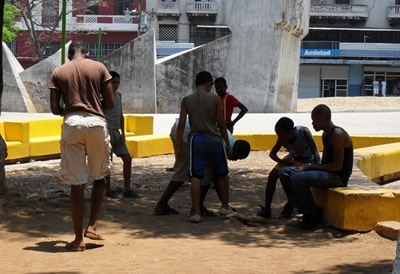
  • Children and teens playing in the street. Photo: Luz Escobar

    Children and teens playing in the street. Photo: Luz Escobar

    « When the teachers aren’t listening, what do the students in your classroom talk about? » I asked my son a few months ago. He barely paused before answering. « The boys talk about football and the women about telenovelas, » he replied, sure of himself. I confess, I expected more. I had imagined slightly risqué topics like sexuality, or problems such as drug use or, in some cases, political controversies. But no, the long minutes of the breaks between one class and another are dominated by Messi, Cristiano Ronaldo, and the latest wickedness of the Brazilian soap and its heartthrob who shows his face on the small screen every week.

    My first reaction was dismay. « If, at the most rebellious age, this is what they talk about… we’re in bad shape. » But then I stopped myself. I was not going to fall into what older people had warned me of when I was a teenager. « Your generation is lost, » they told me, followed by an enumeration of everything they themselves had accomplished. So, before answering Teo, I tried to understand why the reality of the country, its serious problems and possible solutions, occupy so little time — or none — in our young people’s conversations. Apathy, escapism, indifference… were some explanations. After the initial moment of disappointment, I felt relief. Comforted knowing that even this inertia is a way of bringing the current system to an end.

    The Cuban model needs people who applaud wildly, committed soldiers, ideologically convinced individuals. Indolence will never be the soil where rebellion grows, nor will it foster partisan fervor. As I’ve said many times, « I prefer apathy over fanaticism. » From apathy, one can wake up, from fanaticism, I have my doubts. Frivolity is also corrosive to a sober and outdated totalitarianism.

    These young people of today, they still have plenty of time for their civic consciousness to awaken.

    Yoani’s English Language blog is here, and her posts also appear in TranslatingCuba.com here, along with those of over 100 independent voices writing from the Island. You can help translate Cuban bloggers at HemosOido.com here.

    Read the original post:
    For Cuban Youth… It’s All About Soccer and Soap Operas… And That’s a Good Thing