Catégorie : libertés

Les libertés et la répression à Cuba

  • Yesterday I was arguing with a friend about the importance of journalism in the current Cuban situation. He wanted to convince me to join his opposition party and I reminded him that a reporter should not have any kind of militancy. It was an affectionate conversation, peppered with jokes, but one which made clear the different positions that must be taken by a reporter versus a politician.

    Now here I am, remembering the conversation of a few hours ago and posting on my personal blog the face and name of a shared dream. A medium that we hope will support and accompany the necessary transition that is going to take place in our country. A space dedicated to narrating a reality where there are people like my friend, but also other people who applaud the current system, out of conviction, opportunism or fear. A space to report on Cuba from within Cuba.

    It will be a difficult road. In recent weeks we have seen a preview of how official propaganda will demonize us for creating this medium. Already, in fact, several people on our work team have received the first warning calls from State Security. However, we have no reason to be hesitant. 14ymedio emerges with nothing to hide. Information regarding its editorial approach, ethics and financial commitments will be available on our web page which will go live on May 21. Although we had hoped to have it working today, I have to admit that technology is, at times, extremely capricious.

    For those who are wondering why this name, so unique and different, the fact is that we originate from the fourteenth floor in the fourteenth year. In addition, it includes the « Y » that has accompanied me all these years, and the word « media » with all its journalistic connotations. We wanted to shy away from appropriating the name of Cuba for use on our masthead, and instead we have chosen the most universal of codes: numbers.

    Now, all that’s missing is that it pleases you, generates debate, and provides you with information. Thanks in advance!


    My blog, GENERATION Y, has moved: READ IT HERE.

    Read me and other Cuban bloggers on TRANSLATING CUBA.

    And here is a link to my blog IN OTHER LANGUAGES.

    Read More:
    14ymedio: A New Newspaper Is About To Be Born in Cuba


  • Photo from http://www.ojocientifico.com/

    What does the insect caught in the web feel as it watches its predator approach? What are its thoughts in the seconds between the anticipation of the attack and death? It must be a lot like the days in which a repressive trap is built around an individual, a group, a society. Similar to that script that builds the justifications for a blow, molding public opinion, filling in the archive that will later be presented to the press or the courts.

    The current strategy against the Cuban opposition resembles the slow creep of the spider’s legs toward its victim.

    We are living in a soap opera episode-by-episode, an attempt to demonize technologies and the dissidence, who knows if to repeat those dark days of the Black Spring of March 2003. The blow approaches, in the insistence in which the press repeats certain refrains, its obsession with themes like Zunzuneo and trying to link it with the violence of four supposed terrorists recently discovered in the country. Like in a bad TV show, the threads are showing in the tying together of mobile phones, Twitter, death and war. Fortunately these soap operas barely work any more on a Cuban public too focused on their daily needs, overwhelmed by material shortages, saturated with ideology and obsessed more with escapism than with civic consciousness.

    The trap is almost set. Will it be used? Who knows. But there’s not much that can be done to stop it, except to denounce it. At the end of the story the spider is always bigger, stronger, more imposing.


    My blog, GENERATION Y, has moved: READ IT HERE.

    Read me and other Cuban bloggers on TRANSLATING CUBA.

    And here is a link to my blog IN OTHER LANGUAGES.

    Continue Reading:
    Cuba: Repression as Soap Opera

  • Les cris, les banderoles, les slogans récités par des milliers de voix, réveillent en lui des sensations endormies, éteintes. Il regarde la marée humaine qui passe devant la tribune et des pulsations irrégulières battent dans sa poitrine. Le visage rouge, les pupilles dilatées, le poil hérissé, la mâchoire sous tension. Ce sont les premiers symptômes de l’excitation que provoquent les foules sur les leaders.

    Un rituel qui demande de lever la main à certains moments, pour écarter la solitude qu’apporte le pouvoir. Les autocrates s’inventent des marches, d’immenses processions, des défilés fastueux (« les plus grands du monde ») dans lesquels ils jouissent de leur propre autorité. Ils savent qu’eux, et seulement eux, peuvent obliger des millions de personnes à quitter leurs lits (aux premières lueurs du jour), les faire monter dans des bus, relever le nom de chaque personne présente et les faire défiler sur une grande place. Pour faire savoir clairement qui le leur demande, ils font passer le message à travers la foule qui scande leurs noms, les vénère et les remercie.

    Une « masse » qu’ils n’oseraient jamais rabaisser, qu’ils ne fréquentent pas, qu’ils craignent et qu’ils (au fond) n’aiment pas.

    Sur la place de la Révolution, une personne âgée avec des lunettes de soleil préside la cérémonie du premier mai. Plusieurs jours avant, il avait fait inspecter chaque toit à proximité du lieu, il a placé des gardes aux points les plus hauts de la ville et évalué les possibilités de se faire tirer dessus pendant qu’il est à la tribune. Son propre petit-fils se tient à ses côtés pour le protéger et une flottille de voitures l’attendent « au cas où il se passe quelque chose » et qu’il doive s’échapper. Il n’a pas confiance en cette même foule qu’il a pourtant fait venir.

    L’autocrate a peur de son propre peuple. Peur et méfiance. Le sentiment est mutuel. Il sait que les centaines de milliers de petites têtes qu’il voit depuis les hauteurs sont là… parce qu’ils le craignent, et non parce qu’ils l’aiment.

    Lire aussi:

    _______________________________________________________________

    Joyeux 7e anniversaire!

    À l’âge de sept ans, j’avais un sourire incomplet. Je perdais mes dents de lait et je lisais toutes les affiches que je voyais dans la rue. C’était un temps d’apprentissage et de genoux égratignés à force de tomber en jouant. Aujourd’hui, je souffle sur ce même nombre de bougies d’anniversaire, sur un gâteau imaginaire. Cette fois ce n’est pas pour moi, mais c’est pour la créature virtuelle née le 9 avril 2007 et qui est aussi passée par l’étape dentitions, fièvres, rires et chutes.

    Le blog Génération Y fête son anniversaire, avec presque un millier de posts publiés, près d’un million et demi de commentaires, plusieurs amis perdus et d’autres gagnés.

    Durant tout ce temps, je n’ai pas souffert de l’horreur de la page blanche. Au contraire, je sens que ni le temps ni le difficile accès à Internet ne m’ont empêchée de raconter toute cette réalité cubaine qui se montre à mes yeux. Ce blog a désormais sa propre vie. Il respire dans chacun de ses lecteurs et a une existence parallèle où je ne peux le saisir, le cacher, le protéger.

    L’épreuve de la peur du début est passée, de la diabolisation officielle, de la méfiance de tant de gens, des bugs techniques et même de l’instinct de survie qui m’a dit plus d’une fois qu’il fallait tout arrêter. Il est ainsi, avec ses blessures et l’expérience de ses sept années.

    Une nouvelle étape commence bientôt. Génération Y déménage dans sa nouvelle demeure, à l’intérieur d’un journal en ligne, collectif et moderne. Au prochain anniversaire, il y aura d’autres visages sur la photo. Soufflons d’ores et déjà des bougies pour eux !

    Traduit par Aïda

    Retrouvez les articles du HuffPost sur notre page Facebook.

    Pour suivre les dernières actualités en direct, cliquez ici.

    View article:
    Raúl Castro: un homme seul dans la foule

  • Screen Shot 2014-04-23 at 12.32.16 PM

    In these times, when the great media of the press barely seem to survive the crisis, many are wondering, how can we make a good newspaper? The question includes not only choosing content, but also how to make it profitable and the dilemma between digital or paper formats. There are no clear formulas. Small websites become — in a short time — information reference points, while some of the news giants fall into the red and lose readers. No one knows for sure where the press of the future is headed.

    We are used to technological advances and leapfrogging; Cubans will very like jump from an official press under the monopoly of a single party, to a multitude of media pushing to gain prominence. The day when non-government media is legalized, numerous publications — now underground — will be able to be read openly and even sold at the corner newsstand. Although that time is still to come, it’s worth it to begin preparing.

    If I could highlight at least one indispensable feature of the press, I would choose interaction with readers. The close relationship between the writer of the information and its recipient is vital for a newspaper to meet the demands of modernity and objectivity. Right now in Havana, we are putting the final touches on a new digital media that will greatly help us to listen to your opinions. Without you, it would be only a medium talking to itself, ephemeral and inconsequential.

    So back to the main question: How do we make a good newspaper? What are the topics that we should address in its pages? What sections are worth incorporating on the site? How can we involve you in developing the content? Which are the indispensable bylines we should include? What model or example should we follow? And the big question: Can we exercise quality journalism amid the current conditions in Cuba?

    You can leave answers in the comments on this blog, on the Dontknow debate page, or on the CONTACT page. Thanks in advance for helping to give shape to the baby before its birth.

    Originally posted here:
    Launching a New Newspaper in Cuba: How-To?


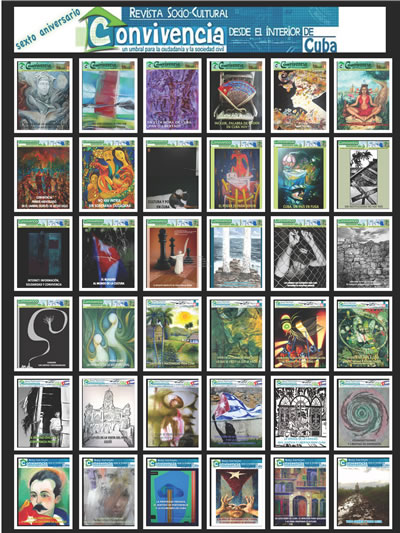
  • Poster for the sixth anniversary of the magazine, Coexistence

    A woman hits a child, who appears to be her son, on one corner. The passersbys who see it don’t get involved. A hundred yards further on, two men get in a fight because one stepped on the other’s shoe. I arrive home thinking about this aggressiveness, just under the skin, that I feel in the street. To relax my tension I read the latest issue of the magazine Coexistence, which just celebrated six years since its founding. I find in its pages an article by Miriam Celaya, who coincidentally addresses this « dangerous spiral » of blows, screams and irritation that surrounds us.

    Under the title « Notes on the anthropological origins of violence in Cuba, » the scathing analyst delves into the historical and cultural antecedents of the phenomenon. Our own national trajectory, steeped in « blood and fire, » does not help much when it comes time to promote attitudes like pacifism, harmony and reconciliation. From the horrors of slavery during the colonial period, through the wars of independence with their machete charges and their high-handed caudillos, up to the violent events that also characterized the republic. A long list of fury, blows, weapons and insults shaped our character and are masterfully enumerated by the journalist in her text.

    The process that started in 1959 deserves special mention, as it made class hatred and the elimination of those who are different fundamental pillars of the political discourse. Thus, even today, the greater part of the anniversaries commemorated by the government refer to battles, wars, deaths or « flagrant defeats inflicted » on the opponent. The cult of anger is such that the official language itself no longer realizes the rage it promotes and transmits.

    But take care! Hatred cannot be « remotely controlled » once fomented. When rancor is kindled against another country, it ends up also validating the grudge against the neighbor whose wall adjoins ours. Those of us who grew up in a society where the act of repudiation has been justified as the « legitimate defense of a revolutionary people, » may think that blows and screams are the way to relate to what we don’t understand. In this environment of violence, for us harmony becomes synonymous with capitulation and peaceful coexistence is a trap that we want to make « the enemy » to fall into.

    See original article:
    Cuba’s Culture of Violence: A Dangerous Spiral

  • The dialogue between the Venezuelan opposition and Nicolas Maduro is in full swing. Its critics are many, its most visible loser: the Cuban government. For a system that for more than half a century has disqualified and reprimanded its dissidents, this discussion table must present a sad acknowledgement of its own inabilities.

    Last Tuesday stunned Cuban viewers could watch a debate between the opposition forces in Venezuela and pro-government representatives. The controversial meeting was broadcast on TeleSur, which is characterized by its tendency to back the work of Chavism with its reporting. On this occasion, however, it was forced to also broadcast the concerns and arguments of the other side.

    The requirement that cameras and microphones would be present at the discussion proved to be a magnificent political move by Maduro’s adversaries. In this way the audience is engaged in the dialogue and it’s more difficult to publish distorted versions later. The participants on both sides were allowed ten minutes each, an exercise in synthesis that the Venezuelan president, clearly, couldn’t accomplish.

    For disinformed Cubans, the first thing that jumped out at us was the high level of the arguments the opposition brought to the table. Figures, statistics and concrete examples expressed within a framework of respect. The next day the most commonly heard comment in the streets of Havana was the popular phrase, « They swept the floor with Maduro. » A clear reference to the crushing critiques of his rivals. The government supporters, however, were notably timid, fearful, and offered a discourse plagued with slogans.

    There is no doubt, this discussion table has been a bitter pill to swallow for those who up until a few hours before were accusing their political opponents of being « fascists » and « enemies of the nation. » Venezuela will no longer be the same, although the negotiations end tomorrow and Nicolas Madura will once again take the microphone to hand out insults right and left. He acceded to a discussion and this marks a distance between the path followed by the Plaza of the Revolution and another that recently began for Miraflores.

    And in Cuba? Is this also possible?

    While the broadcast of the Venezuelan dialogue was airing, many of us asked ourselves if something similar could occur in our political scenario. Although the official press presents these conversations as a sign of strength on the part of Chavism, it has also kept enough distance so that we won’t get illusions of possible Cuban versions.

    It is less chimeric to imagine Raul Castro getting on a plane and escaping the country than to project him sitting at a table with those he dubs counterrevolutionaries. For more than five decades, both he and his brother have been dedicated to demonizing dissident voices, such that now they are prevented from accepting a conversation with their critics. The danger posed by the impossibility of negotiations is that it leaves only the path to an overthrow, with its consequent trail of chaos and violence.

    However, not only do the Cuban regime’s principal figures show reluctance before any negotiating table. The better part of the Island’s opposition doesn’t want to hear it spoken of. Before this double rejection, the agenda of a chimeric meeting fails to take shape. The opposition parties haven’t yet come together on a project for the country that can be coherently defended in any negotiation and look like a viable alternative. We members of the emerging civil society have reasons to feel concerned. Are the politicians now operating illegally in the country prepared to sustain a debate and capable of convincing an audience? Could they represent us with dignity when the time comes?

    The answer to this question will only be known once the opportunity arises. Until now the Cuban political dissidence has concentrated more on tearing down than on elaborating foundational strategies; the greater part of their energy has been directed to opposing the governing Party rather than on persuading their potential followers within the population. Given the limitations on disseminating their programs and the numerous material restrictions they suffer, these groups have not been able to carry their message to a significant number of Cubans. It is not entirely their responsibility, but they should be aware that these deficiencies hinder them.

    If tomorrow the table for a dialogue was set, it would be unlikely that we would hear a speech from the Cuban opposition as well articulated as that achieved by their Venezuelan colleagues. However, although negotiation isn’t a current possibility, no one should be exempted from preparing for it. Cuba needs for the people before those possible microphones to be those who best represent the interests of the nation, its worries, its dreams. They may speak for us, the citizens, but please, do so coherently, without verbal violence and with arguments that convince us.

    See the original post:
    The Venezuelan Dialogue From a Cuban Point of View

  • Better naked than…

    A woman with her breasts bare is an oracle in an ephemeral work of art. It is Havana in the ’80s and the scandal caused by the exhibition « Nine Alchemists and a Blind Man » ends with its closing and the demonization of more than a few artists. The uncovered skin is a challenge, a protest, in a country where power, still today, sheaths itself in olive-green uniforms, long sleeves, hot outfits that hide, instead of display.

    Authoritarians handle nudity badly. They feel impure, dirty, humiliated, when in reality it is the natural and primitive state of human beings. Totalitarians are prudish, prudish and timid. Any libertarian gesture frightens them, and they perceive too much exposed skin as a gesture of defiance. They think this because — deep down — they see the human body as something impure and obscene. Hence, undressing their opponents constitutes one of the repressive practices they most enjoy. They believe that by stripping them of their clothes they reduce them to simple animals. The same mental mechanism that leads them to call their critics « worms, » « vermin » or « cockroaches. »

    In a windowless cell a guard forces a political prisoner to undress; in a room where no one can hear the screams, three women grope around under the clothes of a recently arrested citizen; in a dorm at a school in the countryside the showers don’t have curtains so no student can possess the territory of her own body; in a cold gray room the Jews were stripped of their clothes before entering the gas chambers. Undressing to humiliate, undressing to dehumanize, undressing to kill.

    The images coming from Venezuela confirm that the practice of stripping people of their clothes as a moral punishment continues. A young man is stripped by a group seeking to degrade him by exposing every inch of his skin. However, they end up making him into a beautiful icon, pure, innocent. There is nothing dirty about the human body, there is nothing to be embarrassed about appearing before others as we came into this world.

    What is shameful is these others, hiding behind their uniforms, trappings, the military ranks they awarded to themselves. They should be embarrassed to be hiding under the dishonorable garb of their fear.


    My blog, GENERATION Y, has moved: READ IT HERE.

    Read me and other Cuban bloggers on TRANSLATING CUBA.

    And here is a link to my blog IN OTHER LANGUAGES.

    Visit site:
    #MejorDesnudosQue: Better Naked Than


  • Photo: Silvia Corbelle

    The whole neighborhood called him by the peculiar last name he’d inherited from his Basque grandfather. Vertical for ideological reasons, he always made it clear that he was « a man of the cause. » Meeting after meeting, report after report, complaint after complaint, few exceeded him in offering proofs of faith in the system. He was also characterized by his severe face against the protestors and the hugs he gave to those who shared his ideology. And so it was, until a week ago.

    The family tree bore fruit and the combative man just managed to get his Spanish passport.* In his Communist Party nucleus they told him to choose: foreign nationality or continuing to be a member of that organization. Faithful, but not stupid, he chose the first. As of a few days ago he premiered his new life without red card or statutes. He has already started to wink at some of the dissidents in the neighborhood. « You know you can always count on me, » he blurted out at someone who, until recently, he’d always kept a watch over.

    It’s a curious party organization that brags about exercising internationalist solidarity, but doesn’t want dual nationality communists in its ranks. At least such narrow-mindedness is helping to convert certain extremists into « meek foreigners. » Given the speed with which they change, one wonders if they previously believed in what they were doing, or were simply opportunists. Perhaps in preferring an EU passport they are just choosing a different mask, a new tone for their chameleon skins.

    *Translator’s note: Spain’s Law of Historical Memory set a limited period during which Cubans who could prove a Spanish grandparent qualified for Spanish citizenship.


    My blog, GENERATION Y, has moved: READ IT HERE.

    Read me and other Cuban bloggers on TRANSLATING CUBA.

    And here is a link to my blog IN OTHER LANGUAGES.

    See the article here:
    Militant Cuban Communist Trades Ideology for a Spanish Passport in the Blink of An Eye