Catégorie : libertés

Les libertés et la répression à Cuba

  • « The newspaper was talking about you… » sings the voice of Joaquín Sabina, while I read the newspaper Granma. On the cover, as usual, there’s some event. A tribute to a figure from the past, a reminder, a phrase someone said forty or fifty years ago. All the pages have this rancid stink of journalism that doesn’t dare to address the present, that avoids the here and now.

    The Cuban official press can’t reform itself because to do so would be committing suicide. To report on the national reality it would have to renounce its role as ideological propaganda. It’s not enough to change the design of its digital sites, add new signatures to its articles, or keep the readers’ letters complaining about bureaucrats and corruption. It must go further and shed its political commitments and take on the truth as its only obligation. But this… this we know it cannot do.

    I expect more from the press that will emerge, or consolidate, than a « new official journalism. » But I am also aware that the work of reporting from civil society, precarious and illegal, has to improve. Information is not trench warfare and it is not a weapon. Events should not be reported from the point of view of what we want to have happened, but from what did happen.

    For its part, thematic variety is not contrary to the defense of freedom and human rights. There are many ways of speaking, and of speaking beautifully. We must search, then, for ways of reporting that bring us closer to ordinary readers. Creativity, daring and diverse points of view help us to be better professionals of the press. Going down that path is worth it.

    For my part, I’m taking the first steps. The countdown to the digital media I’ve been working on for four years has begun. A new professional challenge approaches, but I will not be alone; rather I will be accompanied by a team of talented people who want to do journalism with a capital J.

    In the coming weeks this personal blog will be transformed–right in front of your eyes–into a media of the PRESS. Words of encouragement are welcome!


    My blog, GENERATION Y, has moved: READ IT HERE.

    Read me and other Cuban bloggers on TRANSLATING CUBA.

    And here is a link to my blog IN OTHER LANGUAGES.

    Link:
    The Countdown to an Independent Newspaper in Cuba Has Begun
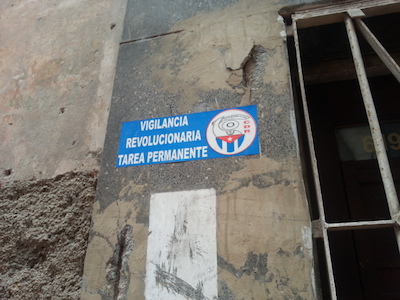

  • Revolutionary Vigilance, a Permanent Task

    He raised his hand at the meeting. The director had told them « don’t hold back, » so he took advantage of the chance to say what he’d remained silent about for months. He started with the very low wages paid to public health workers. Then he talked about the dirty bathrooms, the water shortages, that the only sterilizer was broken, the leaks all over the hospital. He continued with the heat in the waiting room packed with patients and the lack of surgical instruments. He finished up with the exclamation, « it’s more than anyone can stand, » which plunged the room into a heavy and uncomfortable silence.

    At the end someone approached him to say that his criticism hadn’t been constructive but merely a catharsis. So he didn’t speak again at any other meeting.

    Behind the argument of looking for opportune and uplifting criticisms, hide those who in reality do not want any kind of criticism. For them, being proactive means bowing and preceding every statement with a flattering phrase. One should never, according to these encouragers of applause — question the system, much less the inefficiencies that don’t allow it to function. Being « constructive » amounts to not calling to account the current leaders of the political process, much less questioning the ideological model. One also needs to show a blind faith that everything will be resolved with « wise leadership » at the highest levels.

    If someone deviates from the script of tolerated criticism, the disqualifiers will rain down upon them. Chip on the shoulder, whiner, crybaby… will be the first insults, although later it’ll move on to the already hackneyed « CIA agent, » « counterrevolutionary » or « enemy of the nation. » Their observations will never find the opportune moment, because they don’t include submission or self-blame.

    Criticism doesn’t need a name. It doesn’t need to be classified as « constructive » or « destructive, » but it should be delivered with total rigor, regardless. Like rubbing medicine on a festering sore, criticism hurts, it makes you cry, it’s torture… but it cures.


    My blog, GENERATION Y, has moved: READ IT HERE.

    Read me and other Cuban bloggers on TRANSLATING CUBA.

    And here is a link to my blog IN OTHER LANGUAGES.

    View post:
    Asking For Criticism and Then Calling the Messenger a Counter-Revolutionary


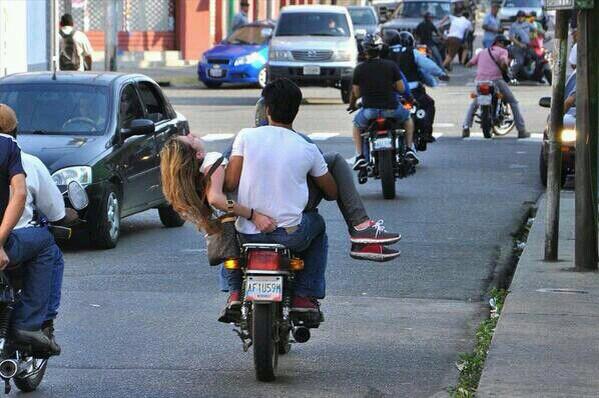
  • Genesis Carmona, college student and local beauty pageant winner shot in the head during the protests, being rushed to the hospital, where she died. Photo from runrun.es

    They say no one learns a lesson through someone else’s head, that we repeat the mistakes of others and stumble, over and over, on the same stone. Skeptics assure us that people forget, close their eyes to the past and commit identical mistakes. Venezuela, however, has begun to disprove that inevitability. Amid a reality marked by insecurity, shortages and inflation, Venezuelans are trying to amend a mistake that has lasted too long.

    Taken over by Cuban intelligence, monitored from the Plaza of the Revolution in Havana, and ruled by a man who incites violence against those who are different, this South American nation now finds itself facing the most important dilemma of its contemporary history. Totalitarianism or democracy, those are the options. What is being decided in its streets is not only Nicolás Maduro’s permanence in power, but the very existence of an axis of authoritarianism and personal ambition that spans all of Latin America. A system that disguises itself with empty words in the style of « socialism of the 21st century, » « a revolution of the humble, » « the dreams of Simon Bolívar » and « the new left, » whose fundamental characteristics are its leaders’ lust for power, economic inefficiency, and the curtailing of freedoms.

    But Venezuelan students have given Chavismo a dose of its own medicine. Young people and college students have been the driving force of the protests this time. Which proves that Miraflores has lost the most rebellious and dynamic part of society. Although the headlines in the government controlled press speak of conspiracies fomented from abroad, it’s enough to look at the images of the police and the armed commandos beating the protestors to understand where the violence comes from.

    Venezuela is going through difficult times, like all awakenings. The oligarchs in red will not give up power voluntarily and Raul Castro will not let them so easily snatch away the goose that lays the golden egg. But at least we already know that Venezuelans will not walk the same road they imposed on us in Cuba. Meekness, fear, complicity, and escape as the only way out… those have been our mistakes. Venezuela doesn’t want to repeat them, it can’t repeat them.


    My blog, GENERATION Y, has moved: READ IT HERE.

    Read me and other Cuban bloggers on TRANSLATING CUBA.

    And here is a link to my blog IN OTHER LANGUAGES.

    See the original post:
    Venezuela, With Eyes Wide Open


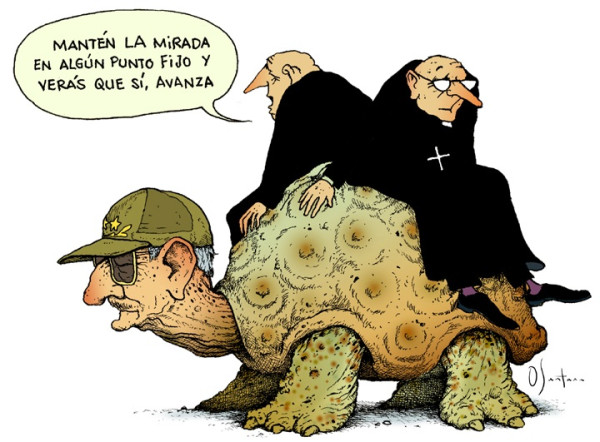
  • Focus on a fixed point and you’ll see that we are, in fact, advancing. Graphic humor from Santana

    Everything moves clumsily, heavily. Even the sun seems to take longer than normal up there. The clock knows nothing of precision and the minute hand is stuck. Making an appointment with the exactitude of three-fifteen or twenty-to-eleven is the pure pedantry of those in a hurry. Time is dense, like guava jam with too much sugar.

    « If you hurry, your problems double, » the clerk warns the customer anxious to get home early. The man sweats, drums his fingers, while she cuts her really long fingernails before even hitting a key on the cash register. The line behind him also looks at him with scorn, « Another one who thinks he’s in a big hurry, » says an annoyed lady.

    We live in a country where diligence has come to be interpreted as rudeness and being on time as a petulant quirk. An Island in slow motion, where you have to ask permission from one arm to move the other. A long crocodile that yawns and yawns as it lolls in the Caribbean waters.

    Someone who manages to complete two activities in one day might feel fortunate. It’s common not to be able to find ways to do even one. There’s a hitch at every step, a sign that says, « Today we’re closed for fumigation, » « We don’t serve the public on Friday, » or Raul’s phrase, « Without hurry but without pause. » Delay, postpone, suspend, cancel… the verbs most conjugated when you face any procedure or paperwork.

    The turtle’s pace is everywhere. From the bureaucratic offices and the bus stops to the recreation and service centers. But the big winner of the award for having « the blood of a turnip » is the government itself: Three years after the fiber optic cable was connected between Cuba and Venezuela it is still impossible to contract for a home Internet connection.

    Two decades of the dual monetary system and they still haven’t published a schedule for the elimination of this economic schizophrenia. Fifty-four years of single-party government and there is no sign of a day when we will have the right to free association. Half a century of government blunders and mistakes and they haven’t even begun to hint at an apology.

    At this rate, one day they’ll re-baptize the Island « Never Never Land, » a place where clocks and calendars are banned.


    My blog, GENERATION Y, has moved: READ IT HERE.

    Read me and other Cuban bloggers on TRANSLATING CUBA.

    And here is a link to my blog IN OTHER LANGUAGES.

    View the original here:
    Am I Living in Cuba, or Never Never Land?


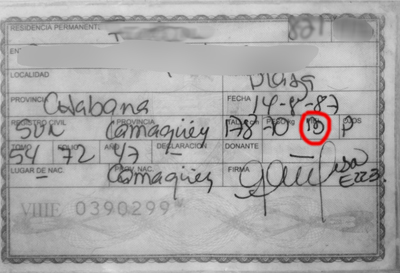
  • Backside of the Cuban Identify Card with a box for « Skin »

    It’s just been born and in a few hours they will register the baby with its brand new name. A few days will pass before the parents get the birth certificate and then the so-called « minor card. » Without an identification card you can’t receive products from the ration market, enroll in school, get a job, travel on an inter-provincial bus, or put your belongings in a bag-check at a shop. Every day of your life you need this document, which at the top carries a unique combination of eleven digits. On the little piece of cardboard your temporal and geographic data is registered… and also certain physical details.

    It looks just like a letter on the back of the identity card, but it is an initial that describes the color of our skin. This consonant classifies us as one race or another, divides us into one group or another. Amid repeated institutional calls to end discrimination, the Cuban Civil Registry still maintains a racial category for every citizen. Along with the date of our birth, and our address, it specifies if we are white, mixed or black. The assignment of a « B, » « M » or « N, » (Blanco-white, Mestizo-mixed, Negro-black), in a nation with so much race mixing, is often the result of a functionary’s subjective judgement.

    Amid so many priorities, so many rights to demand and injustices to end, it might seem trivial to demand the withdrawal of a letter on our identify card. However, its small presence doesn’t diminish its gravity. Especially when the document itself already has a photo of its holder, where you can see his or her physical features.

    No citizen should be evaluated by the color of their skin, nor placed in a category according to the amount of pigment they carry in their epidermis. Such bureaucratic backwardness speaks more to prison files than civil registries. It’s not a question of melanin, but of principles.


    My blog, GENERATION Y, has moved: READ IT HERE.

    Read me and other Cuban bloggers on TRANSLATING CUBA.

    And here is a link to my blog IN OTHER LANGUAGES.

    More:
    Race and Identity in Cuba


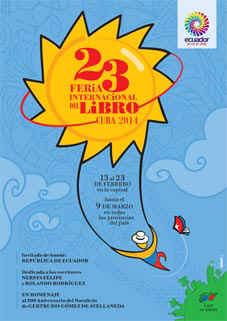
  • Behind the shelves there is another International Book Fair. One barely perceived among the partitions and walls of the exhibition areas. The national newspapers will never report on it, but these parallel and hidden events sustain the other one. A network of hardship, endless workdays and poverty-level wages, support the main publishing showcase on the island. For each page printed, there is a long list of irregularities, improvisations and exploitations.

    The Cuban Book Institute (ICL) is the principal organizer of this celebration of reading that is held every February. However, the state entity that controls literary production is overwhelmed by the lack of resources and corruption scandals. Its director, Zuleica Romay, asked to step down weeks before the start of the book fair. However, it’s still unknown if she will be granted « liberation » from her responsibilities, or will « follow her duty » to maintain her position.

    Many of the people who worked on this twenty-third edition of the Fair played the role of the ants who prevent the collapse of the anthill. The « credits » chalked on the Cuban government’s account are the fruit of personal sacrifices and violations that no union would demand: lunches delayed or missed completely, editorial decisions that can’t be taken because first « you have to consult the comrade from State Security, » workers who bring resources from their own homes to decorate the place, books that travel in the trunk of a private car — or in the basket of a bike — a lack of institutional gasoline and water supply that never makes it to the mouths of the thirsty employees…


    My blog, GENERATION Y, has moved: READ IT HERE.

    Read me and other Cuban bloggers on TRANSLATING CUBA.

    And here is a link to my blog IN OTHER LANGUAGES.

    Excerpt from:
    The Havana Book Fair Behind the Scenes

  • Our apologies, we do not have subtitles for this video. Article 53 of the Cuban Constitution (referenced in the video) reads:

    ARTICLE 53. Citizens have freedom of speech and of the press in keeping with the objectives of socialist society. Material conditions for the exercise of that right are provided by the fact that the press, radio, television, cinema, and other mass media are state or social property and can never be private property. This assures their use at exclusive service of the working people and in the interests of society.

    Reinaldo speaks little of his time as an official journalist. When he does, it is with a mixture of frustration and relief. The first from his responsibility for the fabrication of so many stereotypes, and the second because by expelling him from the newspaper Juventud Rebelde (Rebel Youth) they turned him into a free man. Cuba International Magazine holds a prominent place in his memories, as he worked there for almost fifteen years.

    In our house we have created an entire category of news with the name of this publication. When a provincial correspondent speaks on TV of the marvels of a battery factory — without mentioning how many are actually being produced — we watch, laugh, and say to ourselves: « This is in the worst style of Cuba Magazine. » If there is an article in the press presenting the life of a small provincial town through rose-colored glasses, we connect this, as well, with the editorial approach that has done and is doing so much damage.

    Mayerín, unlike Reinaldo, just graduated from the Faculty of Social Communication. Sometimes he calls from a public pay phone to tell me about his latest article on a digital site he collaborates on. « Did you see, » he asks me, « what I managed to slip in in the third line of the second paragraph? » So I go check my reporter friend’s daring and find that instead of writing « our beloved and invincible Commander-in-Chief, » he has simply put « Fidel Castro. » Keep up your daring work!

    Several generations of information professionals have had to approach their work through censorship, ideological propaganda and the applause of power. Sugarcoating reality, using national media as a showcase for false achievements and filling newspapers with a doctored and distorted Cuba, these are some of the evils of our national press. If these deformations leave a sour taste the mouths of readers and television viewers, the effect is even worse on the journalists themselves.

    The informants end up prostituting their words to stay out of trouble or to earn certain privileges, and the social prestige of the reporter plummets and the press becomes an instrument of political domination. For this informant, who as a child dreamed of uncovering some scandal or investigating an event to its ultimate consequences, all he is left with is folding or breaking down the door, continuing to put make-up on reality, or being declared a « non-journalist » by the government.

    My blog, GENERATION Y, has moved: READ IT HERE.

    Read me and other Cuban bloggers on TRANSLATING CUBA.

    And here is a link to my blog IN OTHER LANGUAGES.

    See more here:
    Being a Journalist in Cuba: Success Is Measured By Your Ability To Make Things Up

  • Infanta and Vapor Streets, eight at night. The scaffolding creaks under the weight of its occupants. The area is dark, but there are still two painters passing their brushes over the dirty balconies, the facades, the tall columns facing the avenue. Time is short, the 2nd Summit of the Community of Latin American and Caribbean States (CELAC) will start in just a few hours and everything should be ready for the guests. The streets where the presidential caravans will pass will be touched up, the asphalt addressed, the potholes and poverty hidden. The real Havana is disguised under another stage-set city, as if the dirt — accumulated for decades — was covered by a colorful and ephemeral tapestry.

    Then came the « human cleansing. » The first signs of one more stage set being erected comes via our cellphones. Calls are lost into nothingness, text messages don’t reach their destinations, nervous busy signals respond to attempts to communicate with an activist. Then comes the second phase, the physical. The corners of certain streets teem with supposed couples who don’t talk, men in checked shirts nervously touching their concealed earphones, neighbors set to guard the doors of those from whom, yesterday, they asked to borrow a little salt. The whole society is full of whispers, watchful and fear-filled eyes, a huge dose of fear. The city is tense, trembling, on alert: the CELAC Summit has started.

    The last phase brings detentions, threats and home arrests. Meanwhile, on TV the official announcers smile, comment on the press conferences and carry their cameras to the stairs of dozens of airplanes. There are red carpets, polished floors, tree ferns in the Palace of the Revolution, toasts, family photos, traffic diversions, police every ten yards, bodyguards, accredited press, talk of openings, people threatened, dungeons filled, friends whose whereabouts are unknown. Not even the Ñico López refinery is allowed to let its dirty smoke leave the chimney. The retouched postcard is ready… but it lacks life.

    Then, then everything happens. Every president and every foreign minister returns to their country. The humidity and grime push through the fine layer of paint on the facades. The neighbors who participated in the operation return to their boredom, and the officials of #OperaciónLimpieza — Operation Cleansing — are rewarded with all-inclusive hotels. The plants installed for the openings dry up for lack of water. Everything returns to normal or to the absolute lack of normality that characterizes Cuban life.

    The fake moment has ended. Goodby to the Second CELAC Summit.


    My blog, GENERATION Y, has moved: READ IT HERE.

    Read me and other Cuban bloggers on TRANSLATING CUBA.

    And here is a link to my blog IN OTHER LANGUAGES.

    Visit link:
    Cuban Regime "Cleans up" Opposition for CELAC Summit