Catégorie : libertés

Les libertés et la répression à Cuba

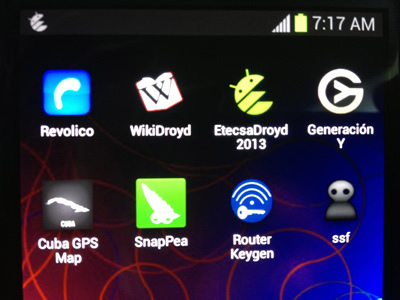
  • etecsa_droyd

    Ils sont diplômés de l’Université de Science Informatique ou de quelque autre école d’ingénieurs, mais ils gagnent leur vie en indépendants. Ce sont les nouveaux créateurs d’applications pour Android qui prolifèrent à Cuba. De leurs claviers est sortie une « appli » populaire connectée à la base de données piratée de la compagnie de téléphones et intitulée –très opportunément- ETECSA-Droyd. Il suffit de l’installer sur son téléphone mobile et l’on peut connaître le nom, l’adresse et même la date de naissance de la personne qui appelle. Personne n’échappe à l’analyse. On a sous la main les informations relatives à un ministre, à un fonctionnaire limogé et aux propres enfants du Général Président. Merveille de la clandestinité dans un pays ou l’interdit se mêle toujours davantage au souhaitable et au possible.

    Parmi ces jeunes nationaux spécialistes du numérique, les meilleurs programmeurs ont déjà des contrats avec des entreprises d’autres pays. Ils travaillent depuis chez eux à La Havane, Camagüey ou toute autre province, mais le produit final part à Tokyo ou à Paris. Il s’agit de ceux qui ont le mieux réussi. Pour atteindre ce type rêvé d’emploi à distance, la grande majorité devra d’abord passer par une longue période à installer des fonctionnalités -prestations au détail- sur les téléphones d’usagers nationaux. S’ils ont de la chance ils pourront un jour tomber sur un touriste qui aura besoin de faire réparer son Iphone ou son Samsung Galaxy. Ce sera l’occasion de faire briller son talent technologique et d’arracher au visiteur étranger un accord de collaboration ou une invitation à aller travailler dans un autre pays.

    Pourtant la route de ces génies peut être semée de sérieuses embûches. Ces derniers mois les tribunaux cubains ont poursuivi plusieurs personnes impliquées dans le commerce des téléphones mobiles et des logiciels pour Smartphone. Julio, un des détenus a été arrêté avec un chargement de smartphones HTC et de GPS pour voitures, en plus d’un atelier de création de nouvelles versions d’applications parmi lesquelles l’ETECSA-Droyd illégale. Actuellement il attend son jugement et une bonne part de ce qu’il a gagné avec son talent informatique lui servira à payer son avocat. Les délits numériques ne concernent plus seulement les copies de films étrangers.

    Hacker, planter un site web, tester des outils de piratage des codes WIFI, sont devenus le divertissement de quelques jeunes doués pour la codification et les langages de programmation. Les nouvelles technologies viennent s’ajouter au commerce illégal, cette zone tellement rudimentaire –presque moyenâgeuse- de nos vies, mais aussi tellement sophistiquée et innovante.

    Traduction Jean-Claude Marouby

    Originally posted here:
    Android et le génie des astucieux
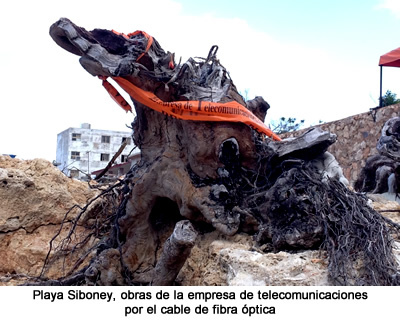

  • Playa Siboney, the telephone company’s work for the fiber optic cable.

    The residents of Siboney have reasons to be sad and upset, very upset. Hurricane Sandy devastated a good part of their coastal infrastructure, destroying houses, throwing up huge rocks on the shore, and seriously damaging the area’s vegetation. More than eight months after this hellish morning when the storm affected them, very little has been done by the State to reconstruct the place. Some locals have restores a part of the walls that surround their houses which the strong winds toppled. Although there are bulldozers and trucks carrying stones and dirt everywhere, they are not focused on once again raising the ruined village. They have, instead, a more pointed objective: the fiber optic cable that links this region of Cuba to Venezuela.

    Several owners of private restaurants and rooms or houses for rent are complaining about the decline in international tourism after the debacle of Sandy. « The foreigners come with the idea of staying a week or more, but when they see the state of things these days they leave after two days… if they even stay that long. » the natural beauty of the place makes its current situation more dramatic. Facing a sea so blue it looks like a retouched postcard, many people try to make a living however they can. « But at least you will soon have the Internet, with the cable so close »… I provoke them, in search of information, as well. The reaction when the tendon that cost more than 70 million dollars is mentioned, comes loaded with pure skepticism. « With this cable they’ve protected even us! » says a lady with eyes almost the same color as the Caribbean, glancing about as she talks.


    A « coffin of concrete and metal » is the first place the fiber optic cable touches ground in Cuba.

    The point where the so-called ALBA-1 touched land in 2011, shows no benefit of the data that circulates through it. A « sarcophagus » of concrete with a heavy metal cover, serves as the first « stop » of the cable that also links to neighboring Jamaica. A guard keeps his eyes on the place where so many kilobytes enter and leave. The irreverent hurricane from last October passed, ripping apart the previous box from where the end of the cable was guarded, leaving entirely open the framework fibers and its cover. The next morning after the incident, local residents looked out curious to see the place’s « new tenant. » Heavy equipment immediately appeared to recover it and make a small causeway under which it ran. After some weeks of work carried out by a brigade from ETECSA Telecommunications Company, the work is now in the hands of the Armed Forces (MINFAR).

    As hope is the last thing to die, or so the older people there insist on recalling, the neighbors of Siboney are still waiting for the miracle of reconstruction and connectivity. « This could be the people with best Internet access in all of Cuba, » says a young man fishing from a cliff. » But I can not tell if he’s making a joke or is serious, as the harsh sun forces his face into a permanent grin. The truth is that this place still in ruins, could become more prosperous and have more opportunities to have access to the web.

    Private businesses could attract more visitors with ads in cyberspace, they would have better information about upcoming weather patterns, and who knows, they might even launch a crowdfunding campaign to restore the nearby beach. But that’s a dream too far, I’m assured by an old man chewing tobacco and wearing an olive green cap that comes down over his ears.

    Away from the beach… near the Internet

    Less than 10 miles from where the fiber optic cable made landfall is one of the Internet cafés in the city of Santiago de Cuba. The air-conditioned room with four computers and an attendant employed to watch what each user does in front of the screen. The stratospheric prices for most people (4.50 CUC for an hour), means there are no lines access the site. It’s time to do some testing on the connectivity and the sites allowed or not allowed.

    Among the sites censored on this connection are Cubaencuentro, Cubanet and Revolico. Perhaps also other portals and sites are under the same « loop, » so it will be very useful for users to help rebuild the list of banned sites.

    The good news is, sites that can be read without difficulty include: Café Fuerte, Penultimos Días, Diario de Cuba and El País, as well as the sites of Amnesty International and Reporters Without Borders.

    A speed test of the new connection, resulted in the data shown in the following image:

    In summary, although this is not the Internet we dreamed of, given it high prices, censored sites and the inability to connect from home, at least it’s a crack that has opened the wall of disconnection. Now it is up to us to force this slit to become a door… may we live to see it.

    10 June 2013

    Continue Reading:
    Playa Siboney: Where Cuba’s Fiber Optic Cable Touches Land

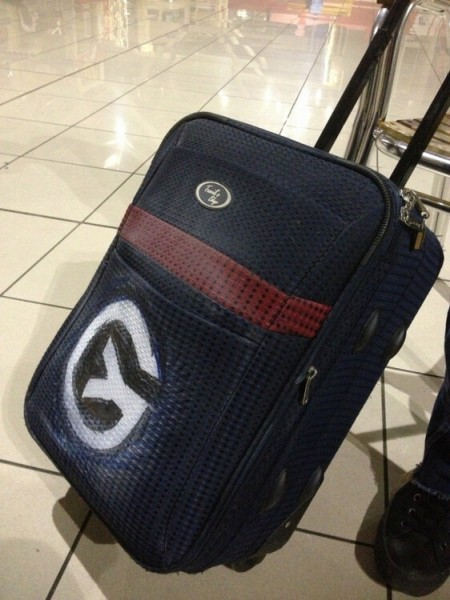
  • la-maleta-de-viaje-de-yoani-sanchez1-450x600

    La valise déposée au coin d’une rue, les petits cadeaux qui ont voyagé à l’intérieur, déjà entre les mains des amis et des parents. Les anecdotes, pour leur part, prendront plus de temps, car elles sont si nombreuses que je pourrais passer le reste de ma vie à en éplucher les détails. Je suis déjà de retour. En arrivant j’ai commencé à sentir les particularités d’un Cuba qui en trois mois d’absence a à peine changé. Le nombre des uniformes est la première chose qui m’a sauté aux yeux : ceux des militaires, des douaniers, de la police…Pourquoi voit-on autant de personnes en uniforme et rien d’autre en arrivant à l’aéroport José Marti ? Pourquoi cette impression de peu de civils et beaucoup de soldats ? Après le faible éclairage des salons, l’interrogatoire, sans aucune amabilité, d’une soi-disant doctoresse intéressée de savoir si j’ai été en Afrique. D’où viens-tu déjà ? me lance-t-elle au visage sans même voir mon passeport bleu avec l’écusson de la république sur la couverture.

    A l’extérieur un groupe de collègues et amis qui m’attendent. L’étreinte de mon fils, la plus désirée. Ensuite il m’a fallu me retrouver dans mon espace et dans le temps singulier qui s’écoule ici. Me mettre à jour des histoires, des événements du quartier, de la ville et du pays. Je suis déjà de retour. Avec une énergie que les embuches quotidiennes vont essayer de saper, mais dont il me restera toujours quelque chose pour entreprendre de nouveaux projets. Une étape de ma vie se termine ; une autre se profile. J’ai vu la solidarité, je l’ai touchée et j’ai aussi maintenant le devoir de dire à mes compatriotes dans l’île que nous ne sommes pas seuls. Je rapporte tellement de beaux souvenirs : la mer à Lima, Le Templo Mayor à Mexico, la Tour de la Liberté à Miami, la beauté de Rio de Janeiro, l’affection de tellement d’amis en Italie, Madrid avec son musée du Prado et sa place de Cibeles, Amsterdam et les canaux qui la traversent, Stockholm et les cyber-activistes du monde entier que j’ai connus là-bas, Berlin et ces graffitis qui recouvrent ce qui fut autrefois le mur qui a divisé l’Allemagne, Oslo entourée de verdure, New York qui ne dort jamais, Genève avec ses diplomates et le siège de l’ONU, Gdansk chargée d’histoire récente et Prague la belle, l’unique. Tous ces lieux, avec leurs lumières et leurs ombres, leurs graves problèmes et leurs moments de calme et de rires, je les ai rapportés avec moi à La Havane.

    Je suis déjà de retour et je ne suis plus la même personne. Quelque chose de chaque lieu où je suis passée est resté en moi ; les étreintes et les paroles d’encouragement que j’ai reçues sont également ici aujourd’hui avec moi.

    Traduction : Jean-Claude Marouby

    See the article here:
    Le retour

  • sif2013Someone sitting at the table behind spoke in French, while in chairs at the side two Brazilians exchanged ideas. Two steps further on some activists from Belarus were talking with some Spaniards who had also come to the Stockholm Internet Forum. An event that began on May 21 in the Swedish capital bringing together people interested in digital tools, social networks and cyberspace. A real Tower of Babel where we communicate in the lengua franca of technology. The global and virtual village is now contained in an old factory on the edge of the sea. And in the midst of this back and forth of analysis and anecdotes, are six Cubans, also willing to contribute their labor as cyber activists.

    This is without a doubt the most enjoyable stage of my long journey and not because other places haven’t been filled with beautiful impressions and lots of hugs, but because here I have met up with several colleagues from the Island. Some of the people who, in our country have grabbed hold of new technologies to narrate and to try to change our reality, today are gathered here. The young attorney Laritza Diversent, the director of Estado de SATS, Antonio Rodiles, the keen blogger Miriam Celaya, the information engineer Eliecer Avila, and joining us for one day as well, the independent reporter Roberto Guerra. Here in Stockholm it has felt rather like Cuba, though certainly not because of the weather.

    The Internet Forum has allowed us to feel like citizens of the world, to share experiences with those who live in different situations but, in essence, surprisingly similar ones. It’s enough to chat with another attendee for a little while, or to listen to a talk, to realize that in every word spoken here is the eternal human quest for knowledge, information… freedom. Expressed on this occasion through circuits, screens and kilobytes. This meeting has left us with the sensation that we are universal and that technologies have made us into people capable of transcending our geography and our time.

    like_webb

    Continued here:
    Cubans, Too, Can Transcend Geography and Time With the Internet

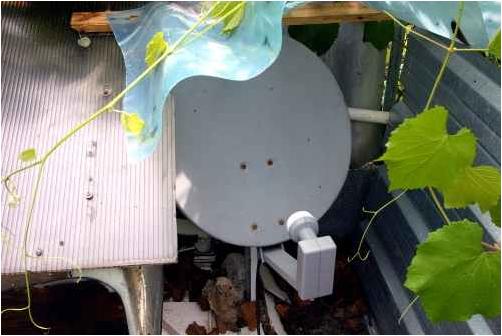
  • Parabolica Cubana

    For World Telecommunication and Information Society Day

    They look the same as everyone else: small, restless, ready to play and joke, like any child. But something distinguishes them beyond the neighborhood where they live or the family they belong to. They are part of a generation that is escaping the indoctrination of the official media because they have taken refuge in illegal television programming. They are « the children of the satellite dish, » the direct consumers of the programming on these satellite dishes, as widespread as they are persecuted. When the teacher asks them, in the classroom, what they saw on the news the day before, they are the ones who look at the ceiling and invent some response. But when they interact among themselves, they all know the name of the trendy host in Florida or who won the latest Nuestra Belleza Latina contest.

    There are no clear studies of how many people on the Island access these banned channels. It is difficult to calculate because it is a topic little spoken of in public, for fear of confiscations and fines; but also because it’s enough for one family to have one of these satellite dishes to pass the signal via cable to a dozen, a score, or 50 neighboring homes. The most daring have installed the cable under the streets, pretending they were making an authorized repair because of some broken pipe. The principle owner of the persecuted artifact is the one who decides the programming that all subscribers then see on their respective screens. The monthly price is around 10 dollars, although some can have the service for free, especially the neighborhood informers, to buy their silence.

    However, beyond these technical details of how such an illegality is committed, the most interesting thing is the sociological phenomenon it is generating. Many Cubans of the younger generations — particularly in the capital — barely watch national television. They have escaped the ideological dose of this portal and have replaced it with a more frivolous but less politicized assortment. Among this TV audience are many children, for whom the effect of the slogans and official campaigns is detrimental. They are the children of the satellite dish, breastfed with the illicit and used to the other side of information or misinformation. They have grown up with the remote control in their hands and, with a simple click, they access the prohibited every day.

    P.S.: « It makes no sense to prohibit » the circulation of news, because it is « an almost impossible chimera, » because people « know it. » « Today the news is everywhere, the good, the bad, the manipulated and the true, the half-truths, circulating on the networks, reaching the people, people know it, and the worse thing is silence, » the official told a conference of educators — according to a television report from a few days ago about the words of Miguel Diaz-Canel, first vice president of Cuba.

    Another post on this topic: Satellite vs. TELEsur

    Visit link:
    The Children of the Satellite Dish, Bypassing Ideology in Cuba

  • anetan_parabolica.jpg

                                                                                                                          A l’occasion de la journée mondiale des télécommunications et de la          Société de l’Information

    Ils sont pareils à tous les autres : petits, turbulents, prêts à s’amuser et à plaisanter comme tous les enfants. Mais au-delà de ça, quelque chose les distingue du quartier qu’ils habitent ou de la famille dans laquelle ils vivent. Ils appartiennent à une génération qui échappe à l’endoctrinement des medias officiels, car elle s’est réfugiée dans la programmation télévisuelle illégale. Ce sont les “enfants de la parabole”, les clients directs de l’offre de ces antennes paraboliques qui se développent à mesure qu’elles font l’objet de poursuites. Quand à l’école la maîtresse leur demande s’ils ont regardé le journal télévisé de la veille, ils sont de ceux qui regardent le plafond et inventent une réponse. Mais quand ils discutent entre eux ils savent tous le nom du présentateur de mode dans « La Florida » ou de la gagnante du dernier concours de « Notre Beauté Latina ».

    Il n’existe pas d’étude précise sur le nombre de personne dans l’île qui accèderaient à ces chaînes interdites. Il est donc difficile de le calculer car c’est un sujet dont on parle peu en public, de crainte des confiscations et des amendes ; mais aussi parce qu’il suffit qu’une famille possède une de ces antennes paraboliques pour que le signal transite par câble vers une dizaine, une vingtaine voire une cinquantaine de logements voisins. Les plus osés ont même installé l’antenne dans la rue en faisant semblant d’effectuer une réparation autorisée sur une tubulure cassée. Le propriétaire principal de l’instrument objet de poursuites est celui qui décide de la programmation que verront ensuite tous les abonnés sur leurs écrans respectifs. Le prix mensuel tourne autour de 10 dollars bien que certains aient accès au service gratuitement, en particulier les délateurs du quartier dont on achète ainsi le silence.

    Cependant, plus que les détails techniques sur la façon dont se commet une telle illégalité, c’est le phénomène sociologique qu’elle génère qui est intéressant. Beaucoup de cubains des jeunes générations, particulièrement dans la capitale, regardent peu la télévision nationale. Ils échappent à la dose d’idéologie que celle-ci transporte et ils lui ont substitué une gamme plus frivole mais moins politisée. Parmi ces téléspectateurs il y a beaucoup d’enfants sur lesquels l’effet des slogans et des campagnes officielles est en chute libre. Ce sont les enfants de la parabole, allaités à la mamelle de l’illicite et habitués à l’autre versant de l’information, ou de la désinformation. Ils ont grandi avec la télécommande entre les mains et ils accèdent chaque jour d’un simple clic à l’interdit.

    PS : « Cela n’a pas de sens d’interdire » la circulation des informations, « c’est presque une chimère impossible » parce que les gens « les connaissent ». « Aujourd’hui toutes les nouvelles, celles qui sont bonnes et celles qui sont mauvaises, celles qui sont manipulées et celles qui sont vraies, celles qui le sont à moitié, circulent sur les réseaux, arrivent chez les personnes, les gens les connaissent et le pire serait le silence » aurait selon un reportage télévisé, assuré Miguel Diaz-Carmel, premier vice président de Cuba dans une conférence d’éducateurs il y a quelques jours.

    Traduction : Jean-Claude Marouby

    See the article here:
    Les enfants de la parabole

  • Please see Hans Rosling’s TED Talk: The Magic Washing Machine

    From a distance you feel the strokes… bam, bam, bam. The arm raises the thick fat stick and then lets it falls hard on the twisted sheet. The spray of lather explodes with every stroke and white water seeping from dirty fabric mixes with the river. It is very early, the sun barely up, and already the clotheslines are waiting for with damp clothes that must dry in the morning. The woman is exhausted. From the time she was a teenager she has washed her and her family’s clothing in this way. What other choice did she have? In that little village lost in the eastern mountains all her neighbors did the same. At times as she slept her body would move restlessly in the bed and repeat the hint of a movement: up… down… bam… bam… bam.

    Lately the discussion of women’s emancipation in Cuba has been focused on persuading us of its extent, showing the numbers of women in parliament. There is also talk — in the official mass media — of how many have managed to climb into administrative positions, or to lead an institution, a scientific center or a business. However, very little is said about the sacrifice involved for them in managing in these positions with their busy domestic schedules and material shortages. You only have to look at the faces of those over 40 to note the tense frown common in so many Cuban woman. It is the mark left by a daily life where a good part of the time must be dedicated to burdensome and repetitive tasks. One of these is the laundry, which many of our countrywomen do, at least a couple of times a week, by hand and in very tough conditions. Some do not even have running water in their homes.

    In a country where a washing machine costs an entire year’s salary, we can’t talk about women’s emancipation. Facing the washtub and the brush, or the boiler filled with baby diapers bubbling on the firewood, thousands of women pass many hours of their lives. The situation becomes more difficult if we move away from the capital and look at the hands of the women who clean, with the strength of their fingers, the shirts, pants and even the military uniforms of their families. Their hands are knotted, stained white by the soap or detergent in which they’re immersed for hours. Hands belie statistics about emancipation and the fabricated gender quotas, with which they try to convince us otherwise.

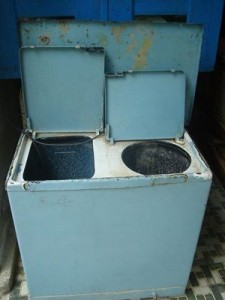
    1980s Aurika washing machine imported from the USSR to Cuba and still used by many Cuban families … in the absence of another.Photo from museodelanostalgia.blogspot.ch »]
    aurika80-225x300

    Other texts with this theme: With Clitoris and With Rights; Violence Against Woman.

    Read More:
    Cuba’s Supposedly ‘Emancipated’ Women Are Still Boiling Their Babies’ Diapers Over Fires

  • On entend de loin les coups boum, boum… boum. Le bras se lève en tenant un gros bâton lisse, avant de retomber avec force sur le drap tordu. La mousse de savon jaillit à chaque coup et de la toile sort une eau blanchâtre qui se mêle à celle du ruisseau. Il est très tôt ; le soleil est à peine levé et déjà les cordes à linge attendent le linge humide qui devra être sec en fin de matinée. La femme est épuisée. Depuis son adolescence elle lave ainsi ses vêtements et ceux de sa famille. Comment pourrait-elle faire autrement ? Dans ce petit village perdu des montagnes de l’est, toutes ses voisines font la même chose. Parfois dans son sommeil, son corps s’agite nerveusement dans le lit et amorce le mouvement répétitif : levée…descente…boum…boum…boum.

    Ces derniers temps, lorsqu’on évoque l’émancipation féminine à Cuba on essaie de nous persuader qu’elle est achevée, en nous montrant le nombre de femmes au Parlement. On indique également, dans les journaux les plus officiels, combien ont réussi à grimper dans la hiérarchie administrative, à diriger une institution, un centre de recherche ou une entreprise. Cependant il est dit peu de choses sur les sacrifices qu’elles endurent pour concilier ces fonctions avec la charge des tâches domestiques et la précarité matérielle. Il suffit de voir le visage des plus de quarante ans pour constater ce rictus des lèvres baissées, commun à tant de femmes cubaines. C’est la marque que laisse un quotidien dans lequel une grande partie du temps doit être consacré à des tâches accablantes et répétitives. Parmi lesquelles le lavage du linge, que beaucoup de compatriotes font, au moins deux fois par semaine, à la main et dans des conditions très difficiles. Certaines ne disposent même pas de l’eau courante à la maison.

    On ne peut pas parler d’émancipation féminine dans un pays où le prix d’une machine à laver représente le salaire d’une année de travail. Des milliers de femmes passent beaucoup d’heures de leur vie face à la cuvette et à la brosse, ou devant la lessiveuse, pleine des langes du bébé, qui bouillonne sur le feu de bois. La situation est plus difficile si on s’éloigne de la capitale, et que l’on regarde les mains de ces femmes qui maintiennent propres, à la force de leurs doigts, les chemises, les pantalons et même les uniformes militaires des membres de leur famille. Ce sont des mains noueuses, avec des taches blanches laissées par le savon et le détergent dans lesquels elles trempent pendant des heures. Des mains qui démentent les statistiques sur l’émancipation féminine à Cuba et les quotas fabriqués avec lesquels on essaie de nous convaincre du contraire.

    Traduction Jean-Claude Marouby

    Lavadora Aurika importada en los años ochenta a Cuba desde la URSS y que todavía muchas familias cubanas conservan... a falta de otra. Foto tomada de: http://museodelanostalgia.blogspot.ch/2009/02/la-infame-lavadora-aurika-80.html

    Taken from:
    De la cuvette au lave-linge