Catégorie : Politique

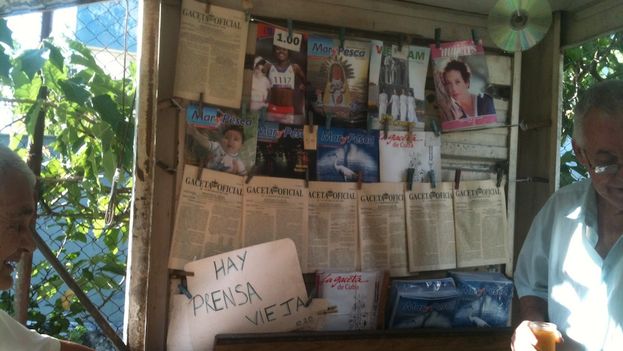
  • News kiosk (Luz Escobar)
    News kiosk (Luz Escobar)

    14YMEDIO, Havana, Yoani Sanchez, 22 August 2014 – The phone rings and it’s a friend who works for a government publication. She’s content because she’s published an article that attacks bureaucracy and corruption. The young woman finished college two years ago and has been working in a digital medium that deals with cultural and social issues. She has the illusions of a recent graduate, and she believes she can do objective journalism, close to reality, and help to improve her country.

    My friend has had some luck, because she exercises this profession at a time when the national media is trying to more closely reflect the problems of our society. The official journalist exists in a timid Glasnost, 25 years after a similar process in the Soviet Union. If that attempt at « information transparency » was promoted through Perestroika, on the Island it’s been pushed by the Sixth Communist Party Congress Guidelines. In this way, a more objective and less triumphalist press is pushed–from above. The same power that helped create laudatory newspapers, now urges a shift from applause to criticism. But it’s not easy.

    The original sin of the official press is not the press, but propaganda. It emerged to sustain the ideological political-economic model and it can’t shed that genesis. The first steps in the creation of the current national media always includes an act of faith in the Revolution, It is also funded entirely by the Government, which further affects its editorial line. It’s worth noting that the official media is not profitable, that is, it doesn’t generate income or even support its print runs or transmissions. Hence, it operates with subsidies taken from the national coffers. All Cubans sustain the newspapers Granma and Juventude Rebelde (Rebel Youth), the Cubavision channel or Radio Reloj (Clock Radio)… whether we like it or not.

    Moreover, the official press is structured so that nothing can escape to the front page of the newspapers or to the TV and radio microphones that hasn’t been previously inspected. They are characterized by their strict elements of supervision.

    Architecture of Control

    My friend is facing at least four strong mechanisms of censorship she must deal with every day and which she rarely manages to successfully evade. Cuba has come to have one of the most sophisticated methods of monitoring information anywhere in the world. At the highest point of this architecture of control is the Department of Revolutionary Orientation (DOR), an entity belonging to the Central Committee of the Cuban Communist Party. A group of people–designated for their ideological loyalty–analyze all the journalistic content published in the country, and, from these observations, follows certain topics and authors.

    The DOR is also responsible for drawing up the so-called « thematic plan » in which it programs the issues the Cuban press will address in a specified time period, and with what intensity it will do so. Right now, for example, just looking at national television we can see that there is a marked intention to speak optimistically about the Port of Mariel, foreign tourism and agricultural production.

    Not only political issues or international relations pass through that filter. Control is also exerted over the music broadcast on radio stations and the music videos, soap operas, and science programs aired on television. The so-called black lists of singers or banned authors in the national media come entirely from the DOR. This so painful and prolonged phenomenon has been losing ground in recent years, more from social pressures than because of a sincere process of self-criticism among the censors.

    The heads of the press organs must meet regularly with « the comrades from the DOR » to ensure that the plan of topics decided from above is carried out. But the influence of this entity does not end there. The directors of the newspapers and the heads of specific pages or specialized pages will only be appointed with the consent of this department, which in many cases is the person who placed them in their positions. This extends to the national and provincial organs, the municipal radio stations and the specialized magazines. The Journalism School at the University of Havana also receives direct attention from the Department of Revolutionary Orientation, which controls its curriculum and involves itself in the process of choosing new students. Nothing moves in the Cuban press without this watchtower of censorship knowing about it.

    Promote the positive results

    Another control mechanism that grips the official press is that imposed by the institutions and ministries. From the departments overseeing these entities, journalists are encouraged to promote the sectors they cover. Only with the authorization of these State organs, can the reporters access offices, files, review meetings, press conferences, the interior of a factory, or a cultural center or school.

    This second control filter placed on institutions gives birth to a kind of journalism that has done a great deal of harm to Cuban society. One full of triumphalism, inflated figures, and « everything is perfect. » This pseudo-information has been so abused that popular humor is full of jokes about it. Like the one about when the news comes on and people put a bag under the TV to collect the food that appears in the reports, but that never show up in reality. This practice fosters opportunism, as well as making reporters think, « I’d better not get in trouble, if it’s good for me here. » There are sectors that are very attractive to cover, like tourism, because they include gifts, invitations, eating in hotel restaurants, and even all-expense-paid weekends at resorts.

    Surveillance in the hallways

    The third control mechanism makes people afraid to even say its name. The role of the Ministry of the Interior in every press organ. Every newspaper, radio station, TV channel or provincial newspaper has one or several people who are responsible for « seeing to » the security of the center. This department is responsible for investigating the extra-professional activities of every reporter, photographer or graphic designer. To spy on what they say in the hallways, supervise the questions they ask in interviews–particularly if it involves a foreigner–and whether they have contacts in the opposition or among independent journalists.

    The more sophisticated control mechanism

    If my friend makes it past those three control mechanism without deleting a line or one of her works being prohibited, she will still face the most efficient and sophisticated of all. It’s euphemistically called self-censorship and is nothing more than the result of pressure exercised over the communicator by the instruments of control and punishment.

    Self-censorship acts as a psychological barrier and is expressed in the omissions that each journalist makes to stay on safe ground and not get too close to the allowed limit. However, the victim of self-censorship doesn’t always see it like this, rather she justifies her attitude. For a communicator from the official press who believes in the system, it’s an act of political militancy, a question of faith. So she remains silent about certain topics, to « not give arms to the enemy, » or because they’ve made her believe that « only they can offer constructive criticism. » Journalists come to think that if they question the immigration policy, the single-party system, and the political intolerance in the country, they will be doing more harm than good.

    The professional who accepts and successfully passes through these four censorship and control filters and can call themselves an editor, a composer of sentences, a typist, a propagandist… but never a journalist.

    Maybe one day my young friend will call me, not to tell me that she has managed to sneak a text into an official media, but to tell me that she’s decided to become an independent journalist. She will take on new challenges and problems, but be much freer.

    More here:
    Cuba’s Official Press: Triumphalism, Blacklisting and Censorship
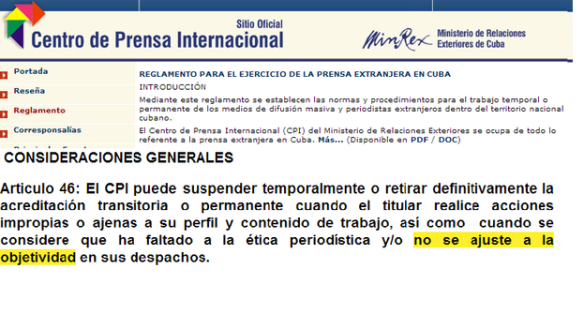
  • Big Brother stands as judge of journalistic "objectivity." (The text says that CPI can temporarily or permanently cancel press credentials for Big Brother stands as judge of journalistic « objectivity. » [The text says that CPI can temporarily or permanently cancel press credentials for « lack of journalistic ethics… or objectivity.’ » Minrex is the Foreign Ministry)

    A few years ago I met a foreign correspondent based in Cuba who related an absurd and revealing anecdote. The International Press Center (CPI) had called him in to warn him about the content of an article. Receiving the summons didn’t surprise him, because warning calls like that were a common practice of this agency in charge of registering and controlling foreign journalists living on the island. Nor could he refuse to appear, because he depended on the CPI for his credentials to report on a nature reserve and even to interview a government minister. So there it was.

    The reporter arrived at the centrally located building on 23rd Street, where the CPI is headquartered, and was led to an office with two annoyed looking men. After bringing him coffee and talking about other things, they got to the point. They reproached the journalist for a report where he had referred to Cuba as « the communist Island. » This was a huge surprise to the correspondent because previous warnings he’d received were for « reporting only on the bad things about the Cuban reality, » or « not treating the leaders of the Revolution with respect. » But he never imagined that this time he would be scolded for the complete opposite.

    But yes, the censors who minutely examine the cables written by foreign agencies had not been at all pleased with the use of the adjective « communist » to characterize our country. « But the Communist Party governs here, right? » asked the incredulous reporter. « Yes, but you know the word looks bad, it doesn’t help us, » responded the higher-ranking official. The man stood there in shock for a few seconds while trying to comprehend what they were saying to him and think of a response other than laughing.

    The correspondent knew that annoying the CPI could bring more than just a slap on the wrist. Also in the hands of this institution is permission for foreign journalists to import a car, rent a house and–at that time–even to buy an air conditioner for their bedroom. The dilemma for the reporter was to give in and not write « the communist Island » any more, or to engage in conflict with the institution, where he had everything to lose.

    The mechanisms of control over the foreign press go far beyond warning calls from the CPI. Should a correspondent get married on the island, start a family in this land, his objectivity comes into doubt. The intelligence organs know how to pull the strings of fear to cause damage or pressure to a loved one. Thus, they manage to temper the level of criticism by these correspondents « settled » in Cuba. The perks are also an attractive carrot to keep them from touching on certain thorny issues in their articles.

    I know one foreign journalist who, every time she writes a press release about the Cuban dissidence, adds a paragraph where she declares, « the Government considers this opposition to be created and paid from Washington »… But her texts lack the phrase she could add to give the readers another point view, briefly communicating, « the Cuban dissidence considers the Island’s government a totalitarian dictatorship that has not been subjected to scrutiny at the ballot box. » This way, those who consult the press release could draw their own conclusions. Sadly, the objective of correspondents like her is not to inform, but to impose an opinion framework that is as stereotyped as it is false.

    Press agencies need to strengthen and carefully review their codes of ethics when dealing with Cuba. They should control the time their representatives spend on the island, because as the long years pass here emotional bonds are created that the regime can use for blackmail and pressure. An objective examination–every now and again–wouldn’t be a bad thing, given the possible coercion and Stockholm Syndrome their employees might suffer. The credibly of an information giant sometimes depends on whether a new imported car, or a beautiful young Cuban partner, is valued more than a commitment to journalism.

    Take care, foreign press agencies! Your representatives in these parts are always in danger of becoming hostages, first, and then collaborators, of the ruling regime.

    View original post here:
    ‘Calling Us Communists Makes Us Look Bad’

  • 2014-08-05-1000472_474759539275644_1332749336_n.jpg
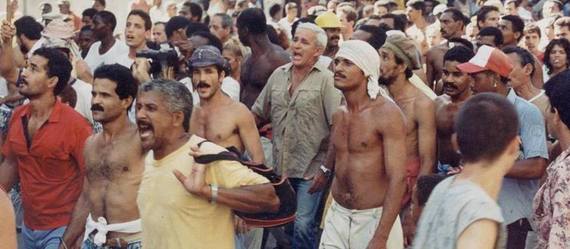
    Photo: Karl Poort, 5 August 1994

    We had run around together in our Cayo Hueso neighborhood. His family put up several cardboard boxes in vacant lot near Zanja Street, similar to those they’d had in Palmarito del Cauto. His last name was Maceo and something in his face recalled that Titan of so many battles, except that his principal and only skirmish would entail not a horse, but a flimsy raft. When the Maleconazo broke out he joined in the shouting and escaped when the arrests started. He didn’t want to go home because he knew the police were looking for him.

    He left alone on a monstrosity made of two inflated truck tires and boards, tied together with ropes. His grandmother prepared water for him in a plastic tank and gave him a can of condensed milk she’d been saving for five years. It was one of those products from the USSR whose contents arrived on the island congealed, after the long boat ride. My generation grew up drinking this sugary lactose mixed with whatever came to hand in the street. So Maceo added the can to his scanty stores — more as an amulet than as food — and departed from San Lazaro cove.

    He never arrived. His family waited and waited and waited. His parents searched the lists of those held at the Guantanamo Naval Base, but his name was never on them. They asked others who capsized near the coast and tried to leave again. No one knew of Maceo. They inquired at the morgues where they kept the remains of the dead who washed up on shore. In those bleak places they looked at everyone, but never saw their son. A young man told them that near the first shelf he had come across a single raft, floating in nothingness. « It was empty, » he told them, « it only had a piece of a sweater and a can of condensed milk. »

    Editor’s note: Today is the 20th anniversary of « The Maleconazo. » You can read more about this uprising and the subsequent Rafter Crisis in previous posts:

    More:
    The Maleconazo and the Rafter Crisis in a Can of Condensed Milk

  • Iliana Hernandez
    Iliana Hernandez

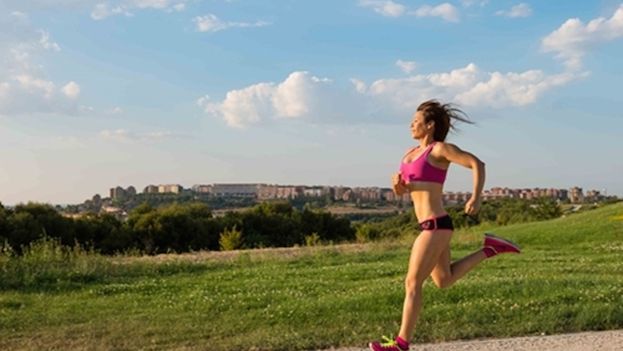
    14ymedio, Yoani Sanchez, 1 August 2014 – A Cuban balsera, a rafter, has set herself a new challenge. This time it’s not about escaping Cuban on a fragile craft, but rather crossing the Sahara desert. Iliana Hernandez will cross 144 miles of sand dunes, luging food, water and a sleeping bag, over seven long days.

    The Marathon des Sables will hold its next event from April 3-12, 2015. This intrepid Guantanameran will be the only Cuban put to the test, although before her another compatriot tried it in 2008. To overcome exhaustion and physical pain, Iliana is counting on her will, an impressive physical preparation and the experience of having been a Cuban rafter.

    In the midst of her hard training the young woman took a few minutes to share the challenge that awaits her with the readers of 14ymedio.

    Question: The Marathon des Sables has a long tradition and is considered one of the toughest races in the world. Can you tell us more about your organization, requirements and concept?

    Answer: It started in 1985 and is indeed one of the most demanding races in the world. It constitutes a great challenge for many elite athletes as well as for others who, without possessing excellent physical form, want to prove themselves in a fight where the most important thing is not the legs but the will.

    The contest lasts for seven days during which there are six stages. It takes place in the Moroccan Sahara. Each runner must be self-sufficient in terms of their own food and everything they need along the 144 miles. Backpack, sleeping bag and other things for survival become your inseparable allies for one week. The contest is divided into six stages that range from 12 to 48 miles. The terrain is desert with many stones, areas of ancient dry lakes and sand dunes. And if that’s not enough, the runners must suffer temperatures that reach 120°F. (suite…)

  • Putin and Raul Castro together on Cuban television. (14ymedio)

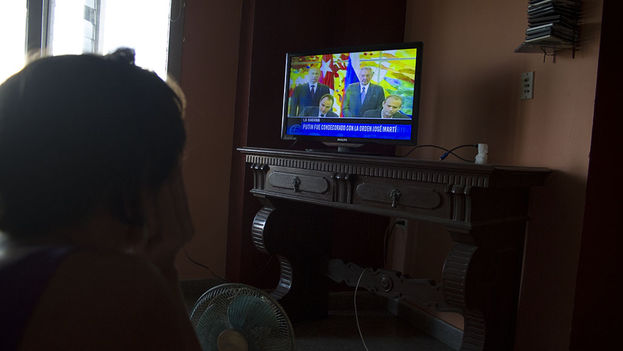
    Putin and Raul Castro together on Cuban television. (14ymedio)

    « These are the last sweets! » The cry could be the simple proclamation of a candy seller, but I heard it 23 years ago at my high school in the countryside and it was the first evidence I had of the collapse of the Soviet Union. The person shouting was Olga, a student who resold what the wives of the Russian technicians in Alamar gave her. She was the bridge between our Cuban money, worth less every day, and a series of products such as candy and canned goods « Made in USSR. » I remember this teenager, who warned us of the coming of shortages, like a blind Tiresias, alerting us to the adiós of the « bowling pins » (as we called the Russians).

    The old relationship with the Kremlin comes to mind now, with Vladimir Putin’s visit to Cuba. We have seen the official delegation on national television with its businesslike demeanor in suits and ties, no longer speaking of Marxism-Leninism or the dictatorship of the proletariat. They look different, but so much the same. The same glance from above they once had when they knew our island was just a small domino in the game of power. They come looking for alliances, to define the contours of those blocks they are reassembling — right before our eyes — in a new return of the Cold War. We are one step away from returning to our old status as a satellite, diminished before Moscow’s power, its oil, the debt relief it just granted us.

    Not a single official commentator has hinted at the dangers entailed in this approach, nor to the Russian government’s need to use Latin America as a diplomatic « launching pad » against its old enemy, the United States. In the midst of this renewed confrontation among the great powers, we are trapped as a disposable and negotiable part, as the case may be. The risk is such that I again remember Olga and the last Soviet candies she offered us in that dorm. Those sweets in extinction predicted an end, the goodies being announced today, like a new airport and possible Russian investment in the Port of Mariel project, compromise our future. You don’t have to be blind, nor Tiresias, to realize it.


    Click here for selected English Translations from Yoani Sanchez’s newly launched newspaper, 14ymedio.

    See the article here:
    Putin In Havana, Seeking an Ally or a Satellite?

  • Seminario-transiciAn-espaAola-Madrid_CYMIMA20140709_0006_13

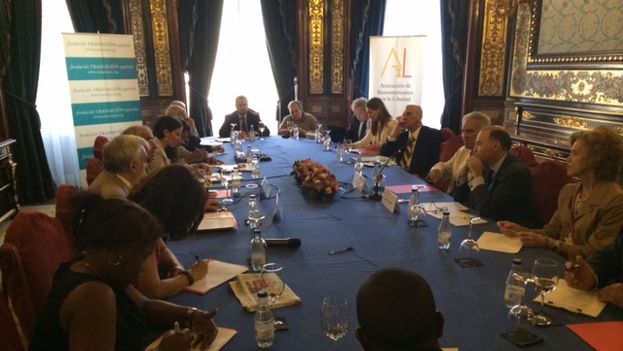
    Yoani Sánchez, Madrid, 9 July 2014 – Right now I am taking part, along with several Cuban activists, in a seminar on the Spanish transition being held in Madrid. Organized by the Association of Ibero-Americans for Freedom and the Spanish Transition Foundation at the Casa de America, the event includes the participation of nine activists from within the Island from many different sectors, such as law, citizenship, human rights and journalism. An opportunity for us to meet with each other without the police cordons or acts of repudiation.

    While I listened to several speakers, I remembered when, in 2011, I watched the series The Transition, with the voice of Victoria Prego. Coincidentally, the morning I started to watch the excellent scenes of that documentary and the analysis that accompanied it, a friend from Madrid visited me. She looked at the TV screen and said to me, « I experienced many of those events, but at that time I didn’t know we were in transition. » Her phrase has stayed with me as solace and hope all these years. Today, in the Casa de America, I remembered it.

    Are we Cubans living in the transition? Just asking this question is enough to annoy some people and excite others. A transition — the experts and analysts tell me — needs more political, social and economic evidence. A word of such magnitude requires real substance, not just desires, others warn me, also with very good arguments. If it turns out that an irreversible and defining change has occurred within Cubans, could we see that as the transition? In this case, the micro look beats out the macro analysis.

    Every day I meet more people who are no longer collaborating, who no longer believe, who no longer support the system. I also stumble upon people who aren’t interested in watching official TV, or taking part in official events, or accepting official perks. What do we call that? May the transition theorists forgive me, but if that is not a change, what is it? « Pre-transition » perhaps?


    Click here for selected English Translations from Yoani Sanchez’s newly launched newspaper, 14ymedio.

    View article:
    Is Cuba Already in Transition?

  • Havana, 3 July 2014 — Yesterday on the bus, with the summer heat and after the long wait at the stop, two men commented loudly on their annoyance. « This sure doesn’t happen in Cyprus! » one said to the other, and laughter rang out all over the bus. He was referring to a monologue by the comedian Nelson Gudín, which has become a viral phenomenon on the alternative distribution network for videos. The actor plays a drunk who, among many other absurdities, complains about the space given in the national media to relating the problems of other countries, while remaining silent on ours. The old technique of « the mote in another’s eye… » — which is one of the pillars of the official Cuban press.

    Unemployment, corruption, economic cuts and social unrest… in Cyprus… were a topic of discussion and analysis by the panelists on the Roundtable show on several occasions. To underpin the axiom that « it’s hell out there and paradise in here, » the unpopular TV program placed a special emphasis on the difficulties being experienced by this member state of the European Union. So much time and so many reflections were dedicated to it, that the character played by Gudín ended up commenting, « Huh?… I didn’t know we were living in Cyprus? » The sarcastic phrase has almost become a slogan on our streets.

    Just let an official delay some paperwork, for an ironic voice to note, « this guy surely comes from Cyprus. » That lady who is out of work due to economic adjustments, « is probably Cypriot, » her acquaintances will comment maliciously. Not to mention the empty shelves because of shortages; « It shouldn’t happen in Havana, only in Nicosia, » a frustrated customer claimed a few days ago. « At this rate, we’ll know more about the antagonisms between the Greeks and the Turks than about our own national problems, » a university professor pointed out to his students.

    By the work and grace of the ideologues of the official press our principal preoccupations no longer take the form of an island in the Caribbean, but of this other one in the far off Mediterranean, where all the problems are concentrated.


    Click here for selected English Translations from Yoani Sanchez’s newly launched newspaper, 14ymedio.

    View article:
    ‘It’s Hell Out There… But Paradise Here in Cuba’

  • Havana | 20 June 2014 — Damaris is almost 40 and has several scars on her face. They were made by a 5th grade classmate with a hair clip. They were in the middle of class and a dispute over the ownership of a pen led the opponent to scream, « I’ll be waiting for you at four-thirty! » This is the worst threat a student can receive in a Cuban elementary school. The phrase lets you know that when school gets out strength and supremacy will be proved with fists or fingernails.

    For Yosniel it was worse. He jumped from a water tank at the People’s Republic of Romania High School, after months of ridicule about the size of his head from his classmates in the dorm. He fell on concrete and no effort at resuscitation was able to save him. The next day, during the funeral, the very students who had ridiculed him offered their condolences to the bereaved family in the impoverished Romerillo neighborhood.

    However, the problem touches both the poor and the better-off. The cold metal of a knife pierced the heart of Adrian, also a high school boarding student, because another student, stronger than he, decided he wanted his Converse sneakers. The parents of the dead boy were in the military, but even so they could not understand how the schools that were supposed to form the « New Man » could end up functioning with the same bullying as in prisons.

    Cecilia, meanwhile, was always one of the ones who hit… not one of those who was hit. She would choose which uniform skirt she wanted, searching the lockers of the weaker and smaller students. One day she met her match in a skinny little gap-toothed girl who — with a knife improvised from a hacksaw blade — slit her face from ear to ear.

    Abuse at school, bullying, is an issue that is rarely discussed in the national media, but it affects hundreds, even thousands, of students across the country. Among the most alarming characteristics of this problem is the complicity or indifference on the part of the teachers. Often the teachers support « these tough guys and girls » in order to control the rest of the students. The result is an institutional validation of a structure of bravado and abuse.

    How can it be reported? No one knows. There is no telephone number that a student victim of bullying can call. There is no Ministry of Education circular protecting the victims in these cases. The parents usually respond to their children’s complaints of abuse with « hit him harder » or « show them who you are. » The teachers don’t want to get in the middle of a dispute and many school directors respond defensively, « You can imagine, I no longer know what to do with this boy. »

    The truth is that the drama of school abuse is not reported, debated, questioned… meanwhile, the many Cecilias who are out there continue taking smaller children’s uniforms, cutting classmate’s faces with a blade, or mocking — to the point of suicide — the head size of another.

    Link:
    Bullying: A Serious Problem in Cuban Schools