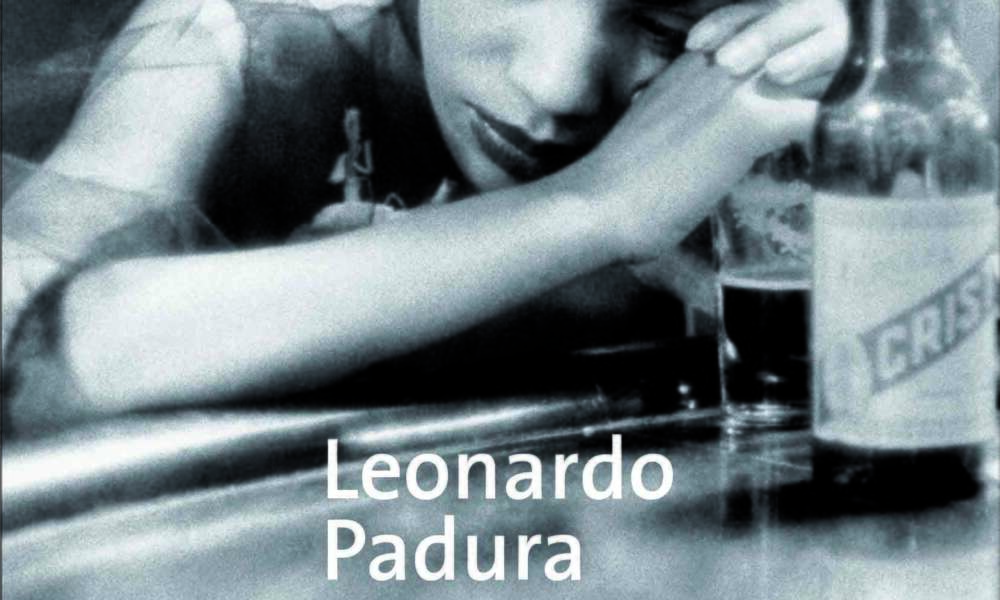
Séries Mania a présenté au Forum des images, à Paris, en première mondiale, les deux premiers épisodes de la série Quatre saisons à La Havane, adaptée des polars de Leonardo Padura. (suite…)
-

Cette maison a une clôture métallique aux pointes acérées, celle d’à côté une énorme grille avec une serrure double. Sur la porte de certains immeubles de bureaux une affiche nous avertit « réservé au personnel autorisé », et aux alentours du conseil d’Etat les gardes armés se succèdent tous les cent mètres. Se protéger de l’autre, éviter le contact, éloigner l’étranger, sont les objectifs de ces barrières physiques et légales. Ceux-là même que le maître Ryszard Kapuschinski décrivait dans son article « Les cent fleurs du dirigeant Mao » pendant son voyage en Chine.
Dans ce texte vif et subtil, le journaliste polonais nous révèle la manie des hommes de construire des obstacles pour nous séparer de ce qui est différent de nous. L’exemple parfait en est ce serpent de briques, de pierres et de matériaux divers qui traverse le grand géant asiatique. Tout pour se défendre –ou s’isoler- de ceux qui sont restés de l’autre côté de la muraille. Pour Cuba, les choses ont été plus simples car c’est la mer qui nous a éloignés du reste de la planète. Une frange d’eau salée qui a merveilleusement servi le discours politique sur la « place assiégée » et « l’ennemi » de l’autre rive. Tout cela par peur, par simple peur de la diversité.
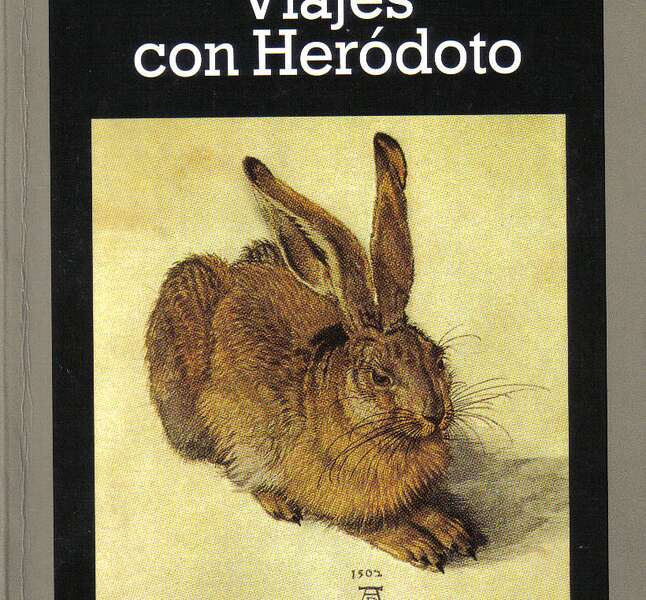
Kapuscinski s’interrogeait sur les coûts humains et matériels de la construction –réelle ou dans les discours- des murailles. Nous pourrions faire le même exercice concernant notre pays. Combien nous a coûté notre isolement ? Quelles ressources avons-nous gaspillées en tranchées et tunnels pour la guerre, en campagnes diplomatiques agressives, en endoctrinement scolaire pour fomenter l’idée de l’ennemi étranger ? Combien de vies a-t-on détruites, réduites ou achevées à cause de ces murs élevés au bénéfice de quelques-uns ? « La muraille ne sert pas seulement pour se défendre… elle permet de contrôler ce qui se passe à l’intérieur » -peut-on lire dans les Voyages avec Hérodote- et il est triste que soixante ans après, cela reste une réalité dans beaucoup d’endroits.
Traduction Jean-Claude Marouby
[ad_2]
Source link -

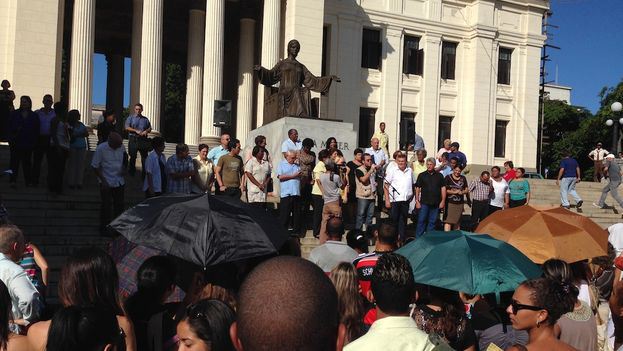
Une foule en attente se pressait à l’extérieur de cette imposante bâtisse du quartier du Vedado dont le jardin est orné d’une statue d’Abraham Lincoln. L’école de langue ouvrait ses portes pour de nouvelles inscriptions et l’on faisait passer ces jours-ci les tests de niveau aux intéressés. Nous attendions tous nerveusement, pensant qu’on nous évaluerait qui sur des prononciations, qui sur du vocabulaire. A notre grande surprise les questions principales ne portaient pas sur la langue mais versaient plutôt dans le politique. En milieu de matinée, une fille qui avait été refusée nous prévint : « ils interrogent sur le nom du premier secrétaire du Parti Communiste du quartier « Ville de la Havane » ». Nous restâmes bouche bée : mais qui pouvait bien savoir ça ?
Quelques décennies auparavant, les dirigeants de celles que l’on appelle « organisations politiques et de masses » étaient des figures connues à travers tout le pays. Soit du fait de leur présence excessive dans les médias officiels, de leur longévité à leur poste ou de l’exercice d’une politique personnaliste, ces visages pouvaient être facilement identifiables même par les enfants d’école primaire. Nous entendions parler avec insistance du secrétaire de l’Union des Jeunes Communistes. Chaque jour aux infos on nous montrait l’homme qui dirigeait le PCC dans telle province ou on nous farcissait le crâne de déclarations émanant de quelque président de la Fédération Etudiante Universitaire. Certains avaient même gagné des surnoms ou étaient à l’origine de blagues liées à leurs petites manies et à leur manque d’efficacité.
Ils ont mentionné ce matin à la télévision nationale un certain Carlos Rafael Miranda, coordinateur national des Comités de Défense de la Révolution (CDR). J’ai alors réalisé à quel point ces fonctions dans lesquelles les hommes semblaient avoir un si grand pouvoir et décider de tant de destins étaient devenues inconsistantes. Des personnes à présent inconnues dirigent des institutions qui tombent chaque jour un peu plus dans l’indifférence et l’oubli. Des dirigeants régnant sur des dirigés qui ne parviennent pas à retenir avec certitude les nom et prénom des premiers. Tout simplement les fantômes d’un système où la pénurie de charisme se fait de plus en plus sentir.
Traduction MK et L1
[ad_2]
Source link -
Angle des rues Infanta et Vapor, 20h. Un échafaudage grince sous le poids de ses occupants. La zone est sombre, mais malgré cela, deux peintres passent leurs rouleaux sur les balcons sales, les façades, les hautes colonnes qui donnent sur l’avenue. (suite…)
-
[ad_1]

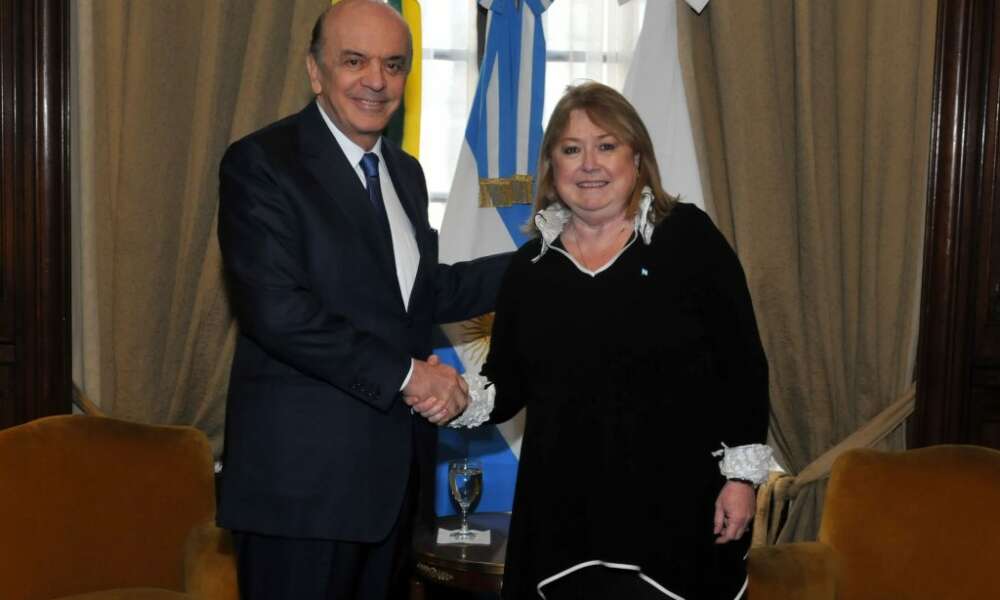
Le ministre brésilien des relations extérieures, José Serra, rend visite à son homologue argentine, Susana Malcorra, à Buenos Aires, le 23 mai.
Six mois à peine après avoir été nommée ministre des relations extérieures de l’Argentine, Susana Malcorra, 61 ans, est candidate à la succession de Ban Ki-moon, secrétaire général des Nations unies. Etrange décision d’un gouvernement de centre droit qui a trouvé une diplomatie malmenée depuis des décennies par les péronistes qui se sont succédé à la tête de l’Etat.
« Le président Mauricio Macri a estimé que ma candidature était positive pour la projection internationale de l’Argentine », explique Mme Malcorra, de passage à Paris. Haute responsable de l’ONU de 2004 à 2012, elle sait pertinemment que la succession de Ban Ki-moon devrait échoir à un ressortissant de l’Europe de l’Est, selon le système de rotation géographique en vigueur dans les organismes onusiens. A ce titre, Irina Bokova, à la tête de l’Unesco, faisait figure de favorite.
« La rotation est une tradition, elle n’est pas une règle inscrite noir sur blanc dans les textes, rétorque Mme Malcorra. Lorsque des candidatures d’Europe occidentale et de Nouvelle-Zélande se sont déclarées, je me suis dit qu’il fallait occuper le terrain. Je pense que mon nom pourrait représenter l’Amérique latine. Il y a un mouvement positif dans cette direction. »
Une candidature latino-américaine est une gageure, à un moment où la région semble écartelée par des divergences et des tendances centrifuges. L’Argentine et le Brésil, dont la convergence de vues était minée par la concurrence et le protectionnisme, essayent de relancer une relation que les deux pays ont toujours considérée stratégique pour la stabilité de l’Amérique du Sud.
-
14ymedio, Yoani Sanchez, Havana, 1 September 2014 — Today is Zero Day, the fateful date, the day the General Customs of the Republic enacts its new restrictions for non-commercial imports. The measure called to mind an old joke that circulated in the nineties and is still heard today. In this humorous story, a foreign journalist interviewed Fidel Castro and he listed all the obstacles we had faced. « The Cuban people have survived the collapse of transportation, the food crisis and power cuts, » the delusional politician said proudly. The reporter interrupted him and asked: « And you haven’t tried cyanide, Comandante? »
Nearly two decades have passed and they are still imposing limits and prohibitions incompatible with development and with life. As if in this social laboratory they want to test what they can do to get the guinea pigs — which are us — to keep breathing, clapping, accepting. The new experiment doesn’t come in the form of a syringe, but through customs rules governing the luggage of every traveler. Measures that were taken without previously allowing commercial imports that favor the private sector. As if in the closed glass box in which we are trapped, they are cutting off the oxygen… and watching from the other side of the glass to see how much we can stand.
And you haven’t tried cyanide, Comandante? echoed in my head while I read « The Green Book » with the new prices and limits applied to imports from electric razors to disposable diapers. We lab rats, however, have not remained calm and quiet, like so often in the past. People are complaining, and with good reason, that these restrictions are suffocating self-employed labor and the domestic economy. Everyone is upset. Those who receive parcels from abroad as well as those who don’t, because some of those bouillon cubes or rheumatism creams end up reaching their hands through the black market or the solidarity of a friend.
It’s not that we Cubans have a specific gene to accumulate things and — out of pure neurosis — throw stuff into our suitcases from toilet paper and toothpaste to lightbulbs. The reason is not an altered chromosome, but a system that has failed to maintain a stable and high-quality supply of almost any product… except canned ideology and the insipid porridge of the cult of personality. While the shelves of the stores are empty, or filled with the worse quality merchandise at stratospheric prices, we have to bring from outside what we don’t have here. A law on commercial imports was not what we needed and the knife of customs restrictions falls very heavily upon us.
That the measures have come into force is still more evidence of the divorce between the Cuban ruling class and the people’s reality. In their mansions there is no lack of resources, food, nor imported products! They, of course, have no need to bring them home in their luggage. To stock up they reach out to the Ministry of Foreign Commerce, to the official containers that arrive at our ports, and a network of transport that brings chlorine for their swimming pools and French cheese right to their doors. The customs rules do not affect them, because they don’t pay excess luggage fees on their luxuries, which are not considered sundries, household items or food. They live outside the law and watch us locked behind the thick glass of the laboratory they’ve built for us.
Have you tried cyanide… General? Perhaps it would be faster and less painful.
Originally posted here:
Have You Tried Cyanide… General? -

New students at the University of Havana (14ymedio)Born during the Special Period, they have grown up trapped in the dual currency system, and when they get their degrees Raul Castro will no longer be in power. They are the more than 100,000 young people just starting college throughout the country. Their brief biographies include educational experiments, battles of ideas, and the emergence of new technologies They know more about X-Men than about Elpidio Valdés, and only remember Fidel Castro from old photos and archived documentaries.
They are the Wi-Fi kids with their pirate networks, raised with the « packets » of copied shows and illegal satellite dishes. Some nights they would connect through routers and play strategy video games that made them feel powerful and free. Whoever wants to know them should know that they’ve had « emerging teachers » since elementary school and were taught grammar, math and ideology via television screens. However, they ended up being the least ideological of the Cubans who today inhabit this Island, the most cosmopolitan and with the greatest vision of the future.
On arriving at junior high school they played at throwing around around the obligatory snack of bread while their parents furtively passed their lunches through the school gate. They have a special physical ability, an adaptation that has allowed them to survive the environment; they don’t hear what doesn’t interest them, they close their ears to the harangues of morning assemblies and politicians. They seem lazier than other generations and in reality they are, but in their case this apathy acts like an evolutionary advantage. They’re better than us and will live in a country that has nothing to do with what we were promised.
A few months ago, these same young people, starred in the best known case of school fraud uncovered publicly. Some of those hoping to earn a place in higher education bought the answers to an admissions test. They were used to paying for approval, because they had to turn to private tutors to teach them what they should have learned in the classroom. Many of those who recently enrolled in the university had private teachers starting in elementary school. They are the children of a new emerging class that has used its resources so that their children can reach a desk at the right hand — or the left — of the alma mater.
These young people dressed in uniforms in their earlier grades, but they struggled to differentiate themselves through the length of a shirt, a fringe of bleached hair, or through pants sagging below their hips. They are the children of those who barely had a change of underwear in the nineties, so their parents tried to make sure they didn’t « go through the same thing, » and turned to the black market for their clothes and shoes. They mock the false austerity and, not wanting to look like militants, they love bright shiny colors and name brand outfits.
Yesterday, with the start of the school year, they received a lecture about the attempts of « imperialism to undermine the revolution through its youth. » It was like a faint drizzle running over an impervious surface. The government is right to be worried; these young people who have entered the university will never become good soldiers or fanatics. The clay from which they are made cannot be molded.
Excerpt from:
Who Is Filling Cuba’s University Classrooms? -

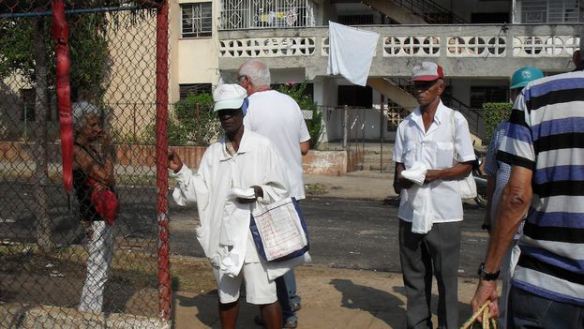
Selling ‘jabitas’ (plastic bags) in front of an agricultural market in Havana. (Luz Escobar)14ymedio, Yoani Sanchez, Havana, 28 August 2014 – « I need some dark glasses, » Veronica told me one day when I ran into her on the street. Almost seventy, the lady underwent cataract surgery some months ago and now must « take care of my eyes, » as she explained to me. She works in the sun selling jabitas (plastic bags) to the customers of the farmers market on Tulipan Street. The harsh midday glare is hard on her eyesight, but that’s not the worst of her problems. « We have an alarm system to know when the police are coming, although sometimes they’re in plainclothes and catch us by surprise. » Last month she paid a 1,500 Cuban peso fine (roughly $60 US) for engaging in illegal sales, and this week she received a warning letter for recidivism for the same offense.
If you read articles like Randy Alonso’s about the absence of bags in the hard currency stores, you might come to believe this resource is being diverted into the hands of unscrupulous traders. However, it’s enough to simply know Veronica to understand that her business is one more of misery than of profit. For the four decades she worked as a cleaning assistant in a school, the lady now receives a pension that doesn’t exceed ten dollars a month. Without the resale of the plastic bags, she would have to beg, but she asserts that she « would die before asking for money in the streets. » She is not to blame, rather she is a victim of the circumstances that have pushed her into an illegal activity to survive.
Having to carry purchases in one’s hands in the absence of bags is something that annoys any buyer. But realizing that Randy Alonzo, one of the great spokesmen of the current system, doesn’t know the human dramas that lead to the diversion of plastic bags, is even more irritating. It’s not about callous people who are dedicated to enriching themselves through the fruits of State embezzlement, but rather citizens whose economic poverty leads them to resell whatever product comes into their hands. Right now Veronica is outside some business, wearing the old dark glasses they gave her, muttering « I have jabitas, I have jabitas, one peso each. »
More:
After 40 Years of Working, Keeping Body and Soul Together Selling Plastic Bags