
De gauche à droite : Nicolas Maduro, Evo Morales et Raul Castro, le 5 mars à Caracas. Juan Barreto/AFP Combien sont-ils ?
De gauche à droite : Nicolas Maduro, Evo Morales et Raul Castro, le 5 mars à Caracas. Juan Barreto/AFP Combien sont-ils ?
Let’s go to Alamar! My mother would say and we would head out to visit some relatives who lived in that so-called « Siberia. » We arrived in an area of ugly, coarse buildings haphazardly tossed on the grass. We would play with other kids among these concrete boxes in the high grass that grew all around. It smelled of the sea, and also of boredom. It should have been the city of the New Man, but it was just a failed architectural experiment.
Alamar, despite its urbanist failings, has been the hotbed of a vibrant and rebellious musical genre: hip-hop. Its amphitheater has hosted some of the most memorable alternative concerts in Island memory. Hard songs, composed with the words of daily life and the poetry of the street. Duels between opponents who, instead of throwing weapons or blows, launch words and rhymes. How did the stage for this « citizen laboratory » end up sheltering these lyrics of the rebellion? What happened with the victorious anthems that led to such corrosive verses of survival?
What happened was that reality set in. Alamar was one of the areas of Havana hardest hit by the economic hardships of the Special Period. It saw thousands of its inhabitants leave during the 1994 Rafter Crisis, and suffered extremely long power cuts accompanied by robberies and other acts of violence. The Russian technicians left, the squatters made the empty homes they left their own, and the Chilean exiles who lived there, for the most part, returned to their own country.
Then the immigrants from the eastern provinces arrived, illegal constructions extended on all sides, and the police declared that bedroom city a « danger zone. » A « people warehouse, » conceived for disciplined and mediocre people, demonstrated that when you play with the social or constructive alchemy, you rarely achieve the desired results.
Amid the gray cement, the tiny rooms and the boredom, hip-hop has become the daily soundtrack. Alamar has its own rhythm. A cadence that hits the head like the waves that crash against its dogtooth coastline. Like the picks hitting the ground to lay the foundation of a quadrilateral and submissive future that never came.
Link:
Alamar and Hip-Hop: The Soundtrack of Cuba’s Reality (VIDEO)
The dialogue between the Venezuelan opposition and Nicolas Maduro is in full swing. Its critics are many, its most visible loser: the Cuban government. For a system that for more than half a century has disqualified and reprimanded its dissidents, this discussion table must present a sad acknowledgement of its own inabilities.
Last Tuesday stunned Cuban viewers could watch a debate between the opposition forces in Venezuela and pro-government representatives. The controversial meeting was broadcast on TeleSur, which is characterized by its tendency to back the work of Chavism with its reporting. On this occasion, however, it was forced to also broadcast the concerns and arguments of the other side.
The requirement that cameras and microphones would be present at the discussion proved to be a magnificent political move by Maduro’s adversaries. In this way the audience is engaged in the dialogue and it’s more difficult to publish distorted versions later. The participants on both sides were allowed ten minutes each, an exercise in synthesis that the Venezuelan president, clearly, couldn’t accomplish.
For disinformed Cubans, the first thing that jumped out at us was the high level of the arguments the opposition brought to the table. Figures, statistics and concrete examples expressed within a framework of respect. The next day the most commonly heard comment in the streets of Havana was the popular phrase, « They swept the floor with Maduro. » A clear reference to the crushing critiques of his rivals. The government supporters, however, were notably timid, fearful, and offered a discourse plagued with slogans.
There is no doubt, this discussion table has been a bitter pill to swallow for those who up until a few hours before were accusing their political opponents of being « fascists » and « enemies of the nation. » Venezuela will no longer be the same, although the negotiations end tomorrow and Nicolas Madura will once again take the microphone to hand out insults right and left. He acceded to a discussion and this marks a distance between the path followed by the Plaza of the Revolution and another that recently began for Miraflores.
And in Cuba? Is this also possible?
While the broadcast of the Venezuelan dialogue was airing, many of us asked ourselves if something similar could occur in our political scenario. Although the official press presents these conversations as a sign of strength on the part of Chavism, it has also kept enough distance so that we won’t get illusions of possible Cuban versions.
It is less chimeric to imagine Raul Castro getting on a plane and escaping the country than to project him sitting at a table with those he dubs counterrevolutionaries. For more than five decades, both he and his brother have been dedicated to demonizing dissident voices, such that now they are prevented from accepting a conversation with their critics. The danger posed by the impossibility of negotiations is that it leaves only the path to an overthrow, with its consequent trail of chaos and violence.
However, not only do the Cuban regime’s principal figures show reluctance before any negotiating table. The better part of the Island’s opposition doesn’t want to hear it spoken of. Before this double rejection, the agenda of a chimeric meeting fails to take shape. The opposition parties haven’t yet come together on a project for the country that can be coherently defended in any negotiation and look like a viable alternative. We members of the emerging civil society have reasons to feel concerned. Are the politicians now operating illegally in the country prepared to sustain a debate and capable of convincing an audience? Could they represent us with dignity when the time comes?
The answer to this question will only be known once the opportunity arises. Until now the Cuban political dissidence has concentrated more on tearing down than on elaborating foundational strategies; the greater part of their energy has been directed to opposing the governing Party rather than on persuading their potential followers within the population. Given the limitations on disseminating their programs and the numerous material restrictions they suffer, these groups have not been able to carry their message to a significant number of Cubans. It is not entirely their responsibility, but they should be aware that these deficiencies hinder them.
If tomorrow the table for a dialogue was set, it would be unlikely that we would hear a speech from the Cuban opposition as well articulated as that achieved by their Venezuelan colleagues. However, although negotiation isn’t a current possibility, no one should be exempted from preparing for it. Cuba needs for the people before those possible microphones to be those who best represent the interests of the nation, its worries, its dreams. They may speak for us, the citizens, but please, do so coherently, without verbal violence and with arguments that convince us.
See the original post:
The Venezuelan Dialogue From a Cuban Point of View

Better naked than…
A woman with her breasts bare is an oracle in an ephemeral work of art. It is Havana in the ’80s and the scandal caused by the exhibition « Nine Alchemists and a Blind Man » ends with its closing and the demonization of more than a few artists. The uncovered skin is a challenge, a protest, in a country where power, still today, sheaths itself in olive-green uniforms, long sleeves, hot outfits that hide, instead of display.
Authoritarians handle nudity badly. They feel impure, dirty, humiliated, when in reality it is the natural and primitive state of human beings. Totalitarians are prudish, prudish and timid. Any libertarian gesture frightens them, and they perceive too much exposed skin as a gesture of defiance. They think this because — deep down — they see the human body as something impure and obscene. Hence, undressing their opponents constitutes one of the repressive practices they most enjoy. They believe that by stripping them of their clothes they reduce them to simple animals. The same mental mechanism that leads them to call their critics « worms, » « vermin » or « cockroaches. »
In a windowless cell a guard forces a political prisoner to undress; in a room where no one can hear the screams, three women grope around under the clothes of a recently arrested citizen; in a dorm at a school in the countryside the showers don’t have curtains so no student can possess the territory of her own body; in a cold gray room the Jews were stripped of their clothes before entering the gas chambers. Undressing to humiliate, undressing to dehumanize, undressing to kill.
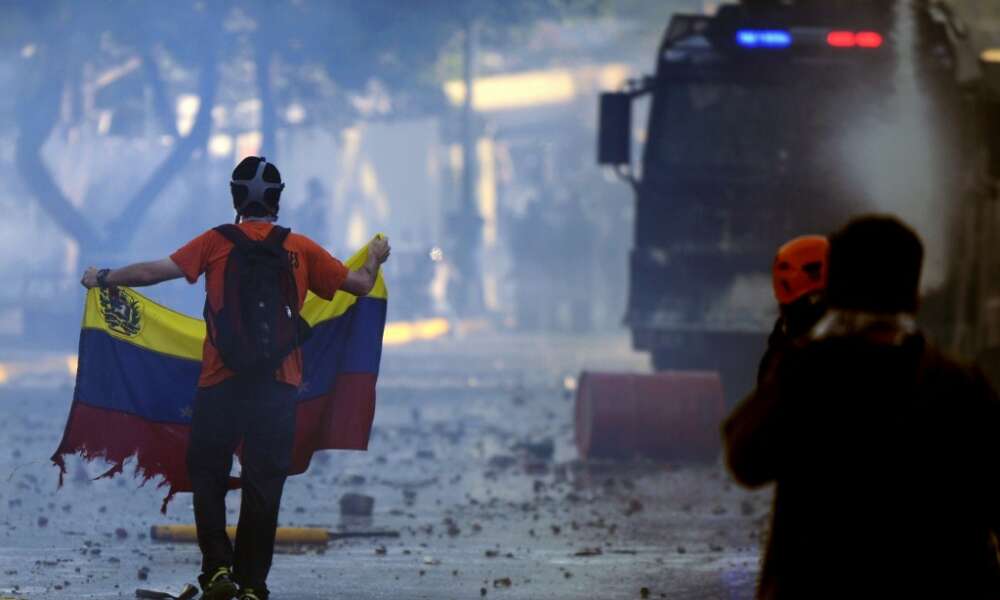
The images coming from Venezuela confirm that the practice of stripping people of their clothes as a moral punishment continues. A young man is stripped by a group seeking to degrade him by exposing every inch of his skin. However, they end up making him into a beautiful icon, pure, innocent. There is nothing dirty about the human body, there is nothing to be embarrassed about appearing before others as we came into this world.
What is shameful is these others, hiding behind their uniforms, trappings, the military ranks they awarded to themselves. They should be embarrassed to be hiding under the dishonorable garb of their fear.
My blog, GENERATION Y, has moved: READ IT HERE.
Read me and other Cuban bloggers on TRANSLATING CUBA.
And here is a link to my blog IN OTHER LANGUAGES.
Visit site:
#MejorDesnudosQue: Better Naked Than
Le général Raul Isaias Baduel, 58 ans, reçoit la famille et des amis dans sa cellule de la prison militaire de Ramo Verde, à Los Teques (Etat de Miranda), à trente kilomètres de Caracas, samedi 29 mars, après avoir été privé de visite depuis la fin février.
Read More:
Au Venezuela, le général Baduel, qui a sauvé Chavez des putschistes, en prison depuis cinq ans

Photo: MJ Porter
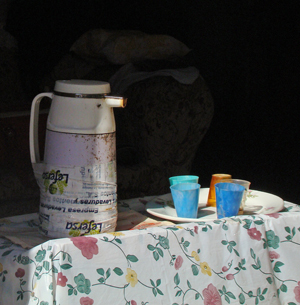
The day started with a certain nightmarish atmosphere. The little sip of morning coffee was missing, because the seller with a thermos and paper cups wasn’t on the corner. So she dragged her feet to the bus stop, while keeping an eye out for a collective taxi. Nothing. Not even an old Chevrolet came down the avenue, nor was there one of those ingenuous station wagons that can fit up to twelve people anywhere in sight. After an hour’s wait she managed to climb on the bus, irritated that she didn’t even have a little paper cone of peanuts to calm the hunger pangs emanating from her stomach.
At work that day she couldn’t do much. The director didn’t make it in because the woman who cares for her daughter was absent. The same thing happened with the administrator; her Russian-made Lada blew a tire and the tire-repair guy in her neighborhood closed early. At the lunch break the food trays were so empty they barely weighed a thing. The guy with the cart selling vegetables and tubers, with which they stretch the lunch menu, didn’t come by. The head of public relations had a nervous breakdown because he couldn’t print the photos he needed for a visa. The door of the nearest studio had a sign saying « Not Open Today, » so his travel plans were ruined.
She decided to walk home to avoid having to wait. Her son asked if there was something to snack on, but the bread delivery man, with his sharp cry, hadn’t shown up. Nor were the pizza kiosks open, and a raid on the farmers market had left all the stands empty. For dinner she cooked the little she found and washed the dishes with a rag from an old shirt, because there weren’t any vendors selling dish mops. On top of everything, the fan wouldn’t go on and the appliance repairman wasn’t in his workshop.
She went to bed, in a pool of sweat, uncomfortable, hoping she would wake up to the return these figures who make her life possible: the self-employed, without whom her days are a sequence of deprivations and aggravations.
My blog, GENERATION Y, has moved: READ IT HERE.
Read me and other Cuban bloggers on TRANSLATING CUBA.
And here is a link to my blog IN OTHER LANGUAGES.
Read this article:
Cuban Regime Ambivalent About Self-Employed, While the People Can’t Live Without Them

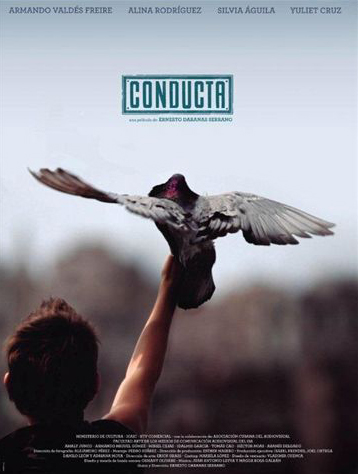
Miguel has earned a lot of money this week. He managed to sell almost one hundred pirated copies of the Cuban movie Conduct. Although the film is showing in several of the country’s theaters, many prefer to see it at home among friends and family. The story of a boy nicknamed Chala and his teacher Carmela is causing a furor and leading to long lines outside the premiere cinemas. It’s been decades since any national production has been so popular or provoked so many opinions.
Why is the latest creation of director Ernesto Daranas becoming such a social phenomenon? The answer transcends artistic questions to delve into the depth of his dreams. While it is clearly told with excellent cinematography and superb acting, its the realism of the script that is the greatest achievement of this film. The movie generates an immediate rapport with the audience, reflecting their own lives as if reflected in a mirror.
In the dark theaters, facing the screen, the spectators applaud, scream and cry. The moments of greatest emotion from the house seats coincide with the politically, most critical speeches. « No more years than those who govern us, » answers the teacher Carmela when they want her to retire because she’s spent too much time in the teaching profession; an ovation of support runs through the theater at that instant. The semi-darkness exacerbates the audacity and complicity.
The « Conduct phenomenon » is explained by its ability to reflect the existence of many Cubans. But it goes far beyond a simple realistic portrait, to become an x-ray that lays bare the bones. A Cuba where there is hardly any moral framework left for a child in this environment light-years away from the ideal claimed by the official media. Barely 12, Chala supports his alcoholic mother with what he earns from illegal dog fights, inhabiting a harsh unjust city, impoverished to the point of tears.
It’s not the first time Cuban cinema has shown the tough side of reality. The film Strawberry and Chocolate (1993) paved the way for social criticism, particularly with regards the discrimination against gays and artistic censorship. The cost of its daring was high, because it had to wait 20 years to be shown on national TV. Alice in Wonderland (1991) faced a worse fate, with the political police filling the theaters where it was projected, and party militants screaming insults at the screen. Conduct has arrived in at different juncture.
The spread of new technologies has allowed many filmmakers to find ways to make their projects. Critical, acerbic and rebellious scripts have seen the light in the last five years because they have no need for the approval and resources from the Cuban Institute of Cinematographic Art and Industry (ICAIC). This proliferation of shorts, documentaries and independent films has been a very favorable situation for Ernesto Daranas’ filmstrip. The censors know that it’s not worth the trouble to veto such a movie on the State circuits. It would run through the illegal networks like wildfire.
A brief conversation outside the Yara cinema exposed the controversy this story unleashed. « There are a lot of people who live better than Chala, that’s true, but there are others who live much worse, » said a man in his sixties. A young woman responded that she wondered if the director « exaggerated the squalor of the situations shown. » Another girl joined the debate to say, « You say this because you live in Miramar, where these things don’t happen. »
On Tuesday night, the ruling party journalist Randy Alonso also joined the line to see the movie in the final showing of the day. Behind him giggles and comments were heard — « So what’s he doing here? » — given that his face is associated with uncritical journalism, a sycophant of power. Once inside the theater, those who sat near him did not see him join the chorus of shouts of support. With every minute that passed, he seemed to sink more deeply into his seat, not wanting to be noticed. What he was seeing on the screen was the exact opposite of what he explains on his boring Round Table show.
So it is that Conduct was able to gather in the same room the fabricators of the myth and those burdened by it. After the projector is turned off, the doors open and the viewers exit to reality similar to the script, but one where they can no longer express themselves under the protection of the shadows. Chala waits for them on every corner.
My blog, GENERATION Y, has moved: READ IT HERE.
Read me and other Cuban bloggers on TRANSLATING CUBA.
And here is a link to my blog IN OTHER LANGUAGES.
Read this article:
Cubans Flock to New Film That Exposes the Myth