Catégorie : Politique

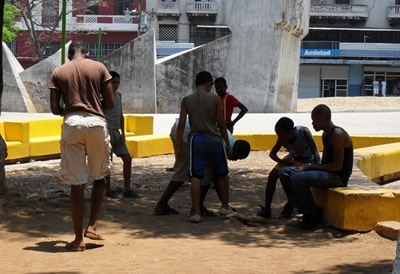
  • Children and teens playing in the street. Photo: Luz Escobar

    Children and teens playing in the street. Photo: Luz Escobar

    « When the teachers aren’t listening, what do the students in your classroom talk about? » I asked my son a few months ago. He barely paused before answering. « The boys talk about football and the women about telenovelas, » he replied, sure of himself. I confess, I expected more. I had imagined slightly risqué topics like sexuality, or problems such as drug use or, in some cases, political controversies. But no, the long minutes of the breaks between one class and another are dominated by Messi, Cristiano Ronaldo, and the latest wickedness of the Brazilian soap and its heartthrob who shows his face on the small screen every week.

    My first reaction was dismay. « If, at the most rebellious age, this is what they talk about… we’re in bad shape. » But then I stopped myself. I was not going to fall into what older people had warned me of when I was a teenager. « Your generation is lost, » they told me, followed by an enumeration of everything they themselves had accomplished. So, before answering Teo, I tried to understand why the reality of the country, its serious problems and possible solutions, occupy so little time — or none — in our young people’s conversations. Apathy, escapism, indifference… were some explanations. After the initial moment of disappointment, I felt relief. Comforted knowing that even this inertia is a way of bringing the current system to an end.

    The Cuban model needs people who applaud wildly, committed soldiers, ideologically convinced individuals. Indolence will never be the soil where rebellion grows, nor will it foster partisan fervor. As I’ve said many times, « I prefer apathy over fanaticism. » From apathy, one can wake up, from fanaticism, I have my doubts. Frivolity is also corrosive to a sober and outdated totalitarianism.

    These young people of today, they still have plenty of time for their civic consciousness to awaken.

    Yoani’s English Language blog is here, and her posts also appear in TranslatingCuba.com here, along with those of over 100 independent voices writing from the Island. You can help translate Cuban bloggers at HemosOido.com here.

    Read the original post:
    For Cuban Youth… It’s All About Soccer and Soap Operas… And That’s a Good Thing
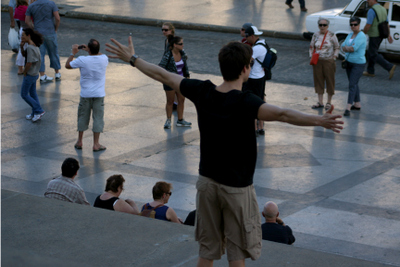

  • Photo by Silvia Corbelle

    If reality could personify itself, climb into a body, have physical contours. If a society could be represented by a living being, ours would be a growing adolescent. Someone who will stretch out his arms and legs and throw off paternalism to become an adult. But that beardless boy is wearing clothes so tight they hardly let him breathe. Our daily life has been compressed by the corset of a legality with excessive prohibitions and by an ideology as outdated as it is dysfunctional. This is how I would draw the Cuba of today, this pubescent but repressed form would represent the context I live in.

    The governmental trend is not moving to recognize our needs for economic and political expansion. Rather it is trying try to squeeze us into absurd molds. This is the case with the limited occupations allowed to self-employed workers, the sector that in any other country would be classified as « private. » Instead of expanding the number of licenses to included many other productive activities and services, the authorities are trying to cut reality to fit within the accepted list. The law doesn’t work to encourage creativity and talent, but rather to constrain the limits of entrepreneurship.

    The latest example of this contradiction is seen in the operations against those who sell imported clothes, primarily from Ecuador and Panama. According to the official media, many of these merchants are licensed as « Tailors, » which allows them to market articles coming from their own sewing machines; and instead they offer industrially manufactured blouses, pants and bags. Violators are punished by confiscation of their merchandise plus heavy fines. The inspectors attempt, in this way, to force our reality into the straitjacket regulated by the Official Gazette.

    Why, instead of so much persecution, don’t they authorize the work of « merchant. » Buying, transporting and reselling articles in high-demand should not be a crime, but rather a regulated activity that also contributes to the treasury through taxes. To deny this key piece in the machinery of any society is to misunderstand how to structure its economic fabric. The legal framework of a nation shouldn’t condemn it to the infancy of timbiriches — tiny Mom-and-Pop stands — and to the manufacture and sale of churros, but rather it should help us expand professionally and materially. As long as the Cuban government doesn’t accept the ABCs of development, our reality must grow and stretch its arms towards illegalities and the underground market.


    My blog, GENERATION Y, has moved: READ IT HERE.

    Read me and other Cuban bloggers on TRANSLATING CUBA.

    And here is a link to my blog IN OTHER LANGUAGES.

    Continue reading here:
    Cuba: Where ‘Merchant’ Is a Dirty Word

  • L’économiste Oscar Espinosa Chepe, une des figures les plus respectées de la dissidence cubaine, est mort à Madrid, lundi 23 septembre, à 72 ans. Il avait été un des 75 opposants pacifiques condamnés en 2003 à de lourdes peines de prison – dans son cas vingt ans de détention pour avoir collaboré à des médias de l’étranger.

    More here:
    Oscar Espinosa Chepe, figure de l’opposition à Cuba, est mort à Madrid

  • Le réalisateur Daniel Diaz Torres est mort à La Havane, lundi 16 septembre, à 64 ans. Il était le metteur en scène d’un film, Alicia en el pueblo de Maravillas (Alice au village des Merveilles, 1991), qui avait fortement déplu aux autorités de La Havane, au point de les amener à envisager la dissolution de l’Institut cubain de l’art et de l’industrie cinématographiques (ICAIC).

    Excerpt from:
    Le cinéaste Daniel Diaz Torres est décédé à Cuba

  • Chef du groupe de « jazz fusion » Interactivo, le Cubain Roberto Carcassés, 41 ans, a été interdit de se produire en public par les autorités de La Havane, lors d’une réunion à l’Institut cubain de la musique. Cette interdiction frappe en fait l’ensemble du groupe, privé de son pianiste et chanteur. La censure sanctionne une improvisation de « Robertico » Carcassés, au cours d’un concert de solidarité avec les agents secrets cubains emprisonnés aux Etats-Unis depuis quinze ans pour espionnage – ceux que la propagande officielle de Cuba appelle « les cinq héros » (même s’ils ne sont plus que quatre)

    Taken from:
    Cuba censure le musicien Roberto Carcassés après une improvisation politique au cours d’un concert


  • Beto was one of those who handed out beatings in August of 1994. With his helmet, his mortar-splattered pants and an iron bar in his hand, he lashed out at some of the protestors during the Maleconazo. At that time he was working on a construction team and felt like part of an elite. He had milk at breakfast, a room he shared with other colleagues, and a salary higher than any doctor’s. He spent the years of his youth building hotels, but a decade ago, when his brigade was demobilized, he became unemployed. He didn’t want to return to the village of Banes where he was born, not him, nor many others of that troop ready to build a wall or break heads.

    Several of these construction workers were allowed to settle in a makeshift neighborhood in the Havana suburbs. The received the benefit of permission to build a « llega y pon* » — a shantytown — near Calle 100 and Avenida Rancho Boyeros. A crumb, after so much ideological loyalty. Without the perks and high wages, many of these bricklayers had to survive on what they could find. Beto set up a workshop for fabricating « creole bricks. » Other neighbors in his makeshift neighborhood also dedicate themselves to building materials: sand, stone powder… bricks. With the new relaxations giving permission for the repair and building by one’s own efforts, the business of « aggregates » prospers, involving more people every day. The producers, transporters, brigade leaders, and finally the men who load the sacks on the trucks. A chain of work — parallel to the State’s — more efficient, but also at higher prices.

    Beto doesn’t like talking about the past. In his shirt full of holes he walks between the stacks of Creole blocks coming out of his little factory. When he sees one that has cracked or that has a broken corner, he shouts at one of his employees who mixes the mortar for casting the molds. He carries an iron rod in his hand, as he did on 5 August 1994, but this time it’s for knocking against the blocks, checking the strength of his product. He frequently glances over to the little house he is building at the end of this unpaved street with no drains. For the first time he has something of his own, something no one has given him. He is a man with neither privilege nor obedience.

    *Translator’s note: « llega y pon » is literally « arrive and put. »


    My blog, GENERATION Y, has moved: READ IT HERE.

    Read me and other Cuban bloggers on TRANSLATING CUBA.

    And here is a link to my blog IN OTHER LANGUAGES.

    Visit site:
    Cuba: A Man With Neither Privilege Nor Obedience


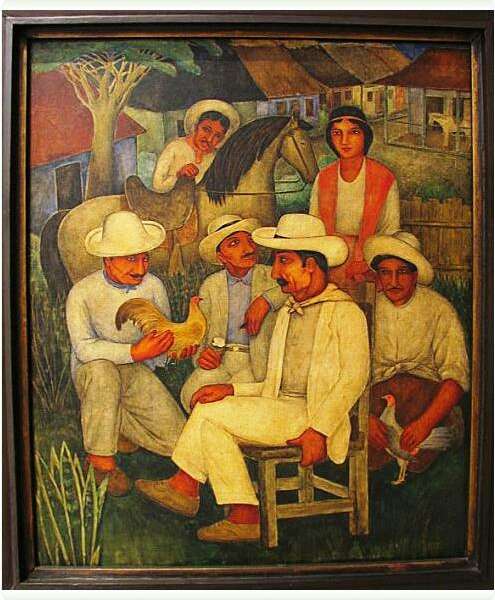
  • Guajiros (peasants), Eduardo Abela

    The composition is almost circular, compact. The eyes follow a spiral line that starts on the shoe of the man seated in the foreground and ends at the rooster held by another. There is peace, vestiges of good conversation, and in the background a village of wood and palm leaf huts. Six Cuban peasants have been represented in this painting by Abela, as well known as it is plagiarized. Their faces are tanned by the sun and vaguely indigenous. They are magnetic, irresistible. Our gaze takes us to the details of their clothing. « Dressed to the nines, » impeccable sombreros, long sleeves, perhaps with the fabric starched for the occasion.

    Infected by the familiarity of the painting, I go to the countryside, put myself in the furrows where so many times I have picked tobacco, beans, garlic… I go in search of that original exemplar of Cubanness that is rural man. However, under the scorching sun of August, instead of « Abela’s guajiros, » I find people dressed in military garb. Olive-green pants, shirts that lost their epaulettes long ago, old berets from some battle that never happened. They don the uniforms of the Armed Forces or the Ministry of the Interior to face the rigors of the fields. They don’t have many choices.

    In the informal market it’s easier to buy an official jacket than a shirt for farm work. A police cap costs less than a straw sombrero. Belts made out of cowhide are also a thing of the past; today it’s easier and cheaper to find those used in the army. The situation is the same for shoes. Rubber boots are scarce and instead the men and women of the land wear shoes designed for the trenches and combat. In a militarized country, even in the smallest details the military prevails over tradition.

    State centralization was drying up the autonomous production of clothes designed for farming. Not even the recent relaxations for self-employment have encouraged this production. It is not just an issue of economics or supply, this situation also affects questions of our national idiosyncrasies and popular customs. A current version of Abela’s painting would leave us with the impression of a looking at a militia group in tattered clothing posing for the painter in the middle of an encampment… about to sound the reveille.


    My blog, GENERATION Y, has moved: READ IT HERE.

    Read me and other Cuban bloggers on TRANSLATING CUBA.

    And here is a link to my blog IN OTHER LANGUAGES.

    More here:
    Where Are Abela’s Guajiros?


  • Photo: Silvia Corbelle

    My grandmother made a living washing and ironing for others. When she died, in her mid-eighties, she only knew how to write the three letters of her name: Ana. For her whole life, she worked as a maid for a family, even after 1959 when official propaganda boasted of having emancipated all servants. Instead, many women like her continued to work in domestic service but without any legal security. For my sister and me, Ana spent part of her days in « the house on Ayestarán Street, » and we never said out loud that she was paid to clean the floors, wash the dishes and prepare the food there. I never saw her complain, nor did I hear of her being mistreated.

    A couple of days ago I heard a conversation that contrasted with the story of my grandmother. A plump lady dressed in expensive clothes was telling her friend — between glasses of white wine — how she behaved with her young domestic. I transcribe here — without adding even a word — a dialog that left me feeling a mixture of revulsion and sadness:


    – From what you tell me, you’re lucky.

    – Yes, I really can’t complain. Suzy started with us when she was 17 and she just turned 21.

    – Now we’ll see if she gets pregnant and you have to throw her out.

    – No, she’s very clear on that. I told her that if she gets pregnant she’ll lose her job.

    – Yes, but you know, « the fox always returns to its den. » So maybe she’ll run after some man from the village where she was born.

    – No way! She won’t even go to that « den » on vacation. Imagine you didn’t have any electricity, the floor of her parents’ house is dirt, and the latrine is shared by four families. It’s like the heavens opened up for her since she’s been with us. All she has to do is what I tell her, that’s all I ask.

    – That’s how they start, but later they start thinking things and ask for more.

    – So far we’re doing fine. She has Sunday afternoons off to do what she wants, but she has to come home by midnight. Most of the time she doesn’t even go out because she doesn’t know anyone in Havana. It’s better that way, because I don’t like the bad influences.

    – Yes, it’s really bad out there. These country girls do better not to even go out because if they do they learn a few things.

    – They learn more than a few things. Because of that I even monitor her phone calls. I don’t want her to learn what she doesn’t need to know.

    – And that boyfriend you told me she had?

    – No, that didn’t continue. We made it clear that we didn’t want men visiting our house. And she, really, has no time to be falling in love, my children take a lot of time. Taking them to the park, their homework after school, they like to paint before going to bed, she has to read them a story, they don’t like to watch movies alone. Poor thing, when it’s time to fall into bed she must be dead on her feet.

    – Woooow… you’re sitting in the catbird seat. I haven’t had any luck. Every time I hire one, they don’t last even a month.

    – If you like I can introduce you to Susy’s younger sister, she seems very serious.

    – How old is she?

    – Fifteen, so you can train her like you want.

    – Yes, give her my phone number and have her call me. Oh, and make it clear, I’ll buy everything: clothes, shoes. But if she leaves one day, she’s not taking even a pin from my house. Make that clear! Because they get a big head and it’s hard as hell to deflate it!

    The two women continue talking as the wine bottle passes the half-way mark. I overhear a rant about her husband’s more than 60 pairs of shoes. They laugh and I feel my stomach knotting up in a familiar way, with the accumulated anger abusers provoke in me. I go outside for a little air and see the « matron’s » car. It has green Army-issue license plates that stands out against the shiny metallic gray body. It’s the new aristocracy class, the olive-green royalty, lacking scruples and modesty. I spit on the windshield, for Susy, for Ana, for me.


    My blog, GENERATION Y, has moved: READ IT HERE.

    Read me and other Cuban bloggers on TRANSLATING CUBA.

    And here is a link to my blog IN OTHER LANGUAGES.

    Continue Reading:
    The Rise of the Cuban Aristocracy… And the Lingering Servant Class