Catégorie : Politique


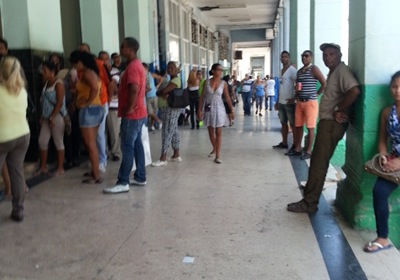
  • Line outside a Metropolitan Bank in Havana

    They don’t have their own places, but they flourish everywhere. They lend money at interest, facilitate loans, and charge the same in cash as in goods and services. They are the new moneylenders. After being stigmatized for decades, these banned bankers have returned without licenses or pity. They offer everything from small amounts to thousands of convertible pesos, although the latter is only for very reliable clients. They operate in areas they know well; they know how much their neighbors make in wages, whether they receive remittances from overseas, or if they have some other source of income. Starting with this information, they distinguish between those who will be « good for it » and those who won’t. Although there can always be surprises. The great nightmare of these « usury experts » lies in the customers’ intentions to board a boat and be smuggled out of the country, without returning to them what is theirs.

    Other situations can be resolved with pressure and threats. When a debtor is overdue in his payments, the lender feels that the time has come to teach him a lesson.

    Edward was watching television last Saturday when they knocked on his door. Two burly men pushed past him into the house and one of them hit him in the face with his fists. They took the stereo and left, but not before warning him, « You have 72 hours to pay back El Primo… if you don’t, we’ll be back and we won’t behave so nicely. » The victim could not go to the police, because, from the beginning, he preferred illicit credit, without possible complications. He spent the next three days selling some of his home appliances and going into debt to friends so that he could repay the loan. He also prayed a little that El Primo and his henchmen might be raided for the great number of crimes they commit.

    María, however, obtained a loan of 10 thousand pesos from the Metropolitan Bank. She needed to fill out endless forms and present written evidence of her employment. She planned to use the money for construction materials to remodel her old house. She felt satisfied to have gotten the sum legally, although now any paperwork she fills out includes the information that she is in debt to the State. Others, who could not meet the requirements, had to accept the conditions and interest rates of their neighborhood moneylender. More than one client has had to pay with favors from her own body when the repayment date has come and gone; more than one family has had to deliver a refrigerator or a car, because an irresponsible member thought to ask for money they could never repay.

    As necessary as he is slandered, the moneylender is just one link in the illegal financial chain of our reality. Cautious when giving, implacable when collecting.

    The English language translation of my blog Generation Y has moved: Please read it here.
    Generation Y in other languages can be accessed here.
    And more than 50 bloggers and human rights activists working from Cuba can be read here, at Translating Cuba.

    Excerpt from:
    The Return of the Loanshark to Cuba
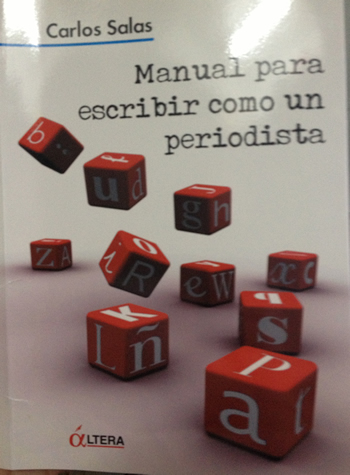

  • Recently I have been reading an excellent book by Carlos Salas, currently the director of the site lainformacion.com. One of those texts essential for any newsroom and for the library of every reporter. With the title, « Manual para escribir como un periodista » (Manual on How to Write Like a Journalist), in its pages he dissects the art of writing headlines, the skills of a good interviewer and the need for research as a prelude at any article. This professional who has devoted decades to narrating reality gives us an agile volume where he shares the knowledge others keep only for themselves.

    Wearing my « Salas glasses, » I began a meticulous analysis of the accuracy with which the official media reports the news. I did not have long to wait for the first inconsistency and deficiencies to spring into view.

    Throughout the week, the news media reported on the unfortunate story of a group of people poisoned by methyl alcohol. A party in a proletarian neighborhood in Havana that ended in tragedy. Eleven dead and dozens of people affected by ingesting this dangerous substance, it was a sad sequence of lack of control, contraband, the black market, economic precariousness and irresponsibility.

    Drama is an inseparable companion of journalism, as those of us who exercise this profession know well. But in the midst of tragedy, we must maintain the ability to discern why the national media treats certain events as so significant, while other news is simply completely silenced.

    Almost on a par with the drama of those poisoned by methyl alcohol, was an accident during a Children’s Carnival in Guantanamo. The bleachers gave way and several children were injured, one of them with head trauma. The confusion, chaos and terror that must have resulted from the collapse of this structure in the middle of a celebration are obvious. Why wasn’t such an incident reported both on television and in newspapers across the country? Because in the case of a product stolen from a warehouse and consumed in secret it was citizens who acted illegally? Who bears the responsibility for a badly constructed grandstand at a public event? The State, that omni-proprietor, that judge of everyone… judged by few.

    The news of those who died from methyl alcohol is meant to hold the victims up as examples of people who had fallen into such circumstances by violating established norms or because they suffered from an uncontrollable addiction. They always try to put responsibility on the people. The fact that, in a country with a tradition of producing rum, many prefer to buy their beverages on the black market, says more about our national penury than it does about vice. Nevertheless, the official moral was summed up as: This is what happens to the unscrupulous and to drinkers. The victims are doubly victimized.

    But in the incident of the bleachers collapse, where children and adults were injured, the official journalists could not assign guilt to the injured. Inevitably, they would have to relate the shoddy work of the state enterprise that built the structure, without any consideration for safety. Or instead, confess that a good part of the materials for the job were embezzled, which presumably caused its weakening and subsequent collapse.

    Both episodes, unfortunate and avoidable, point to a widespread and chronic problem in our reality: the need to steal and divert resources to survive. Thus, poverty wages and economic insecurity are the direct cause of these two tragedies. The culprits are not only sellers of illegal alcohol and the workers who take home some screws or pieces of wood, but also the order of things that turns us into criminals to survive.

    Follow this link:
    Two News Stories, One Focus: If You Can’t Blame the Victim Say Nothing

  • se vende6a00d8341bfb1653ef01910496c10e970c-550wi

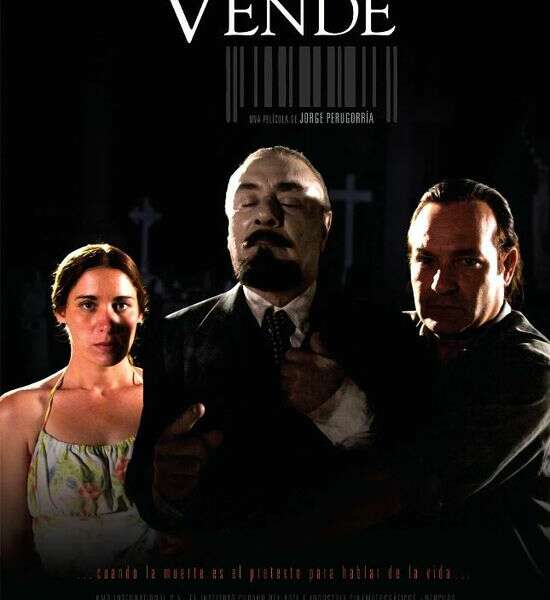
    People laugh in the darkened room, the seats creak, and from the bathroom a reek invades everything. It’s nighttime at a Havana movie theater and the audience is enjoying the most recent Cuban comedy. Titled For Sale, it was directed by the well-known actor Jorge Perugorría and has already been shown in an extended series of openings. A controversial film that provokes laughter on the one hand, and fierce criticism on the other, it has its favor that it doesn’t leave its viewers indifferent. Either they laugh with pleasure, or get up in the middle of the screening and leave. Such reactions are also symptomatic of how we Cubans respond to certain issues, work and people. We tend to love or repudiate; to applaud or reject, with no intermediate points.

    This is a humorously macabre story, with dead people who must be disinterred at the cemetery in the middle of the night. The script takes us by the hand through the absurdity of a reality where the sale of a tomb and the bones sheltered within it is the only path to financial relief for a young professional. For Sale unwinds in an also cadaverous Havana, a city of faded houses with balconies on the point of collapse. It presents us with a society where scruples and urges give way before the imperatives of survival. A wake-up call about the ferocious pragmatism that invades us, leaving nothing safe. A metaphor, perhaps, of a time in which the past is viewed with irreverence and a desire to liquidate it, by we who live in the present.

    In its favor, the movie also makes several references to the classics of Cuban filmography. The well-known game of mirrors — the film within the film — amplified and referenced. An explicit tribute to Tomás Gutiérrez Alea (Titón) and Juan Carlos Tabío. The Death of a Bureacrat, For Trade, Strawberry and Chocolate, are some of the films referred to throughout the movie. However, some of these references pass unnoticed by a large audience, one that younger or less versed in national cinema doesn’t know its antecedents. Rather than a difficulty, this lack of reference points allows another way to understand the story being told. If the script wanted to turn these hints into evocations, they’re left for many as events at the same level as others. The trick of the lens looking into the lens needs an aware viewer, otherwise it’s seen as one more point in the story.

    And then came the actor…

    The figure of the director also cast as one of the protagonists is something new in the cinematography of the island.

    Few native directors have alternated between both sides of the camera. In For Sale, the union of these roles doesn’t occur in the cautious manner of Alfred Hitchcock, where we see, for a few seconds and in the shadows, his chubby profile. In this case the spectator senses that the character of Noel recalls, too much, the actor who plays him, perhaps because his designer and interpreter are the same person. It is clear, however, that the entire filming must have been like a huge party for all the participants. To the point that at the end of the filmstrip it rushes to conclude in a great celebration where it seems to offer a solution to all the problems. An abrupt and often repeate, closing in Cuban comedies, that bore more than entertain.

    Although with Nácar, the female protagonist, the script reaches for it, it misses an intimacy, leaving only a timidity that is not credible. Lacking the weight of interior emotion that has nothing to do with the easy laugh, something we have become accustomed to in movies made in Cuba. The excessive sex scenes and erotic allusions, designed to fill theater seats, in hopes of seeing a nipple here, a thigh there… a couple kissing in the shower. « Wankers » all over the country are pleased with a script that offers them many minutes of bedrooms, beds, cunnilingus and even lesbian moments. Another contribution to the hackneyed stereotype of a hyper-eroticized national identity obsessed with the pleasures of the body. The ideological clichés are harmful, but the carnal also echoes banal and enduring perceptions.

    If you have to sacrifice the dead to feed the living…

    Beyond the pitfalls and limitations of For Sale, its main achievement is to convey a message of particular importance for Cubans today. Filled with laughter, the myths of the past are picked apart, yesterday’s buried bodies are liquidated. The dead stay dead and serve only in regards to the imperatives of the living, every minute of the film seems to tell us. The corpse of the protagonist’s father, an ideologically inflexible man, at the end of the reel is a mere mannequin in an exposition. Played by the actor Mario Balmaseda in the manner of a rigid Lenin, index finger raised, this character embodies the political leaders whose old-fashioned speech provokes laughter more than sympathy. Leaders and ideas in liquidation once their time is passed; the stark conclusion of this filmstrip.

    I am among those who stayed until the final minute of Jorge Perugorría’s film. I laughed through several of its scenes and reflected during others. Despite my own objections and criticisms, I preferred to find its nuances and intermediate points. I gave it a chance and I think it was worth it. Because through its 95 minutes, the script reaffirmed an idea I have pondered for years: no one can bear so much past, carrying on their back the weight of all the deceased. A nation is not a cemetery where the living must comply with the designs of those who are gone. The same thing ends up happening to political last wills and testaments as happens to the bones in the film For Sale: they are auctioned off for the imperatives and pragmatism of now.

    Read More:
    ‘For Sale’ — Perugorría’s Macabre Comedy Elucidates Cuba’s Dilemma

  • Noel repairs the blades of the fan. He has a little workshop in a doorway in Cerro neighborhood. He repairs electric irons, blenders, every kind of obsolete motor, and does good things with rice cookers and water heaters. It’s not a job that generates a lot of dividends. Some of the customers ask for his reliable services and then he doesn’t see them again; others want to pay in installments and end up not paying it off. However, in addition to diminished returns, this labor offers Noel a unique experience. Every day, he is in contact with people, many people. Speaking, opining, telling him what came over the illegal satellite dish and especially listening, opening his ears to what they have to say. So he has become, in his little cubicle full of grease and cables, an actor of opinion, a born leader appreciated for his abilities and respected for his words.

    Cuba is full of people like Noel, anonymous, simple, who know reality at a level no minister can reach, even with the most competent advisors. People who don’t show up on TV screens, who aren’t at the front of any parade, but who have natural charisma and contact with the people to lead changes. For now, we only know those with whom we’ve managed to interact or meet personally, but there are thousands. They will never draft a political platform, but they know by heart the most acute problems that afflict our society. They would not sign an action demanding improvements in human rights, nor will they open a blog, practice independent journalism, or autonomous law. The word « activist » scares them and to call them opponents would put an end to the life they have now. They are — without saying so — all that and much more. They are citizens of conscience, to those who damage the situation in our country.

    The future of our nation will be influenced by Cubans like this. So many who, today, are behind a desk in some office, at the front of a classroom, filling out forms in some State agency, we will see reach the public sphere. As they feel there’s a mark of respect in stating their opinions publicly, they will emerge from all sides. It’s important that at the point when they decide to take that step we do not react with our suspicions nor with confrontation, but with our embrace. Because while Noel fixes a broken fan blade, I feel that one day he will also have the ability to join together the broken and separated pieces of our reality. The same care with which he glues plastic and fixes the motor, he will put into the social leadership he will show tomorrow.

    28 July 2013

    Continue reading here:
    Leadership, for Today… and Tomorrow’s Cuba

  • 6a00d8341bfb1653ef0192ab983bd6970d

    She has broken a nail in her agitation. Tomorrow she will have to go back to the manicurist to restore the nail polish and the miniature English flag painted there. His shirt is falling apart in the effort and his whole body is covered in sweat as if someone had thrown a bucket of water over him. No, it’s not an erotic scene, it’s not love, but lawlessness. A couple under the June sun carrying sand to finish remodeling their kitchen. They’ve stolen it from a theater that is being remodeled. Lurking until the custodian fell asleep after lunch. Then they filled two bags, which are enough to build a little counter. The little house has been built this way, taking a bit from here and there, hoping for someone to look the other way to carry off some bricks or floor tiles. Their little home has been the result of depredation, of this rapacity that so many Cubans assume towards the resources of the State. Take everything you can, grab anything from this powerful owner… and get it done.

    Among the reasons some buildings take so long to build or repair are not only apathy and lack of efficiency. The theft of cement, steel and other construction materials also slows down many public works. Some are already memorable, where the amount of resources stolen increases the initial costs of the building or restoration by a factor of three. The sinks disappear even before they come off the truck, the paint cans are filled with water to resell the paint on the black market, and there is even a hotel where 36 air conditioners were stolen a few days before its opening. Faced with so many thefts, each object and resource must be closely watched and the watchers watched in turn.

    Many eyes are waiting for a slip-up. In one uncontrolled early morning a mound of gravel was reduced by a third. On some summer vacations, a school without a custodian could lose several windows and the occasional toilet. The light fixtures disappear, the electrical switches are ripped out and the looting extends also to the door handles, the stair railings, and even the ceiling tiles. With no pangs of conscience or guilt complexes on the part of the perpetrators. It’s more like the exploited poor taking a piece of the boss’s delicious snack when he’s distracted looking out the window. It is symptomatic that almost all those who take building materials from State construction projects feel no remorse for doing so. They call it « recovering, » « inventing, » « struggling, » « surviving, » When standing in a shower built with stolen tiles, under the running water they think, « you take what they give you and what they don’t give you… too. »

    Follow this link:
    No Pangs of Conscience for Cubans Who ‘Recover’ ‘Invent’ ‘Struggle’ ‘Survive’

  • jmcturk

    Il y a à peine trois semaines nous étions plusieurs activistes cubains en visite à Stockholm pour participer au Forum Internet Freedom. Les  meilleurs moments de notre séjour là-bas n’ont pas seulement été les sessions des rencontres technologiques, mais aussi les activités parallèles en marge du programme. Particulièrement intéressante a été la visite de l’ONG ECPAT qui se focalise sur le combat contre la pornographie, la prostitution et le trafic d’enfants. Comme souvent, la présentation de ses travaux nous a conduits à nous interroger également sur l’occurrence de faits aussi condamnables dans le contexte cubain. La première chose qui nous a sauté aux yeux est l’absence sur cette île d’une entité ou ONG dédiée à ce sujet. Tout au moins autant que nous sachions, même si cela ne fait pas de doute, lors de l’Examen Périodique Universel de l’ONU, aucun groupe officiel ne s’est revendiqué défenseur des victimes des prédateurs sexuels.

    Si le mur du Malecon pouvait parler…il nous raconterait l’histoire de tous ces jeunes entre 16 et 18 ans qui offrent leur corps aux touristes pour quelques dollars. Bien que certains soient encore plus jeunes dans le commerce de la chair, c’est dans cette tranche d’âge que l’absence de protection judiciaire est totale car la loi en vigueur à Cuba les considère comme adultes. Ils restent ainsi en marge de toute statistique et des programmes de prévention et de protection que proposent en réponse les organismes internationaux comme l’UNICEF. Les cas d’adolescents violentés sexuellement par leur beau-père, leur frère aîné ou un parent proche abondent dans les villages cubains. Une fille de douze, treize ou quatorze ans, enceinte d’un adulte, est considérée comme quelque chose de normal, particulièrement dans les zones rurales du pays. Sans parler des relations charnelles entre professeurs et élèves de première et terminale qui font désormais partie de la norme de notre existence.

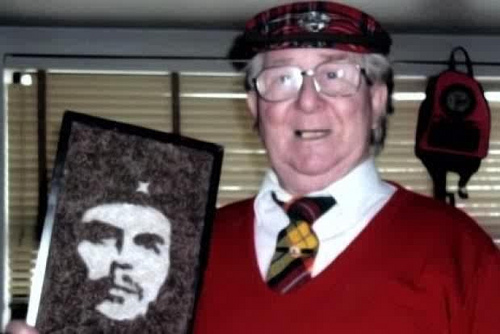
    Récemment le canadien  Jaime McTurk a été condamné à Toronto pour divers délits sexuels envers des enfants cubains, dont certains âgés de trois ans. L’histoire n’a pas été relatée dans les media nationaux même si le prédateur a été présent à 31 reprises dans notre pays entre2009 et 2012. Il n’est donc pas crédible que des autorités migratoires, aussi habiles à détecter si un cubain peut entrer ou non dans son propre pays et des officiers de douane entraînés à repérer un ordinateur ou un téléphone portables dans une valise, ne se soient pas rendu compte que quelque chose n’allait pas avec ce monsieur. Triste également que ceci étant un des maux qui minent notre société, on ne permette même pas aux parents inquiets de former un groupe de dénonciation citoyenne contre les pédophiles et d’apporter aussi un appui solidaire aux victimes de ces criminels. Parmi tous les sujets sociaux qu’aborde la société civile naissante de cette île, comme la dualité monétaire, les bas salaires, la nécessité de réformes politiques et partisanes, il est aussi urgent que nous nous saisissions aussi d’un problème aussi sensible. « Pas avec nos enfants ! » faut-il dire à tous ces prédateurs étrangers et nationaux.

    Traduit par Jean-Claude Marouby

    See the original article here:
    Pas avec nos enfants !

  • paraiso8968140647_76a650238a
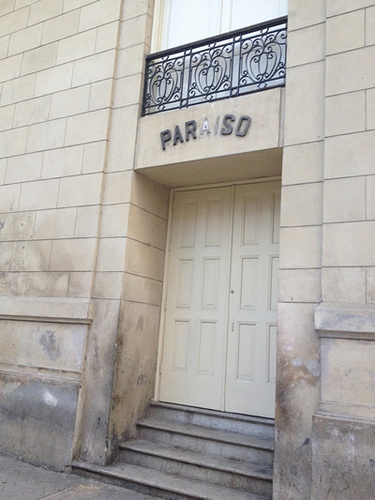
    Photo: « Paradise »

    They’re no longer dressed in blue uniforms and some boys even show off their rebellious manes. Hair that no teacher will demand they cut — at least for the next few weeks — hair that will ultimately fall to the razor of Obligatory Military Service. They still look like students, but very soon many of them will be marching with rifles slung over their shoulders. They are young men who just, days ago, finished their school days at different high schools all over Cuba. The college entrance exams are long past and this week they’ve learned who will have a place in higher education.

    Just outside the schools, the lists of the accepted and unaccepted speak for themselves. José Miguel Pérez High school — in the Plaza of the Revolution municipality — could be a good example to explain the situation. This educational center is one of the best performing high schools in the capital. A situation partly due to the professional and economic composition of the neighborhood, which means many parents can afford after-school tutors (we refer to these as « dishtowels » — they clean things up). Despite these advantages, the end-of-year statistics for this school are more alarming than satisfying.

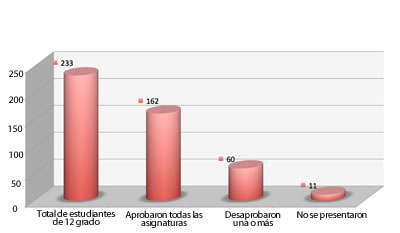
    Of 233 12th grade students in this high school, 222 took the entrance exams and only 162 managed to pass all tests. The rest will have to go to a second round, or content themselves with failure. The highest number of low marks was in Math, in which only 51 students achieved a score of between 90 and 100 points. In the applications for careers, teaching specialties are repeatedly put down as a back-up choice; « To guarantee getting a place, even if the tests don’t go well, » these potential teachers of tomorrow say, with a certain indecency.

    Statistics from José Miguel Pérez High School
    chart8968295055_5aca9ba76b
    Categories L to R: Total Students in Grade 12; Passed All Subjects; Failed One or More Subjects; Did Not Appear

    The beginning and end (?) of a mistake

    The young people who completed secondary school this year are the products of the educational experiments led off by the so-called Battle of Ideas. They are 17 and 18 today, so they started junior high as the « Emergent Teachers » program was gaining strength, a program that put hastily trained young people barely out of their teens — if that — at the front of the classroom. Today’s graduates were educated in classrooms where television and VCRs were the protagonists, for lack of sufficiently trained teachers. At the most difficult times they could count on receiving at least 60 percent of their classes from a screen. They also went through puberty at a time of rising ideological indoctrination. While it is true that this has always been inherent in teaching in Cuba over the past five decades in, its climax came after the Elian Gonzalez case. Fidel Castro took advantage of that event in the late nineties to impart a twist to the political discourse in all aspects of national life.

    Those who graduated from the twelfth grade a few weeks ago, are the first batch who did not have to go to boarding schools in the countryside. Encouraging news for the young people themselves and especially for their parents. However, the readjustment for teachers caused by the change forced many of them to rethink careers based on study, books and binders. The teachers who came from these schools in the countryside had to adapt to new conditions. Despite the difficulties of the former regime of internment, for the teachers these countryside schools were sites of direct contact with the farmers who sold or traded for agricultural products. One of the few incentives for working in such a place was being able to take some bananas, taro, pork or fruit to the city at a much cheaper price than in the markets of Havana. The loss of that little privilege discouraged some teachers from continuing on the path of teaching.

    Memorize or question?

    The countless hours lost in the classroom to teacher absenteeism is another of the hallmarks of recent graduates. To this we have to add the decline of the investigative character of science instruction, due to the deterioration or absence of chemistry, physics and biology labs. In many high schools chemistry experiments were practically canceled due to the shortages and fear that students would have access to the chemicals. Physical education, computer science and English were the biggest losers in the exodus of teachers to other areas of employment. High school education emphasized rote learning of dates, names, events, without progress in creating their own opinions, a spirit of asking questions, or the capacity of discernment. Graduates can hold in their heads the years and important days of our country’s history, but fail to form their own opinion about what it all means.

    The quality of handwriting, spelling and the correct use of Spanish also fell short as educational objectives. This coming September, university classrooms will see students with serious deficiencies in all three areas. But that does not mean that they will be faced with excessive demands or be unable to complete their programs of study. They will attend a University whose quality of teaching is far from that once exhibited in Cuba. In the 2013 ranking of Latin American universities, the University of Havana fell from position 54 to 81, another sign pointing to the urgent need to review the entire educational model. The educational level of the new entrants to higher education, has forced them to lower the bar.

    The tinkering with the alchemy of learning, the successive experiments marked more by the voluntarism than scientific analysis, the excessive presence of ideology in every subject, the encouragement of docile, rather than questioning, minds, students’ limited access to updated materials (read internet) and the educational fraud that flourishes where ethics is absent, are all undermining one of the main pillars of national identity: that which consists of knowledge, academics and teaching. But a problem can not be remedied unless we confess that it exists. So while they continue speaking in a triumphalist tone about Cuban education, it will continue to sink into mediocrity, into material and pedagogical deterioration.

    Excerpt from:
    Entrance Exams: An Assessment of Education in Cuba

  • 2013-06-06-8962409223_c620752244.jpg
    Poster for « British Week » in Havana

    London has come to Havana. During this week of British Culture that is celebrated from the first of June in our country, even the climate has decided to be in sync with that of the other Island. Grey skies, drizzle, mist at dawn. All we lack is the silhouette of Sherlock Holmes sneaking around a corner or a magician knocking with this staff on the wood of our door. They are days of great music and a chance to appreciate unusual schedule in the movie theaters. Since last Tuesday they have been showing a selection that includes the 2013 Oscar-winning documentary Searching for Sugar Man, and also the biographical film Marley, about the life of the famous reggae singer and composer. The selection of cartoons for kids and teens will probably attract a good audience at a time when many are on vacation from school.

    I have been enjoying some of the programming not only for me but also for many others. Especially thinking about those young Cubans, or 40 years ago, secretly listened to an English quartet that the official media now play everywhere. The striking colors and the design of the poster for this « British Week » has evoked for me the iconography of the Mad Hatter in Alice in Wonderland, and also the delightful adventurers in the Yellow Submarine. So some of us have also taken it as a tribute to those battered Beatlemaniacs from back then. These days, however, the greatest comfort comes from the window cracked open to let in this fresh air that comes to us from the outside. This gift of sensing that culture can make the Atlantic seem narrower, the passing years shorter, the losses recoverable.

    Visit link:
    Loose in Havana, Gandalf and Elton John